Home » Isometric Training for Speed » How to Train Hip Flexors for Maximum Speed (Most Athletes Miss This)
If you want to run faster, you need to train hip flexors for speed—and one of the most effective ways to do that is through isometric training.
And yet…
👉 Most athletes never train them properly—if at all.
Instead, they spend years focusing on:
- Glutes
- Hamstrings
- Quadriceps
- Calves
All important muscles…
But all primarily involved in one phase of running:
👉 The push phase
And that’s where the problem begins.
👉 This is exactly why many athletes never reach their true speed potential:
Why You’re Not Getting Faster (Even If You Train Hard)
Why Hip Flexors Are the Missing Link in Speed
Running isn’t just about pushing off the ground.
It’s a three-phase process:
- Push Phase
- Swing Phase
- Pull Phase
Most training programs overload the push phase.
But speed is heavily influenced by what happens next:
👉 The swing phase (your stride)
This is where your leg:
- Leaves the ground
- Travels forward
- Prepares for the next step
And this entire motion is driven by:
👉 Your hip flexor muscles
What Most People Get Wrong About Hip Flexors
Many programs treat hip flexors as:
- Small
- Weak
- Secondary muscles
Or they try to train them with:
- Sit-ups
- Hanging knee raises
But here’s the problem:
👉 Those exercises only train hip flexion
And that’s only half the movement.
The Two Motions That Control Your Speed
During the swing phase, two actions happen in sequence:
- Hip flexion → pulling the thigh forward
- Knee extension → extending the lower leg
👉 These happen almost instantly, one after the other
And together, they determine:
- Stride speed
- Turnover rate
- Running efficiency
If you don’t train both…
👉 You’re leaving speed on the table
The Muscle That Changes Everything
There’s one muscle that plays a unique role in this process:
👉 The rectus femoris
This muscle is special because:
- It’s part of the quadriceps
- It crosses two joints (hip and knee)
That means it controls:
👉 Hip flexion and knee extension
No other muscle does this in the same way.
Why This Matters for Speed
When you run:
- Your thigh is pulled forward (hip flexion)
- Your lower leg extends (knee extension)
👉 The rectus femoris connects both actions
So if it’s weak in this position:
- Your stride slows down
- Your turnover suffers
- Your speed is limited
Why Most Athletes Never Train This Properly
Even advanced athletes:
- Train hip flexion separately
- Train knee extension separately
But rarely:
👉 Train both together in the same position
And almost never:
👉 Under real running conditions
Where Resistance Bands and Isometrics Come In
This is where everything from the previous articles connects.
Using:
- Resistance bands (variable resistance)
- Isometric holds (no visible movement)
Here’s why resistance bands create such a powerful speed stimulus:
Why Resistance Bands Work Better for Speed Training
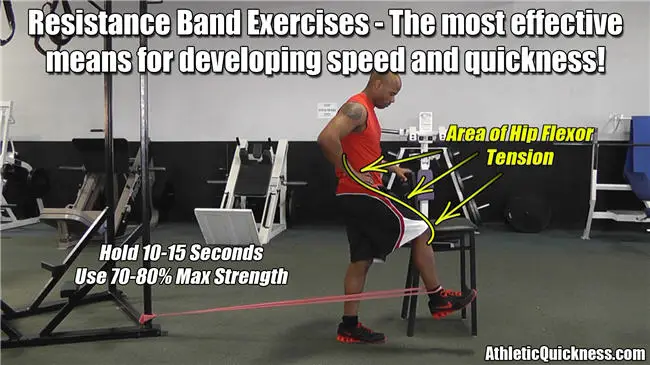
👉 This is where isometric training for speed becomes extremely powerful—because it allows you to isolate and overload this exact position without relying on repetition.
You can train:
👉 The rectus femoris in its exact running position
That means:
- Thigh up
- Lower leg extended
- Full tension applied
Why This Feels So Difficult (Even for Elite Athletes)
When you hold this position:
- The band is pulling
- Your muscles begin to fatigue
And just like we discussed earlier:
👉 The resistance is constantly changing
Because:
- The band length shifts slightly
- The angle of force changes
Now your body must:
- Correct
- Stabilize
- Re-engage
👉 Over and over again
This creates:
- Rapid muscle activation
- Faster neuromuscular response
- True speed adaptation
Why This Produces Fast Results
Here’s the advantage:
👉 Most athletes have never trained this position before
So when you introduce it:
- New muscles activate immediately
- Weaknesses are exposed quickly
- Adaptation happens fast
That’s why:
👉 You can see improvements in days—not months
⏱️ Why You Only Need Minutes Per Day
Because this training:
- Targets speed directly
- Eliminates unnecessary repetition
- Focuses on contraction quality
👉 This is why isometric training is so effective—it develops speed without unnecessary movement or fatigue.
👉 You don’t need long workouts
Just:
- Short
- Focused
- High-tension holds
🔥 Final Takeaway
If you’re not training your hip flexors correctly…
👉 You’re missing one of the biggest drivers of speed
And if you’re not training:
👉 Hip flexion and knee extension together
👉 You’re not training for real sprint mechanics
But when you do:
- Your stride becomes faster
- Your turnover increases
- Your speed improves
👉 And when trained using isometric resistance band methods, these muscles can be developed faster and more effectively than with traditional exercises.
🔗 Next Step in the Series
Now that you understand how to train hip flexors for speed…
Now it’s time to put everything together into a complete speed system.
👉 Read Next: Isometric Training for Speed: The Complete System to Run Faster
❓ FAQ: Train Hip Flexors for Speed
What does it mean to train hip flexors for speed?
It means strengthening the muscles that pull your leg forward during running, especially in the swing phase, to improve stride speed and turnover rate.
Why are hip flexors important for running faster?
Hip flexors control how quickly your leg moves forward. Faster movement here leads to quicker strides and improved overall speed.
What is the rectus femoris and why is it important?
The rectus femoris is a muscle that crosses both the hip and knee joints. It allows you to train hip flexion and knee extension together, which is critical for sprinting.
Do traditional exercises train hip flexors effectively?
Most traditional exercises do not train hip flexors in a way that improves speed. They often isolate movements instead of combining them as they occur in running.
How often should you train hip flexors for speed?
2–3 times per week is effective, especially when using high-quality, targeted isometric exercises.