
Home » Isometric Training for Speed » ISOMETRIC TRAINING FOR SPEED: Why AQ Uses It Differently
🧠 Introduction
Most athletes already train hard.
They:
- sprint
- lift
- jump
- push sleds
- strengthen their legs
Yet many still struggle to run faster.
AQ speed training recognizes that this is often not a simple force-production problem.
💥 It is a support problem.
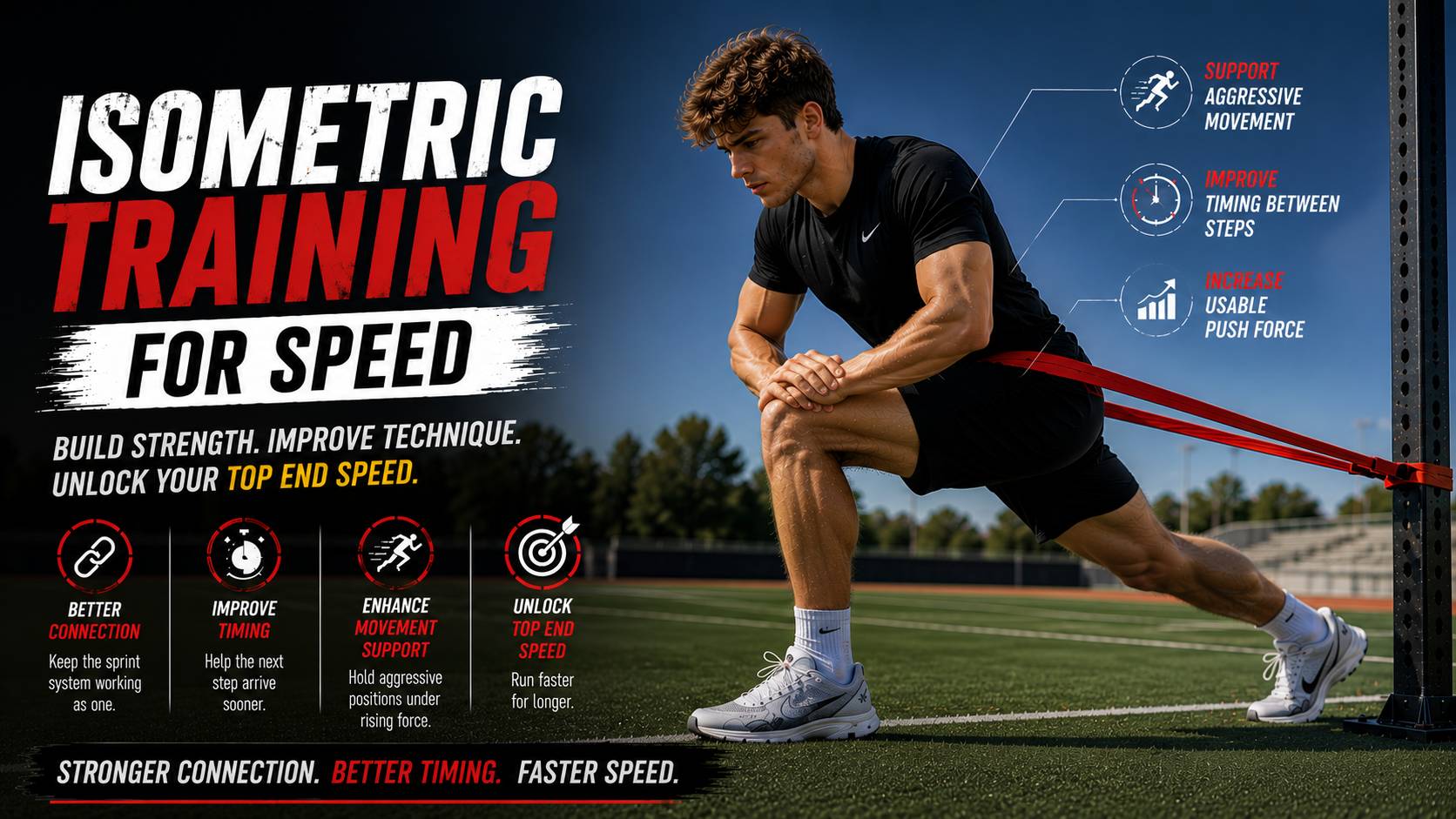
AQ teaches that sprint speed depends on how aggressively the pushing leg, arms, torso, and opposite swing leg continue supporting each other while force and fatigue rise.
If one part of this relationship falls behind:
- timing between steps slows
- aggressive movement becomes harder to support
- the next stride reconnects later
- usable push force drops
💥 This is why AQ does not teach sprinting as:
👉 push → recover → next push
AQ views sprinting as simultaneous aggressive movement support happening across the body at the same time.
During sprinting:
- the pushing leg aggressively drives backward into the ground
- while the arms aggressively support this pushing movement
- the torso rotates to support these force expressions even more
- while the opposite swing leg aggressively attacks forward and balances the system
all simultaneously.
💥 AQ identifies this balancing relationship as one of the most overlooked areas in sprint training.
⚡ Why AQ Uses Isometric Training
AQ uses high-tension resistance-band isometric training because it forces the body to aggressively maintain sprint-support relationships.
AQ isometric training uses short aggressive holds — usually 10–15 seconds — where the athlete maintains sprint-related positions against strong resistance-band tension.
Unlike traditional repetition-based training:
the muscles do not briefly relax between repetitions.
The support relationships must continue organizing force continuously while the athlete aggressively maintains the position.
AQ views this as extremely important for sprinting because sprinting itself gives the body very little time to reorganize movement between steps.
Traditional sprint and gym training already heavily overload:
- glutes
- hamstrings
- quadriceps
- calves
Most athletes spend years developing pushing muscles.
⚡ But AQ speed training recognizes that traditional training often develops pushing muscles far more aggressively than the support relationships responsible for reconnecting the next stride.
If these support relationships cannot continue rising equally:
- timing between steps slows
- aggressive movement becomes harder to maintain
- usable force expression drops
Eventually:
💥 the body limits movement speed to preserve strength balance.
🔄 Why Resistance Bands Matter
AQ uses resistance bands with an isometric training strategy to take advantage of elastic tension that is not available during traditional weight training.
This becomes important because even while the athlete is trying to remain still during an isometric hold:
the body is never completely steady.
Especially under high tension demand.
That means:
- band length subtly changes
- band angle subtly changes
- tension immediately changes
As this happens:
muscles quickly sense these changes and continuously try reorganizing movement to keep the position supported.
🧠 AQ views this as one of the biggest differences between resistance-band isometric training and many traditional fixed-path exercises.
Because sprinting itself is never mechanically static.
From step to step:
- force levels change
- timing changes
- body positions change
- balance demands change
Yet the pushing leg, arms, torso, and opposite swing leg must still continue supporting aggressive movement together cleanly.
💥 AQ trains these changing support conditions directly.
💥 Why The Muscles Shake
Many athletes notice shaking almost immediately during AQ exercises.
AQ speed training intentionally uses aggressive 10–15 second holds because this rapidly exposes weakness inside the support relationships responsible for sprint movement.
As tension rises:
- weaker muscles begin struggling to maintain position
- recruitment demand increases
- more motor units are forced to contribute
- aggressive movement becomes harder to stabilize
The shaking is not random.
AQ views it as visible feedback that the support system is being challenged aggressively enough to expose weakness.
⚡ This is one reason AQ training sessions remain relatively short.
The goal is not endless fatigue.
The goal is:
aggressive recruitment under demanding support conditions.
🧠 Why AQ Focuses Heavily On The Hip Flexors
AQ speed training focuses heavily on the hip flexors because most athletes already develop the pushing side of sprinting far more aggressively than the balancing side.
💥 AQ identifies the opposite swing leg as one of the most overlooked contributors in sprinting.
Not because the leg is passive.
But because AQ teaches that the swing leg aggressively attacks forward to help balance the rotational force created by the pushing leg, arms, and torso.
This becomes even more important with:
👉 the rectus femoris.
The rectus femoris crosses both:
- the hip joint
- the knee joint
AQ identifies this as extremely important because sprinting requires:
- aggressive hip flexion
- while the knee is extending
- while the body continues balancing rotational force simultaneously
⚡ Traditional gym training rarely isolates these relationships aggressively.
AQ uses resistance-band isometrics because they allow these support relationships to be trained directly under aggressive tension.
Not casually.
Not passively.
Aggressively.
⚖️ Strength Balance And Sprint Speed
AQ teaches that sprint speed rises as strength balance across the body rises.
Meaning:
- the pushing leg must continue expressing force aggressively
- the arms and torso must continue supporting these force expressions
- the opposite swing leg must continue balancing the system aggressively
all together.
If one relationship weakens:
the entire movement begins losing support quality.
AQ views this as one of the hidden reasons athletes plateau despite:
- lifting harder
- sprinting more
- training longer
Because the limitation is often not:
👉 effort
but:
👉 hidden support weakness.
🔥 Why AQ Uses Position Changes
AQ does not only train one hip-flexor position.
The AQ system changes:
- hip-flexion angle
- knee position
- internal rotation
- external rotation
to expose additional weakness throughout the movement relationships involved in sprinting.
🧠 AQ recognizes that weakness is often hidden until:
- balance changes
- rotational demand changes
- support timing changes
- aggressive movement becomes harder to stabilize
💥 This is why AQ exercises are intentionally demanding despite their short duration.
🚀 AQ Interpretation
AQ speed training teaches that many athletes already possess enough pushing strength to run faster.
What often limits speed is the ability of the pushing leg, arms, torso, and opposite swing leg to continue supporting aggressive movement equally while force rises.
AQ identifies this hidden imbalance as one of the biggest missing pieces in traditional sprint training.
⚡ That is why the AQ system uses:
- aggressive resistance-band isometrics
- short high-effort holds
- repeated recruitment exposure
- positional variation
- rotational support training
to strengthen the support relationships that help aggressive sprint movement continue cleanly.
🎯 Why AQ Trains This Way
AQ does not chase endless workout volume.
Most AQ sessions take approximately:
👉 15 minutes per day
using:
- short aggressive efforts
- repeated exposure
- alternating exercise structure
- recovery between efforts
because AQ prioritizes:
aggressive movement support quality
over:
endless fatigue accumulation.
🧭 You Are Here (Within The AQ Speed Training System)
You are currently exploring:
👉 ISOMETRIC TRAINING FOR SPEED: how AQ uses instability, fatigue, elastic tension, and aggressive sprint positions differently than traditional speed training.
🌐 See how this fits into the complete AQ speed system:
Learn how the complete AQ system approaches: hidden weakness, aggressive movement, whole-body support, and speed development.
➡️ ISOMETRIC TRAINING FOR SPEED: The Complete System to Run Faster
🪜 Continue Deeper Into Isometric Training For Speed:
Learn why muscles often begin shaking once hidden weakness starts becoming exposed underneath aggressive sprint-position demands.
➡️ Why Your Muscles Shake During Training (And Why It’s a Good Thing for Speed)
Learn how AQ uses motor-unit recruitment to improve sprint performance underneath aggressive sprint demands.
➡️ Motor Unit Recruitment for Speed: Why More Muscle Fibers Firing Faster Matters
Learn why the swing leg can become one of the most important speed-limiting factors during sprinting.
➡️ Why Hip Flexor Strength Matters More For Speed Than Most Athletes Realize
🚀 Ready To Run Faster?
If you are ready to turn this information into real speed:
➡️ Run Faster With Isometric Training
❓FAQ
Why does AQ focus so heavily on hip flexors?
Because AQ identifies the hip flexors as one of the most underdeveloped sprint support muscle groups in many athletes despite years of push-focused training.
Why are the exercises only 10–15 seconds?
AQ uses short aggressive holds to expose weakness quickly while maintaining high recruitment demand and aggressive movement intent.
Why do the muscles shake during AQ training?
AQ views shaking as visible feedback that the support relationships are being challenged aggressively enough to expose weakness and increase recruitment demand.
Why does AQ use resistance bands instead of machines?
AQ uses resistance bands because elastic tension continuously changes during the hold itself, forcing the muscles to repeatedly reorganize movement support under aggressive tension.