
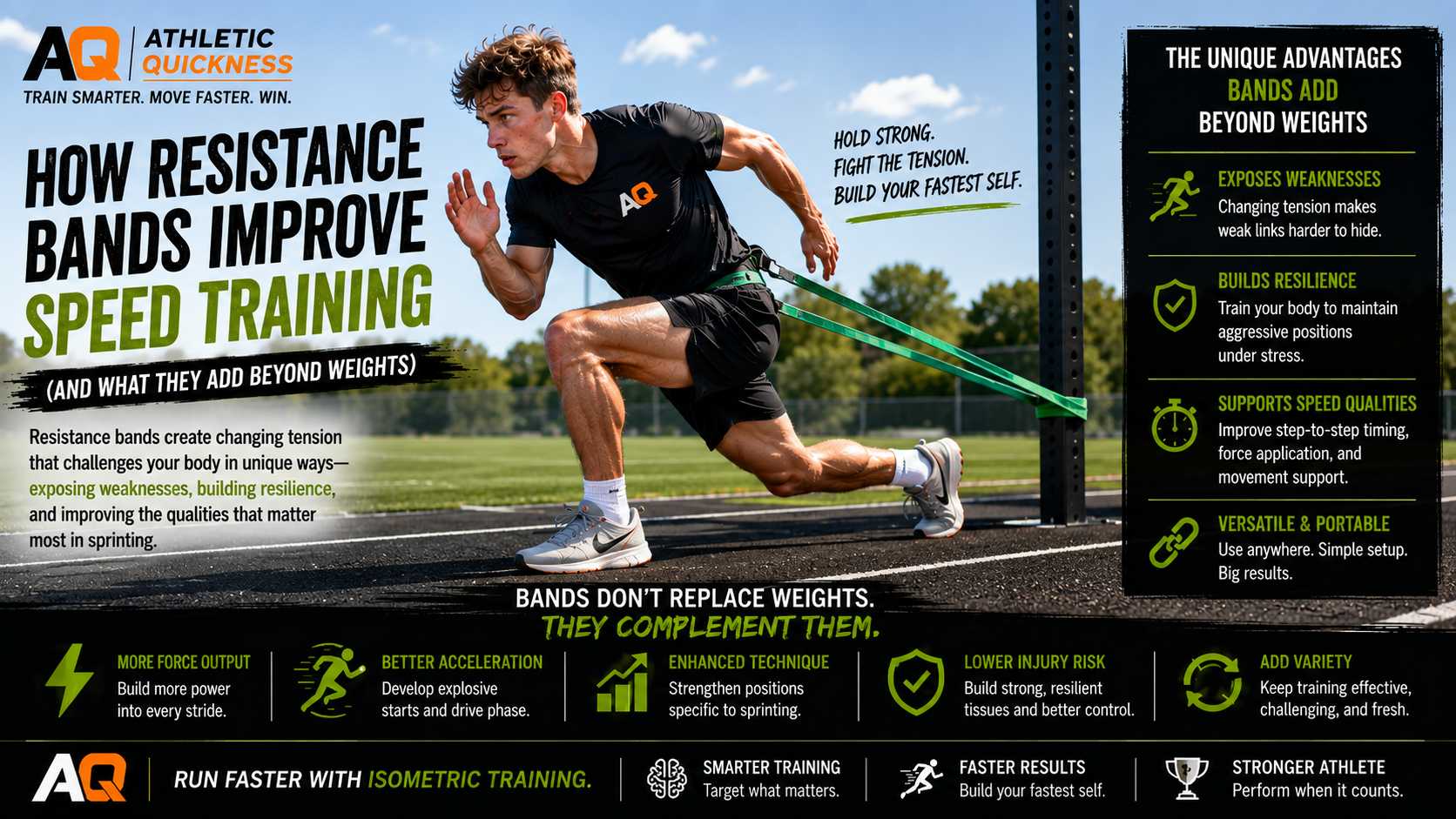
Home » Isometric Training for Speed » How Resistance Bands Improve Speed Training (And What They Add Beyond Weights)
🧠 Introduction
Most athletes think resistance bands simply:
- “add resistance”
- create a pump
- warm the body up
- make exercises harder
AQ views resistance bands very differently.
💥 AQ uses resistance bands because elastic tension creates a constantly changing support environment that traditional weight training cannot fully reproduce.
This becomes extremely important for sprinting because sprinting itself is never mechanically steady.
From step to step:
- force changes
- body position changes
- timing changes
- balance changes
Yet the body must still continue supporting aggressive movement cleanly.
AQ trains these changing support relationships directly.
⚡ Why AQ Uses Resistance Bands Differently
AQ uses resistance bands with an isometric training strategy to take advantage of elastic tension that is not available during traditional weight training.
AQ isometric training uses short aggressive holds — usually 10–15 seconds — where the athlete maintains sprint-related positions against strong resistance-band tension.
Even while the athlete is trying to remain still:
the body is never completely steady.
Especially under aggressive tension demand.
That means:
- band length subtly changes
- band angle subtly changes
- tension immediately changes
As this happens:
the muscles continuously sense these small changes and attempt to reorganize movement to keep the position supported.
💥 AQ identifies this as one of the most important training effects of elastic tension.
🔄 Why Muscles Continuously Reorganize Movement
AQ teaches that muscles are constantly trying to stabilize the desired holding position during the exercise.
But as the muscles fatigue and weaken:
they begin struggling to organize force precisely.
This creates continuous correction attempts.
Sometimes the muscles:
- overcompensate
- apply too much effort
- briefly move beyond the target position
Other times:
- they undercompensate
- cannot supply enough support quickly enough
- begin losing the position slightly
The muscles then immediately try correcting again.
And again.
And again.
💥 But the body never completely settles perfectly over the target position.
Especially under high elastic tension demand.
That means:
the nervous system continuously keeps trying to reorganize movement to regain control of the hold.
AQ views this as an extremely valuable training stimulus.
Because weakness becomes exposed rapidly.
🧠 Why This Matters For Sprinting
AQ speed training recognizes that sprinting itself is a continuous reorganization process.
During sprinting:
- force levels change rapidly
- body positions change rapidly
- balance demands change rapidly
- aggressive movement support must continue changing rapidly
Yet the pushing leg, arms, torso, and opposite swing leg must still continue supporting each other together cleanly.
AQ trains these changing support relationships directly.
This is one reason AQ does not teach sprinting as:
👉 push → recover → next push
AQ views sprinting as simultaneous aggressive movement support happening continuously across the body.
Meaning:
- the pushing leg aggressively drives backward
- while the arms aggressively support this movement
- while the torso rotates to support these force expressions even more
- while the opposite swing leg aggressively attacks forward and balances the system
all simultaneously.
💥 Why Weakness Gets Exposed Quickly
AQ identifies one of the biggest advantages of resistance-band isometric training as:
rapid weakness exposure.
Traditional fixed-path exercises often allow athletes to temporarily hide weakness through:
- momentum
- movement continuation
- compensation patterns
- stronger surrounding muscles
But AQ resistance-band isometric training makes support weakness much harder to hide.
Especially under high tension.
As instability rises:
- muscles begin shaking
- recruitment demand rises
- support timing becomes harder to maintain
- aggressive movement becomes harder to stabilize cleanly
AQ views this shaking as visible feedback that the muscles are being forced to reorganize movement aggressively under tension.
⚡ Why AQ Uses Short Aggressive Holds
AQ does not use endless exercise duration.
Most AQ isometric holds last only:
👉 10–15 seconds
because AQ prioritizes:
aggressive recruitment quality
over:
endless fatigue accumulation.
As tension rises:
- recruitment demand escalates quickly
- correction attempts accelerate
- support relationships become harder to stabilize
- hidden weakness becomes exposed rapidly
AQ recognizes that this creates a powerful neurological training environment without requiring massive training volume.
🚀 Faster And Stronger Muscles Without Chasing Mass
AQ does not primarily chase:
- muscle exhaustion
- bodybuilding fatigue
- maximum bodyweight gain
AQ prioritizes:
improving aggressive movement support.
Because sprint speed depends on how aggressively the body can continue supporting movement while force rises.
AQ views elastic resistance-band instability as extremely valuable because it forces the nervous system to repeatedly:
- recruit
- reorganize
- stabilize
- correct
- reattempt control
under aggressive tension.
Over time:
this helps mature hidden areas of weakness rapidly.
The result is often:
- stronger muscles
- faster muscular response
- improved movement support
- better sprint timing
without requiring excessive bodyweight gain.
💥 AQ Identified Which Sprint Positions Expose Weakness The Most
💥 AQ has identified numerous sprint-support weaknesses that benefit from this type of training but are difficult for traditional methods to isolate effectively.
AQ also recognizes that the training position itself matters.
Because changing:
- hip angle
- knee angle
- rotational demand
- support relationship
changes which weaknesses become exposed during the hold.
⚡ This is one reason AQ does not treat resistance-band isometric training as random exercise selection.
AQ uses specific sprint-related positions designed to expose and strengthen hidden support weaknesses involved in aggressive movement.
⚖️ Why AQ Believes Traditional Training Misses This
Traditional weight training still has value.
AQ is not anti-weight training.
But AQ recognizes that many traditional exercises occur through:
- fixed paths
- stable surfaces
- predictable resistance patterns
AQ identifies this as different from sprinting itself.
Because sprinting constantly requires the body to reorganize aggressive movement support under rapidly changing force conditions.
AQ uses resistance-band isometric training specifically to expose and strengthen these support relationships directly.
🎯 AQ Interpretation
AQ speed training teaches that many athletes already possess enough pushing strength to run faster.
What often limits speed is how aggressively the body can continue supporting movement while force, instability, and fatigue rise together.
AQ uses resistance-band isometric training because elastic tension continuously challenges the muscles to reorganize movement under aggressive support demand.
AQ views this as one of the most effective ways to expose and mature hidden sprint-support weakness rapidly.
🧭 You Are Here (Within The AQ Speed Training System)
You are currently exploring:
👉 HOW RESISTANCE BANDS IMPROVE SPEED TRAINING (AND WHAT THEY ADD BEYOND WEIGHTS): how elastic tension, instability, and aggressive sprint-position demands help expose hidden weakness and improve sprint performance differently than traditional strength training.
🌐 See how this fits into the complete AQ speed system:
Learn how the complete AQ system approaches: hidden weakness, aggressive movement, whole-body support, and speed development.
➡️ ISOMETRIC TRAINING FOR SPEED: The Complete System to Run Faster
🪜 Continue Deeper Into Isometric Training For Speed:
Learn why athletes often stop improving speed once different parts of the body stop supporting aggressive sprint movement together.
➡️ Why You Hit A Training Plateau (And How To Fix It For Speed)
Learn why the swing leg can become one of the most important speed-limiting factors during sprinting.
➡️ Why Hip Flexor Strength Matters More For Speed Than Most Athletes Realize
🚀 Ready To Run Faster?
If you are ready to turn this information into real speed:
➡️ Run Faster With Isometric Training
❓FAQ
Why does AQ prefer resistance bands over traditional weights?
AQ uses resistance bands because elastic tension continuously changes during the hold itself, forcing the muscles to repeatedly reorganize movement support under aggressive tension.
Why do the muscles shake during AQ exercises?
AQ views shaking as visible feedback that the muscles are struggling to maintain aggressive support relationships under rising tension demand.
Why are AQ holds only 10–15 seconds long?
AQ prioritizes aggressive recruitment quality and rapid weakness exposure rather than long-duration fatigue accumulation.
Does AQ believe traditional weight training is useless?
No. AQ recognizes value in traditional strength training. AQ simply believes many athletes already heavily develop pushing muscles while underdeveloping the support relationships responsible for maintaining aggressive sprint movement cleanly.