Home » Resistance Bands for Speed » Best Resistance Bands for Speed Training (What to Use and Why)
If you’re serious about improving speed and athletic performance, the type of resistance band you use matters more than you might think.
Not all bands are created equal—and choosing the wrong one can limit your results, no matter how hard you train.
When it comes to the best resistance bands for speed training, you need a band that delivers the right type of resistance, responsiveness, and elasticity to properly train your muscles.
👉 For how to use them correctly, start here:
How to Use Resistance Bands for Speed
Why the Type of Resistance Band Matters
Most athletes assume that any resistance band will work as long as it provides tension.
That’s not the case.
For speed training, your muscles must:
- React quickly
- Adjust to changing resistance
- Improve coordination and contraction speed
👉 This requires a band with very specific elastic properties.
This is also where one of the biggest misconceptions about isometric training comes into play.
While many people think of isometrics as purely “static,” when combined with a properly designed resistance band, the training becomes highly dynamic—forcing your muscles to constantly react to even the smallest changes in resistance.
If the band does not respond correctly to movement:
- Your muscles won’t receive the right stimulus
- Coordination improvements will be limited
- Speed gains may stall
The Key Property: Elastic Resistance
The effectiveness of a resistance band comes down to one thing:
👉 how it behaves under tension—especially during small, continuous adjustments.
A proper band should:
- Increase resistance smoothly as it stretches
- Respond instantly to small changes in movement
- Maintain consistent elasticity
This is critical because your training depends on:
- Small changes in position
- Constant adjustments in force
- Rapid muscular response
Why Some Resistance Bands Don’t Work for Speed Training
After testing many types of bands, you’ll find that some fall short.
1. Bands That Are Too Weak
- Provide insufficient resistance
- Fail to challenge the muscle
- Do not create enough stimulus for adaptation
2. Bands That Are Too Strong
- Restrict movement
- Reduce control and coordination
- Make proper positioning difficult
3. Bands With Poor Elastic Quality
- Do not respond well to small changes
- Provide inconsistent resistance
- Limit neuromuscular development
These types of bands can actually slow your progress.
👉 Helpful Insight: Many athletes struggle to improve their speed not because they aren’t training hard—but because the equipment they’re using isn’t creating the right type of muscular response.
What to Look for in the Best Resistance Bands for Speed Training
To get the best results, choose bands that:
✅ Have Smooth, Progressive Resistance
Resistance should increase gradually—not abruptly.
✅ Respond to Small Movements
Even slight changes in position should alter resistance.
✅ Allow Full Range of Motion
You should be able to train in multiple positions comfortably.
✅ Support Isometric Training
The band must allow you to hold positions under tension without losing control.
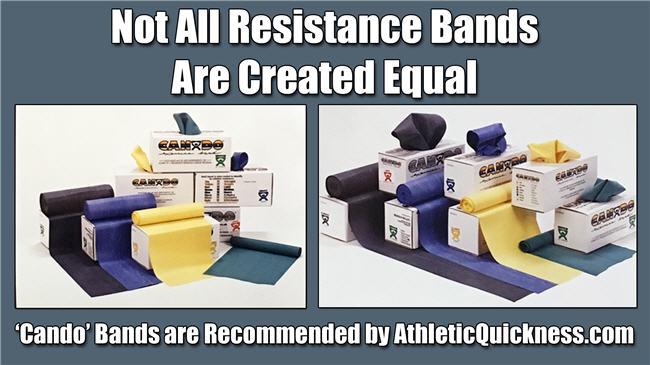
Why CANDO Resistance Bands Stand Out
After extensive use and comparison, one type of band consistently stands out:
👉 CANDO resistance bands
These bands:
- Closely resemble the elasticity of skeletal muscle
- Provide smooth, consistent resistance
- Respond well to small positional changes
This makes them particularly effective for:
- Speed training
- Coordination development
- Isometric resistance work
Don’t Just Use Any Resistance Band
It’s tempting to grab whatever band is available and begin speed exercises with them —but this can be counterproductive.
Using the wrong band may:
- Reduce training effectiveness
- Limit muscle responsiveness
- Slow your progress
👉 The quality of your equipment directly affects your results.
When to Replace Your Resistance Bands
Over time, resistance bands:
- Stretch out
- Lose elasticity
- Become less effective
You may also need additional bands if:
- You get stronger
- You want to increase resistance
- You train more frequently
👉 Always replace bands when performance starts to decline.
Recommended Sizes and Options
When selecting bands:
For Individuals
- A 6-yard roll is typically sufficient
- Allows for multiple cuts and exercises
For Coaches or Teams
- A 50-yard roll is recommended
- Provides enough material for multiple athletes
Recommended Resistance Levels (Colors)
- Red → First choice
- Green → Second option
- Blue → Higher resistance
👉 Choose based on your strength and training needs.
Why Proper Equipment Leads to Better Results
When you use the right resistance band:
- Muscles respond more effectively
- Coordination improves faster
- Speed gains are more noticeable
This is because your muscles are being trained under the correct conditions.
Combine the Right Band With the Right Method
Even the best band will not produce results if used incorrectly.
To maximize speed development:
- Use isometric training
- Train in multiple positions
- Focus on control and stability
While this may appear to be a “static” form of training, the reality is that when done correctly with a resistance band, it becomes highly dynamic—because your muscles are constantly reacting to small, often unnoticeable changes in resistance.
👉 Learn more about how muscles react to isometric training with the resistance band.
💡 Choosing the right band is important—but knowing how to use it correctly is what actually determines your results.
Even the best resistance band will not improve speed if it’s not used with the right level of tension, positioning, and muscle focus.
Final Takeaway
Choosing the best resistance bands for speed training is not about convenience—it’s about performance.
The right band will:
- Deliver proper resistance
- Improve muscle responsiveness
- Enhance coordination and speed
The wrong band can limit your progress.
If you’re serious about getting faster, make sure you’re using equipment that supports your training—not working against it.
🚀 Take the Next Step: Use the Right Band the Right Way
Choosing the right resistance band is an important first step—but real speed improvements come from how you use it.
Most athletes never get the full benefit of resistance band training because they:
- Use the wrong level of tension
- Train in limited or ineffective positions
- Fail to target key muscles involved in speed
One of the most commonly overlooked areas is the hip flexor group, which plays a major role in stride rate and top-end speed—but is rarely trained effectively with traditional methods or equipment.
The Run Faster with Isometric Training program shows you exactly how to:
- Use resistance bands with the correct level of tension
- Train in positions that directly improve running speed
- Target critical muscles like the hip flexors
- Apply a dynamic isometric strategy that improves speed without adding unnecessary body weight
👉 Learn more about the Run Faster with Isometric Training program here
FAQ
What are the best resistance bands for speed training?
Bands with smooth, responsive elasticity—such as CANDO bands—are ideal for improving speed and coordination.
Can I use any resistance band for speed training?
No. Bands with poor elasticity or incorrect resistance levels can limit results.
How often should I replace resistance bands?
When they lose elasticity, show wear, or no longer provide consistent resistance.