Home » Resistance Bands for Speed » Arm Exercises for Running Speed (Improve Sprinting With Resistance Bands)
Introduction
Most athletes focus almost entirely on their legs when trying to run faster
👉 But if you ignore your upper body
👉 you’re leaving speed on the table
💥 Not because your arms create speed on their own
👉 but because of how they support the system
👉 But here’s something most athletes never consider:
👉 your arms may be the reason your legs can’t produce more speed
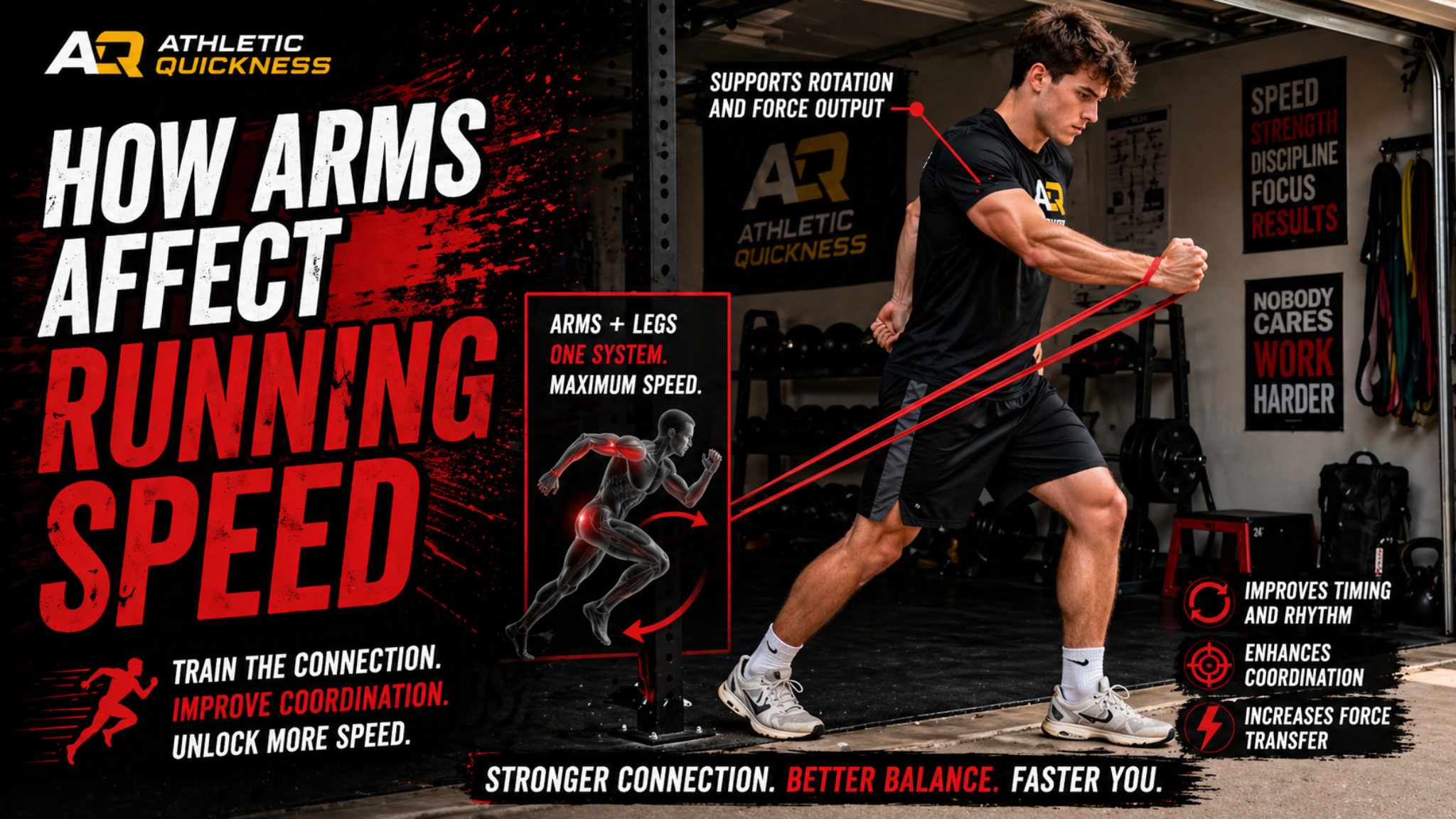
⚡ The Real Role of the Arms
🧠 The arms are not passive
👉 They are directly connected to force production on the ground
💥 Simple rule:
When you run:
• one leg is pushing
• both arms support that action
• the swing leg balances the system
👉 All working together
👉 If the arms cannot support that action:
the system adjusts
💥 And that usually means:
👉 reducing total force output
👉 Which limits speed
⚖️ The Strength Balance Connection
Your body operates as a balanced system
👉 If one part cannot keep up
👉 everything adjusts downward to match it
👉 This includes the arms
If arm strength or coordination is limited:
- rotational support decreases
- timing becomes less precise
- force transfer becomes less efficient
👉 So instead of producing more speed
👉 the system reduces output
💥 This is how imbalance limits speed
🔄 Understanding Rotation (Simplified)
As you run:
👉 your arms alternate between rotational patterns
- clockwise (CW)
- counterclockwise (CCW)
👉 (think of your body subtly rotating with each step)
👉 These patterns switch with every step
👉 With respect to rotation:
• the arms support the pushing leg
• while the swing leg counterbalances the system
💥 This alternating arm pattern of CW and CCW helps provide:
- stability
- efficiency
- strength
👉 allowing the body to remain balanced
👉 To see how this connects to the full system:
➡️ Ultimate Running Speed Equation (URSE): How the Arms are Used in Running
🚨 What Happens When Arms Are Weak or Out of Sync
If the arms are not functioning well:
- timing breaks down
- coordination decreases
- balance is affected
👉 The system must compensate
👉 And when it does:
👉 speed is reduced
👉 And this is what most athletes never see
They try to produce more force
through the legs
💥 while the system is quietly limiting it
🔧 Why Resistance Bands Work So Well
Resistance bands are ideal because:
- they allow multi-directional resistance
- they match real movement positions
👉 This creates a more realistic training environment
💥 And more importantly:
👉 They force your muscles to constantly adjust as they tire during an exercise
⚡ Why Use Isometric Training for Arm Speed
Instead of repetitions
👉 use controlled holds
This means:
- holding positions under tension
- using 70–80% effort
- maintaining for 10–15 seconds
👉 Even though the position looks still
👉 your body is constantly adjusting
👉 This helps improve:
- coordination
- responsiveness
- control
🏃 How This Transfers to Running Speed
When you run:
👉 your arms are not just moving through space
👉 they are supporting the rotational force produced by your pushing leg
If your arms can:
- support that force more effectively
- maintain better timing
- stay in sync
👉 then your stride becomes:
- more efficient
- more stable
- more repeatable
💥 And that allows speed to increase
👉 This directly impacts how quickly your legs cycle:
➡️ How to Increase Stride Rate (Without Overtraining)
🔄 Key Arm Movement Patterns
Focus on:
- forward drive (flexion)
- backward drive (extension)
👉 Train these in positions that reflect running
🔧 Example Exercises
👉 These are not just strength exercises
👉 They are position-based control drills
1. Arm Flexion (Forward Drive)
- band anchored behind
- drive arm forward
- hold 10–15 seconds
2. Arm Extension (Backward Drive)
- band anchored in front
- drive arm backward
- hold 10–15 seconds
👉 Focus on:
- position
- control
- coordination
🚀 What This Means for You
If you want to run faster:
❌ don’t ignore your arms
✅ train them as part of the system
👉 That’s how you improve:
- timing
- balance
- overall speed
👉 Your arms don’t create speed on their own
But they play a critical role in supporting it
👉 When they improve
the system improves
💥 And that’s what allows speed to increase
🧭 You Are Here (Within The AQ Speed Training System)
You are currently exploring:
👉 ARM EXERCISES FOR RUNNING SPEED (IMPROVE SPRINTING WITH RESISTANCE BANDS): why AQ views the arms as important contributors to sprint performance and how resistance-band isometric training can help improve the timing, coordination, and support they provide during running.
🌐 See How This Fits Into The Complete AQ Speed Training System
🪜 Continue Deeper Into Resistance Bands For Speed
Learn why AQ combines resistance bands with isometric training to expose hidden weakness, challenge under-performing muscles, and help more muscles contribute to faster running.
➡️ Why Use Resistance Bands With Isometric Training for Speed
Learn why resistance-band isometric training creates a unique challenge that forces the body to continually adjust, stabilize, and support force under tension.
➡️ Isometric Training With Resistance Bands (Why It Works)
Learn how AQ uses specific resistance-band exercises and sprint positions to improve force organization, coordination, and speed transfer.
➡️ Resistance Band Exercises for Speed: Using Isometric Training for Better Results
🚀 Ready To Run Faster?
If you are ready to turn this information into real speed:
➡️ Run Faster With Isometric Training
❓ Frequently Asked Questions
Do arms actually make you run faster?
They don’t directly produce speed, but they help coordinate the system that allows speed to occur.
Should I train arms separately for running?
Yes—but focus on coordination and control, not just strength.
What happens if arm movement is poor?
It can disrupt balance, timing, and force application, limiting overall speed.
Are resistance bands useful for arm training?
Yes. They allow you to train coordination and control under tension.
Do stronger arms improve sprinting?
Only if they improve how the system works together.
How do arms connect to leg movement?
They work in opposition to help balance the body and support efficient movement.
What should I focus on when training arms?
Focus on how they interact with the rest of your body, not just isolated movement.