Home » Resistance Bands for Speed » Arm Exercises for Running Speed (Improve Sprinting With Resistance Bands)
Most athletes focus almost entirely on their legs when trying to run faster.
But if you ignore your upper body, you’re leaving speed on the table.
The best arm exercises for running speed do more than strengthen your shoulders—they improve how your entire body moves, rotates, and generates force during sprinting.
Most athletes underestimate the role of the arms. They assume:
- The arms simply react to the legs
- Faster arm movement automatically means faster running
- The arms are only for balance
While there is some truth to these ideas, they don’t explain what’s really happening.
The key isn’t just moving your arms faster—it’s how your arms coordinate with the rest of your body to produce efficient, powerful movement.
When trained correctly, the arms don’t just assist speed—they help unlock it by improving timing, balance, and full-body coordination.
To truly improve sprint performance, you need to understand how the arms contribute to rotation, balance, and force production.
👉 Start here for the complete system:
Resistance Bands for Speed
The Real Role of the Arms in Running
The arms are not passive—they are actively involved in driving movement.
Here’s the key concept:
👉 Each arm works with the opposite leg that is in contact with the ground
This creates a rotational force around your spine, often referred to as torque.
This rotational force is critical because it:
- Helps transfer energy through the body
- Maintains balance during movement
- Contributes to forward propulsion
Understanding Rotational Force (Torque) in Sprinting
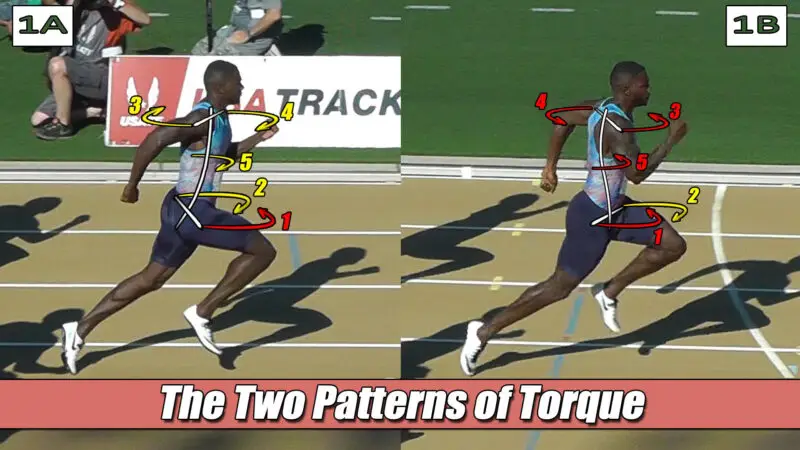
There are only two directions your body can rotate during running:
- Clockwise (CW)
- Counterclockwise (CCW)
These rotational patterns alternate with every step.
Example:
- Left arm forward + right arm back
→ Produces clockwise rotation
→ Works with the left leg (on the ground) - Right arm forward + left arm back
→ Produces counterclockwise rotation
→ Works with the right leg (on the ground)
At the same time:
- The leg that is off the ground works, or, rotates in opposition to maintain balance
This coordinated system is what allows you to:
- Stay stable
- Move efficiently
- Generate speed
Without it, your movement becomes inefficient and slower.
But when this system is trained correctly, even small improvements in coordination can lead to noticeable gains in speed.
👉 Helpful Insight: Many athletes try to fix their speed by focusing only on their legs, but running is a full-body movement—when one part is out of sync, overall speed suffers.
Why Arm Strength and Coordination Matter for Speed
If your arms are weak or poorly coordinated:
- Rotational force decreases
- Energy transfer becomes inefficient
- Balance is compromised
- Speed potential is reduced
This is why training the arms properly can lead to:
- Faster sprinting
- Better running efficiency
- Improved endurance
Why Resistance Bands Are Ideal for Arm Training
Resistance bands are uniquely suited for training sprint mechanics because:
- They allow multi-directional resistance
- They mimic real movement patterns
- They can be used in sport-specific positions
Unlike weights, bands:
- Don’t restrict movement to gravity
- Allow you to train in positions that replicate running
- Provide constantly changing resistance
👉 This makes them ideal for improving both strength and coordination.
Why Use Isometric Training for Arm Speed
Instead of performing repetitions, the most effective method is to use isometric holds.
While this may sound like holding a perfectly still position, under real tension the body is never completely motionless—small, often unnoticeable movements are always occurring.
This means:
- Holding a position under tension
- Using 70–80% effort
- Maintaining the position for 10–15 seconds
This approach:
- Improves motor unit recruitment
- Enhances coordination
- Increases contraction speed
Exactly what you need for sprinting performance.
💡 These arm positions may look simple, but the effectiveness comes from how they’re performed and how they integrate with the rest of your body.
When combined with lower-body training—especially targeting key muscle groups like the hip flexors—this approach creates a much more complete and powerful speed development system.
👉 To see how to apply this method in real training positions, see:
Resistance Band Exercises for Speed (Using Isometric Training for Maximum Results)
Best Arm Exercises for Running Speed
To improve sprinting, focus on two key movement patterns:
- Shoulder flexion (arm forward)
- Shoulder extension (arm backward)
1. Arm Flexor Exercise (Forward Drive)
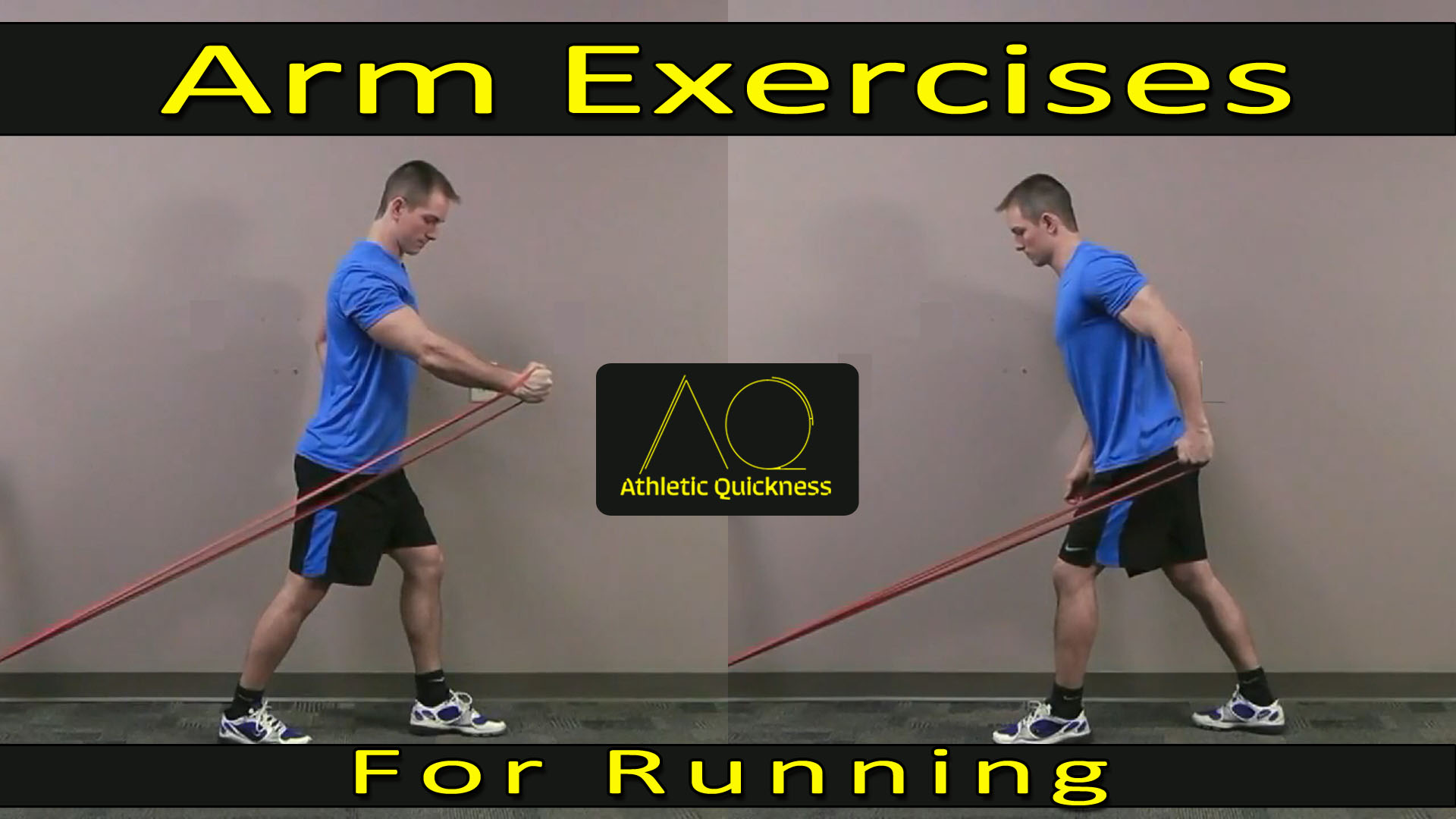
This exercise shown in the video, above, targets the muscles responsible for driving the arm forward during running.
Primary muscles involved:
- Anterior deltoid
- Pectoralis major
- Coracobrachialis
- Biceps (long head)
How to perform:
- Attach the resistance band behind you
- Step forward to create tension
- Bring your arm into a forward running position
- Hold for 10–15 seconds
- Maintain strong posture and alignment
2. Arm Extension Exercise (Backward Drive)
This exercise shown in the video, above, strengthens the muscles responsible for driving the arm backward.
Primary muscles involved:
- Triceps
- Posterior deltoid
- Latissimus dorsi
- Teres major
How to perform:
- Attach the resistance band in front of you
- Step back to create tension
- Drive your arm backward into position
- Hold for 10–15 seconds
- Maintain control and stability
Proper Positioning Is Critical
To maximize results:
- Your stance should mimic your running position
- Maintain proper posture
- Keep movements controlled
Effort level should be:
- 70–80% of maximum strength
- Challenging enough that holding beyond 10–15 seconds is difficult
Training Guidelines
For best results:
- Perform 3 sets per arm
- Train 1–2 times per week
- Do exercises at the start of your workout when fresh
Avoid training arms when fatigued, as this reduces effectiveness.
Why These Exercises Improve Sprinting Speed
These exercises do more than build strength.
They improve:
- Coordination between arms and legs
- Rotational force production
- Neuromuscular efficiency
By training the arms in positions that replicate running, you develop:
- Faster arm movement
- Better timing
- Greater overall speed
👉 Simply put, your muscles are forced to react and adapt continuously—exactly what’s required for faster, more efficient movement.
👉 To understand why this method works so effectively, see:
Isometric Training With Resistance Bands (Why It Works)
Final Takeaway
If you want to run faster, you must train your arms with purpose.
The most effective approach is to:
- Use resistance bands
- Train in sport-specific positions
- Focus on isometric holds
- Develop both strength and coordination
When done correctly, these arm exercises will:
- Improve your running mechanics
- Increase your speed
- Enhance overall athletic performance
🧠 Build Total-Body Speed That Actually Transfers
Training your arms is an important part of improving speed—but it’s only one piece of the system.
To truly run faster, your entire body must work together efficiently.
Most athletes:
- Train muscles in isolation
- Overlook key movement patterns
- Miss critical muscle groups that directly impact speed
One of the most important—and most overlooked—areas is the hip flexor muscle group, which plays a major role in stride rate and top-end speed.
The Run Faster with Isometric Training program shows you how to:
- Train both upper and lower body together
- Use resistance bands with a dynamic isometric strategy
- Target muscles that are often ignored in traditional training
- Improve coordination, timing, and real-world speed
👉 👉 Learn more about the Run Faster with Isometric Training program here
FAQ
Do arm exercises really help running speed?
Yes. The arms play a critical role in rotation, balance, and force transfer, all of which affect speed.
What are the best arm exercises for sprinting?
Isometric resistance band exercises that train forward and backward arm drive are most effective.
How often should I train arms for running speed?
1–2 times per week is sufficient when using high-intensity isometric holds.