Home » Resistance Bands for Speed » How to Use Resistance Bands for Speed (Complete Guide to Faster Muscle Contraction)
How to Use Resistance Bands for Speed (Complete Guide)
If you want to run faster, move quicker, and improve your athletic performance, you need to train your muscles to contract faster—not just get stronger.
Most athletes use resistance bands the same way they use weights—performing repetitions and focusing on strength. The problem is, this approach does very little to improve speed.
There is a better way.
When used correctly, resistance bands can dramatically improve muscle contraction speed, coordination, and quickness in just a matter of days. The key is using them with an isometric training strategy. This forces your muscles to sustain a contraction for longer than they are used to, creating a number of positive changes within them.
In this guide, you’ll learn exactly how to use resistance bands for speed—the same method athletes use to unlock faster movement, better control, and explosive performance. See image below for the kind of band to be used.
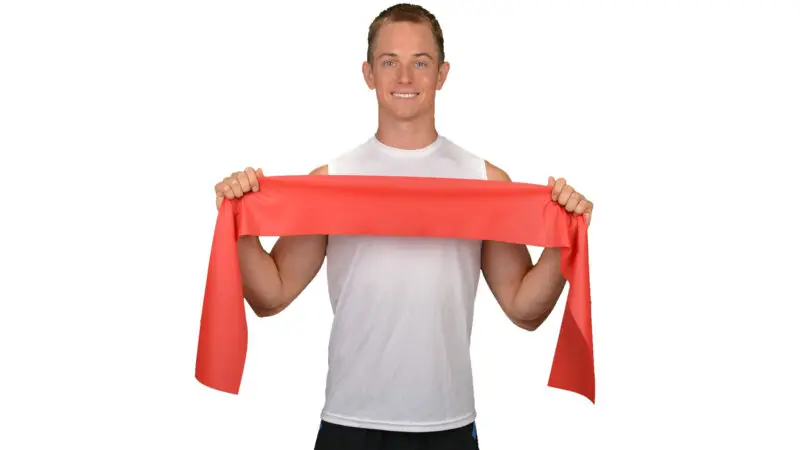
Type of resistance band used for speed.
What Makes Resistance Bands Effective for Speed Training
Resistance bands have a unique property called variable resistance—meaning the more they stretch, the more resistance they apply.
Unlike weights, which rely on gravity, resistance bands:
- Apply force from any direction
- Continuously change resistance
- Force muscles to adapt instantly
👉 This creates the perfect environment for improving speed and coordination
For a deeper breakdown of why this works, see:
➡️ Why Use Bands With Isometric Training
Why Most Athletes Use Resistance Bands Incorrectly
The biggest mistake athletes make with resistance band speed training is using them like weights.
They perform repetitions.
Here’s why that doesn’t work:
- Muscles are weakest at the start → band has least resistance
- Muscles get stronger mid-movement → resistance increases
- End range = strongest position, but least relevant to real speed
👉 Result: You only train part of the movement—and not the part that improves speed.
The Correct Method: Isometric Resistance Band Training
The most effective way to use resistance bands for speed is through isometric training.
Instead of moving the band back and forth, you:
- Stretch the band into position
- Hold it for 10–15 seconds
- Use 70–80% of your max effort
This forces your muscles to:
- React to sustain resistance
- Recruit more motor units
- Improve contraction speed
Step-by-Step: How to Train for Speed With Resistance Bands
Here’s exactly how to do it:
Step 1: Anchor the Band
Attach the band to a stable object.
Step 2: Pre-Stretch the Band
Step away until there is strong tension.
Step 3: Get Into Position
Choose a position that mimics your sport (running, sprinting, etc.)
Step 4: Hold the Position
Maintain the position for 10–15 seconds
Step 5: Reach Muscle Fatigue
You should begin to feel:
- Muscle shaking
- Loss of stability
- Increased effort to hold
👉 This is where speed development happens.
Why Isometric Band Training Builds Speed So Fast
When your muscles begin to fatigue and shake:
- The length of the band changes ever so slightly, even while trying to hold it steady
- The direction of force then shifts
- Resistance increases and decreases instantly as a result
Your muscles are then forced to:
- React rapidly
- Adjust force output
- Develop faster contraction speed
👉 This process trains your fast-twitch muscle fibers far more effectively than traditional workouts.
At this point, you can probably see that it’s not just the resistance band that creates speed—it’s how the resistance is applied and how your muscles are forced to respond to it.
This is exactly where most athletes go wrong.
They use resistance bands, but they don’t position their body correctly, don’t apply the right level of tension, and don’t train the specific muscle patterns needed for speed.
This is the difference between simply using resistance bands… and using them in a way that actually increases speed.
For a deeper physiological explanation:
➡️ How Muscles Respond to Isometric Resistance Band Training for Speed
Best Resistance Band Exercises for Speed
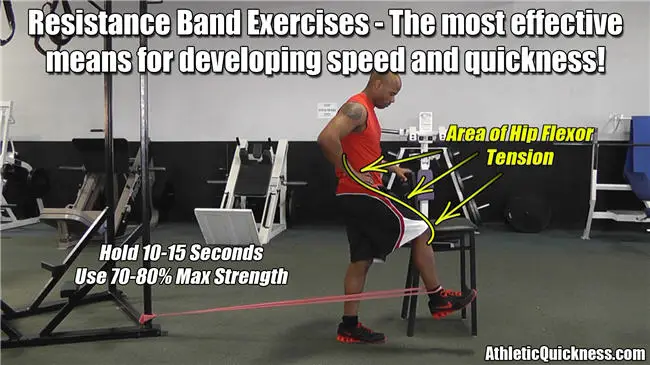
To get the best results, you should train multiple positions across your body.
Examples include:
- Hip flexor holds (for sprint speed). See image, above
- Arm drive positions (for running mechanics)
- Rotational positions (for coordination)
For a full breakdown of exercises:
➡️ Resistance Band Exercises for Speed
How This Improves Running Speed and Performance
Speed isn’t just about stronger legs—it’s about coordination and timing.
Your arms, shoulders, and core all contribute to:
- Balance
- Rotational force (torque)
- Stride efficiency
Resistance band training improves all of these simultaneously.
For more on this:
➡️ Arm Exercises for Running and Sprinting
What Happens Inside Your Muscles
This type of training creates several important changes inside your muscles.
These changes include:
- New neuromuscular patterns
- Faster muscle fiber recruitment
- Increased coordination and responsiveness
It also:
- Exposes weaknesses
- Forces rapid adaptation
- Builds speed without adding bulk
👉 Helpful Hint: Most athletes unknowingly leave a large percentage of their speed potential untapped simply because they are not training all of the muscles involved in running—and this is often the missing piece when it comes to getting faster.
Best Resistance Bands for Speed Training
Not all resistance bands are equal.
Using the wrong band can limit your results.
The best bands:
- Provide consistent elasticity
- Allow multidirectional resistance
- Match natural muscle behavior
See our full recommendation here:
➡️ Best Resistance Bands for Speed Training Workouts
Understanding why this works is important—but applying it correctly is what actually produces results.
The challenge is that small changes in body position, band tension, and joint angles can completely change how your muscles respond during training.
Final Takeaway
If you want to improve speed, quickness, and athletic performance:
👉 Stop using resistance bands like weights
👉 Start using isometric holds
👉 Train in sport-specific positions
This method forces your muscles to adapt faster than ever before—and that’s exactly what creates real speed.
🚀 Take the Next Step: Unlock Your True Speed Potential
If you’re serious about getting faster, the key is not just understanding how this works—but applying it in a way that exposes and develops the exact muscles responsible for speed.
Most athletes only train a small percentage of the muscles involved in running, which is why they plateau.
The Run Faster with Isometric Training program shows you exactly how to:
- Target muscles that are often overlooked in traditional training
- Use resistance bands the right way to improve contraction speed
- Train in positions that directly transfer to running performance
- Develop speed without adding unnecessary body weight
This is the exact system designed to help you break through plateaus and start seeing real improvements in your speed—often much faster than you expect.
👉 Learn more about the Run Faster with Isometric Training program here
FAQ Section
What is the best way to use resistance bands for speed?
The most effective way is through isometric training, where you hold a resistance band in a fixed position for 10–15 seconds under high tension. This forces your muscles to react quickly and improves contraction speed.
Do resistance bands actually improve speed?
Yes, resistance bands improve speed by increasing muscle coordination, fast-twitch activation, and responsiveness to changing resistance.
Are resistance bands better than weights for speed training?
For speed development, resistance bands are often more effective than weights because they provide variable resistance and force muscles to adapt quickly.
How often should I train with resistance bands for speed?
Most athletes benefit from training 2–3 times per week, allowing muscles to recover while still improving coordination and quickness.
What muscles should I target for speed training?
Key muscles include hip flexors, glutes, hamstrings, and shoulders, as they all contribute to speed and coordination.