
Home » Isometric Training for Speed » Isometric Training for Speed: Why It Works (And Why Most Training Fails)
Isometric Training for Speed: The Missing Piece in Speed Training
If you want to understand how isometric training improves speed, you need to look beyond traditional workouts and focus on how your muscles actually produce fast movement.
Most athletes train for speed using:
- Sprint drills
- Weight training
- Plyometrics
And while those methods can improve strength and conditioning…
👉 They don’t directly train the one thing that matters most:
How fast your muscles contract.
What Is Isometric Training for Speed?
Isometric training for speed is a method where muscles are placed under tension without movement, allowing them to contract as fast and as forcefully as possible in a fixed position.
Instead of performing repetitions, you:
- Lock into a specific position
- Apply maximum effort
- Hold briefly under tension
👉 This trains your muscles to fire faster, not just work harder.
Speed Is NOT Strength or Endurance
Here’s where most athletes go wrong.
They assume:
- Stronger = Faster
- More reps = Better performance
But speed is driven by something completely different:
👉 Muscle contraction speed
Think of it this way:
If your muscles can contract faster,
your movements become faster—running, jumping, cutting, everything.
The Role of Fast Twitch Muscle Fibers
Speed comes from fast twitch muscle fibers, not slow twitch.
- Fast twitch fibers → explosive, high-speed movement
- Slow twitch fibers → endurance, longer effort
Most traditional workouts:
- Activate both
- Or lean heavily toward slow twitch over time
👉 That’s why long workouts can actually work against speed development.
Why Most Speed Training Falls Short
Traditional “speed training” relies on repetition:
- Running
- Lifting weights
- Jumping
But repetition does one thing very well:
👉 It builds strength and endurance
Not pure speed.
If simply running made you faster,
you’d get faster every time you ran.
But that’s not how it works.
Why Isometric Training for Speed Works Differently
Isometric training removes repetition entirely.
Instead:
- Muscles are placed under immediate tension
- Fast twitch fibers are activated right away
- No time is wasted building endurance
👉 This allows you to target pure contraction speed
Which is what actually transfers to athletic performance.
A Simple Example
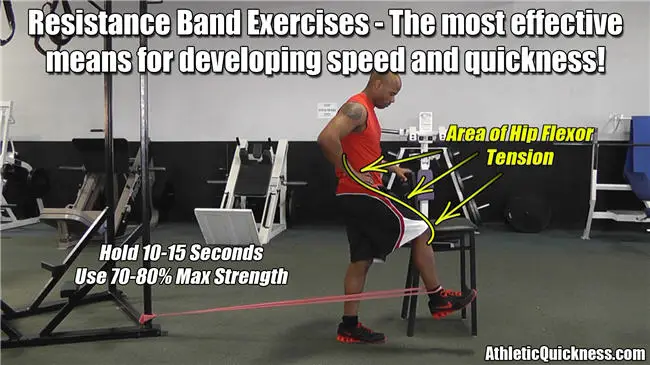
For example, instead of performing repeated leg raises or sprint drills, you can place your leg in the exact position it reaches during the running stride—thigh up and lower leg extended—and apply force against a resistance band while holding that position.
In this position, your muscles are forced to contract at high intensity without movement, which directly targets the speed of muscle contraction instead of strength or endurance.
👉 This is much closer to how your muscles actually function when you run at full speed.
Why Time Matters More Than You Think
This is one of the most misunderstood parts of speed training.
Your body only prioritizes fast twitch activation for a short window.
After that:
- It begins recruiting slow twitch fibers
- The workout shifts toward endurance
👉 Which reduces speed development
That’s why:
True speed training should be short.
The 3-Minute Speed Training Approach
One of the biggest advantages of isometric training for speed is efficiency.
You don’t need:
- Long workouts
- Endless reps
- Hours in the gym
👉 You need focused, high-intensity contraction
In many cases:
Just a few minutes per day is enough to create measurable improvements in speed.
This is why isometric speed training is one of the most effective ways to improve the speed of muscle contraction without wasting time on unnecessary volume.
Why This Works So Fast
Most athletes have never trained their muscles this way.
That means:
- Fast twitch fibers are underdeveloped
- Certain movement patterns are untrained
- Key muscles (like hip flexors) are underutilized
👉 When you finally target them correctly…
Results can happen quickly
Sometimes in days—not months.
This is also why even highly trained athletes often struggle the first time they try this type of training—because these positions and contraction patterns are rarely, if ever, trained directly.
👉 It’s not a matter of effort—it’s a matter of exposure.
👉 If you’re wondering why your current training hasn’t improved your speed:
Why You’re Not Getting Faster (Even If You Train Hard)
Where This Fits Into Your Speed Training
This doesn’t replace everything you’re doing.
Instead, it fills the gap.
- Strength training → builds force
- Sprinting → builds coordination
- Isometric training → builds speed of contraction
👉 See how this fits into a complete speed system:
Isometric Training for Speed: The Complete System to Run Faster
How This Connects to Real Running Speed
As you’ve seen, speed isn’t just about pushing off the ground.
👉 It’s about how fast you can cycle your legs through the running motion.
That includes:
- Pulling the leg forward (hip flexion)
- Extending the lower leg (knee extension)
Isometric training allows you to target both of these actions in the exact positions they occur during running.
👉 Especially during the swing phase, where real speed is created.
Final Takeaway
If your current training isn’t making you faster, it’s not because you’re not working hard enough.
👉 It’s because you’re not training the right way.
Isometric training for speed focuses directly on:
- Muscle contraction speed
- Fast twitch fiber activation
- Efficient, targeted training
And that’s what separates it from everything else.
🔗 Next Step in the Series
Now that you understand how isometric training for speed improves muscle contraction and activates fast twitch fibers…
👉 Now it’s time to understand why the type of resistance you use matters just as much as the method itself.
👉 Read Next: Why Resistance Bands Work Better for Speed Training
FAQ: Isometric Training for Speed
What is isometric training for speed?
Isometric training for speed is a method where muscles are held under tension without movement to improve contraction speed and fast twitch fiber activation.
Does isometric training actually make you faster?
Yes. By improving how quickly your muscles contract, isometric training can directly increase speed, quickness, and explosiveness.
How long should a speed workout last?
True speed-focused workouts should be short—often under 10 minutes—to avoid shifting into endurance training.
Why don’t repetitions improve speed?
Repetitions train strength and endurance by repeatedly lengthening and shortening muscles, but they don’t maximize contraction speed.
Can you get faster without running?
Yes. You can improve muscle contraction speed through targeted isometric training, which transfers directly to running performance.
What muscles benefit most from this training?
Muscles involved in explosive movement—especially hip flexors and sprint-related muscles—benefit the most.