
Home » Running Phases Explained » RUNNING PHASES EXPLAINED: How Your Legs Move When You Run
🚀 Introduction
Most athletes think running is just:
👉 move your legs faster
👉 push harder
👉 sprint harder
But sprinting feels very different once you slow it down mentally and look at what one leg is actually doing during movement. 👀
Because during sprinting:
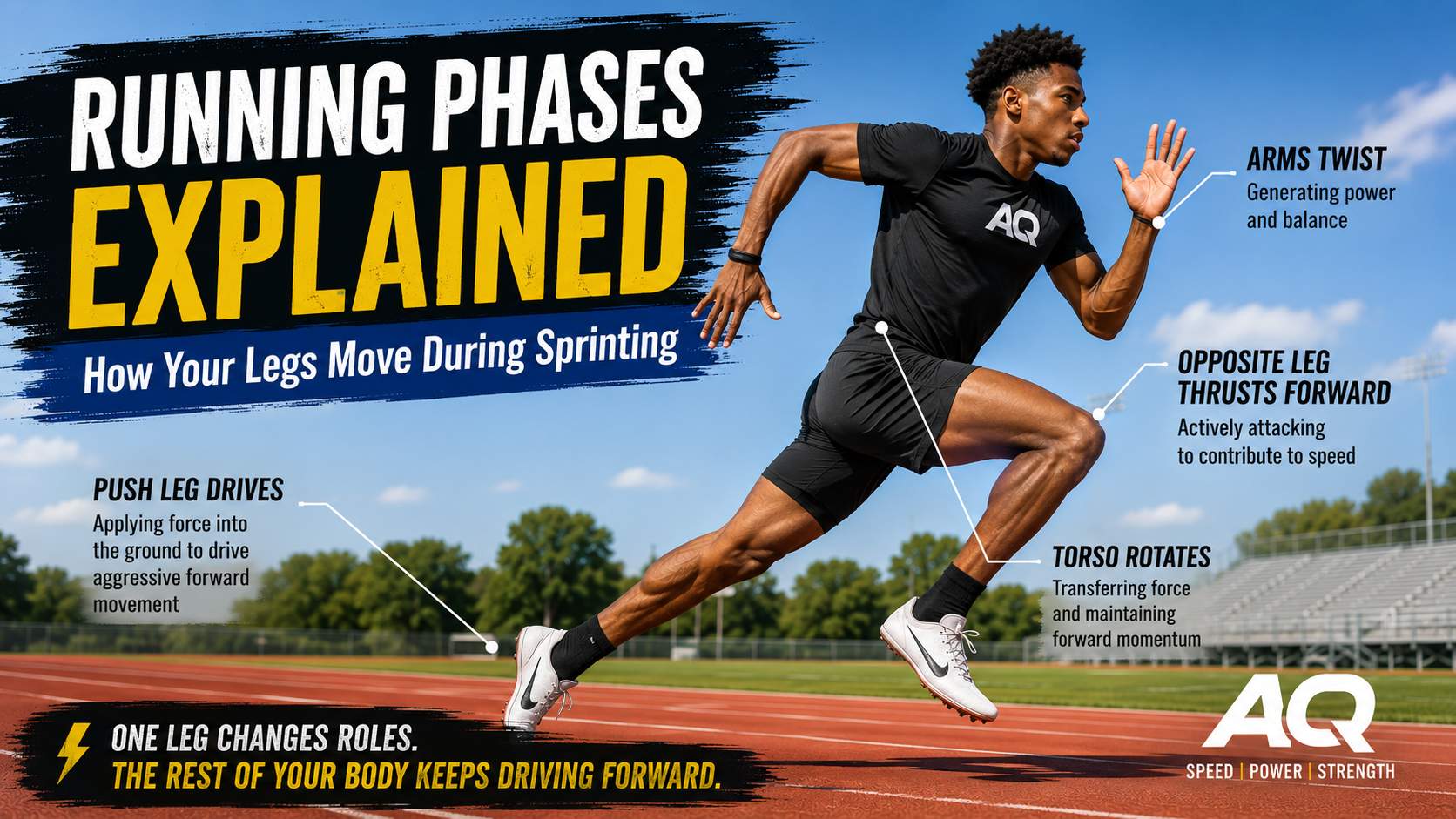
💥 one leg is continuously changing movement roles while the rest of your body (opposite leg, arms, torso) keeps supporting aggressive forward movement.
And once athletes start seeing that overlap…
running mechanics start making much more sense.
⚙️ The Running Phases Explained Simply
During sprinting, each leg moves through three primary movement roles:
🔵 Push (Drive)
🟡 Swing
🟢 Transition
But sprinting is not:
❌ one leg working alone.
While one leg moves through these phases:
👉 the opposite leg thrusts forward
👉 the arms twist
👉 the torso rotates
all simultaneously contributing to aggressive forward movement.
That overlap is part of what makes sprinting feel fluid, powerful, and fast.
🔵 Push (Drive) Phase
The push phase is when the leg applies force into the ground to support aggressive forward movement.
This is where athletes usually FEEL force the most.
👉 glutes drive force
👉 hamstrings support force transfer
👉 calves stiffen and transfer force
👉 the leg pushes the body forward
This phase is powerful.
But AQ does not see push as:
❌ the “main” phase of sprinting.
Because while one leg pushes against the ground:
💥 the rest of the body is already contributing to movement simultaneously.
The opposite leg is already attacking forward.
The torso is already rotating.
The arms are already supporting balance and force transfer.
That’s real sprinting.
👉 Go deeper here:
➡️ Push (Drive) Phase of Running: Why Most Athletes Overtrain It
🟡 Swing Phase
The swing phase is when the leg leaves the ground and aggressively attacks forward.
AQ does NOT see this as:
❌ recovery
❌ waiting
❌ passive repositioning
The swing leg is actively contributing to speed right along with the pushing leg.
Fast sprinting requires:
👉 aggressive forward leg movement
👉 rapid front-side movement
👉 continuous movement support
👉 ongoing force transfer through the body
And when athletes improve this phase:
💥 sprinting often feels lighter, faster, and more responsive.
That’s why the swing phase matters so much.
👉 Go deeper here:
➡️ Swing Phase of Running: Why Hip Flexors Play a Major Role in Speed
🟢 Transition Phase
The transition phase is where the leg moves back underneath the body and reorganizes for force.
This happens fast.
Very fast.
And most athletes barely think about it.
But this phase helps determine:
👉 timing of force application
👉 movement continuity
👉 how naturally force transfers through the body
AQ does not treat transition as:
❌ a separate sprint event
Instead:
💥 it is part of the continuous movement happening during sprinting.
The leg is constantly reorganizing movement while aggressive forward movement continues.
👉 Go deeper here:
➡️ Transition Phase of Running: An Often Overlooked Opportunity for Speed
🔄 Running Phases Overlap During Sprinting
One important thing athletes often miss:
👉 both legs are not doing the same thing at the same time.
During sprinting:
💥 one leg may be pushing while the other leg is swinging forward.
Then those roles switch.
Continuously.
That overlap matters because sprinting is not:
❌ one leg completely finishing before the other begins.
Instead:
👉 both legs continuously contribute to aggressive forward movement together.
While one leg applies force into the ground:
👉 the opposite leg helps organize balance, timing, and ongoing movement.
That’s part of what makes sprinting feel fluid instead of forced.
And when athletes improve how these movement roles support each other:
💥 aggressive forward movement often becomes faster, smoother, and easier to sustain.
⚡ The Real Speed Reframe
Most athletes grow up thinking sprinting is mainly about:
👉 pushing harder with one leg
But sprinting is more connected than that.
Because speed improves when:
👉 movement support improves
👉 force transfer improves
👉 timing improves
👉 aggressive forward movement stays continuous
That’s a very different way to think about running mechanics.
And athletes can usually FEEL the difference immediately.
🧠 Why Most Athletes Get Stuck
A lot of traditional speed instruction separates sprinting into pieces.
One phase.
Then another.
Then another.
But sprinting does not FEEL like separate events.
It feels connected.
Continuous.
Aggressive.
Fast.
That’s why AQ teaches running phases differently:
💥 one leg continuously changes movement roles while the rest of the body simultaneously contributes to movement.
That model usually makes more physical sense to athletes.
🏁 What This Means For You
If you want to run faster:
❌ Don’t think about sprinting as isolated phases.
Instead ask:
👉 Is the leg continuously supporting movement?
👉 Is aggressive forward movement staying connected?
👉 Is force transferring naturally through the body?
👉 Do my running mechanics feel fluid or disconnected?
Because speed is not just about effort.
💥 It’s about how well movement stays connected during sprinting.
🧭 Go Deeper
👉 Want to understand why most athletes overtrain the push side of sprinting?
➡️ Push (Drive) Phase of Running: Why Most Athletes Overtrain It
👉 Want to see why the swing leg may be contributing more to speed than most athletes realize?
➡️ Swing Phase of Running: Why Hip Flexors Play a Major Role in Speed
👉 Want to understand how the leg reorganizes for force during sprinting?
➡️ Transition Phase of Running: An Often Overlooked Opportunity for Speed
🎯 Start Here
👉 Want to understand the full AQ speed system behind aggressive forward movement, force transfer, and sprint mechanics?
➡️ Run Faster With Isometric Training
❓ FAQ
What are the phases of running?
AQ primarily describes three visible movement roles for one leg during sprinting:
👉 push phase
👉 swing phase
👉 transition phase
Is sprinting sequential?
Not in the AQ model.
AQ sees sprinting as simultaneous movement contributions happening continuously across the body during sprinting.
What is the swing phase in running?
The swing phase is when the leg aggressively attacks forward after leaving the ground.
Why does the transition phase matter?
Because it helps organize timing, force transfer, and movement continuity during sprinting.
Does AQ still believe push matters most?
No.
AQ sees push and swing as simultaneous contributors to aggressive forward movement.