
Home » Speed Training Science » The 3 Types of Muscle Contractions for Speed (And How to Train Them)
🧠 Introduction
Many athletes train muscles.
👉 Far fewer understand how muscles contract during sprinting to create speed.
That matters enormously.
Because sprint speed is not simply:
❌ stronger muscles.
💥 Sprint speed depends on how the body supports aggressive movement under force.
And muscle contractions are a major part of that process.
Three contraction types play a huge role:
• concentric
• eccentric
• isometric
Understanding how they work together can completely change how you view speed training.
Because during sprinting:
• the pushing leg drives aggressively backward
• the swing leg attacks aggressively forward
• the arms rotate to support movement
• the torso connects both sides of the body
👉 all continuously.
And different contraction behaviors help support all of those sprint actions under force.
⚡ Why Muscle Contractions Matter For Sprint Speed
Sprint speed often depends on:
• producing force
• controlling force
• transferring force
👉 continuously during movement.
That is massively important.
Because during sprinting the body must constantly support:
• push leg force production
• swing leg repositioning speed
• arm rotational contribution
• torso balance under force
👉 together.
And different contraction types help support those movement relationships in different ways.
Huge point.
💥 Sprint speed is rarely built from one contraction type alone.
It usually depends on all three working together under speed.
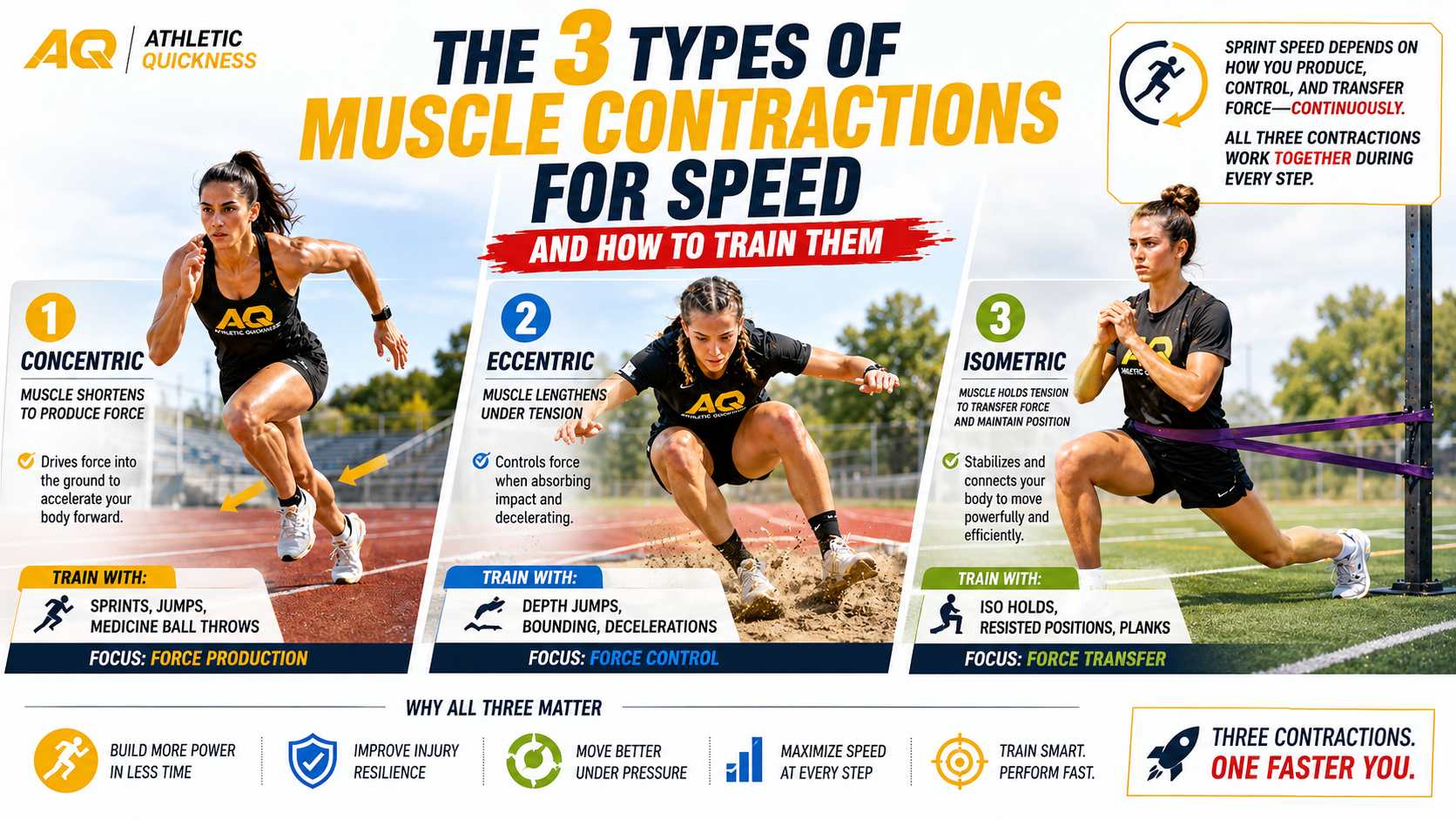
🔄 Concentric Contractions Help Produce Force
Concentric contractions occur when muscle shortens while producing force.
👉 This is often associated with aggressive driving action.
During sprinting,
concentric actions may help support:
• aggressive backward push leg drive
• explosive acceleration force
• forward projection during sprinting
That matters enormously.
Because sprinting requires:
💥 rapid force expression under aggressive movement.
And concentric contractions help contribute to that force production.
🧠 Eccentric Contractions Help Control Force
Eccentric contractions occur when muscle lengthens under force.
👉 This often helps control aggressive movement during sprinting.
That is hugely important.
Because sprint speed does not only depend on:
❌ creating force.
💥 Sprint speed also depends on whether the body can continue supporting force without losing timing, balance, or movement continuity.
That is where eccentric qualities matter enormously.
During sprinting,
eccentric control may help support:
• force absorption under landing
• timing between steps
• swing leg repositioning control
• balance during aggressive movement
• continuous sprint movement support
Huge distinction.
Because uncontrolled force may:
• leak movement efficiency
• disrupt sprint timing
• interrupt movement continuity
💥 Better force control often helps support better sprint movement.
That is a major AQ principle.
🔑 Isometric Contractions Help Support Force Transfer
This is often the misunderstood one.
Isometric contractions involve muscular tension without large visible joint movement.
👉 But that does NOT mean the body is inactive.
In AQ training,
isometric contractions often help support:
• force transfer
• positional support under force
• balance relationships
• movement continuity during aggressive movement
That is massively important.
Because sprinting itself is not:
❌ perfectly stable movement.
💥 Sprinting is aggressive movement continuously supported under changing force conditions.
And isometric qualities may help the body continue supporting:
• push leg force
• swing leg movement
• arm rotational support
• torso connection under force
👉 while sprint conditions continuously change.
That is one reason isometric training can transfer so well to sprint performance when applied correctly.
🚨 Why All Three Matter Together
This may be the biggest realization in the article.
Concentric contractions help produce force.
Eccentric contractions help control force.
Isometric contractions help support force transfer and movement continuity.
👉 But sprinting requires all three simultaneously.
That is huge.
Because during sprinting:
• one area of the body may be producing force concentrically
• another may be stabilizing isometrically
• another may be controlling movement eccentrically
👉 all at the same time.
That is one reason sprinting is such a difficult athletic skill.
💥 Sprint speed often depends on how well the body organizes all of those contraction behaviors together under force.
Not isolated contraction qualities.
Integration.
That is where many athletes miss something important.
⚙️ What This Means For Training
If all three contractions contribute to sprint speed,
👉 training should improve all three.
Not overemphasize only one.
That changes how speed development should be viewed.
Because athletes often improve most when training develops:
• aggressive push leg force
• swing leg repositioning speed
• arm rotational continuity
• torso balance under force
• timing between steps
• force transfer during movement
👉 together.
💥 That is much more complete sprint development.
🔄 Contractions Are Part Of The Bigger Sprint System
Contractions do not occur in isolation.
👉 They occur inside the larger sprint movement system.
Which includes:
• push leg force
• swing leg speed
• arm rotation
• torso support
• timing relationships
• balance under force
👉 continuously.
That is why contraction training matters.
And why it fits into the larger science of sprint speed.
🚀 What This Means For You
Many athletes train muscles.
👉 Fewer train how muscles function together during sprinting.
That is a massive difference.
Because sprint speed depends on more than:
❌ muscular strength alone.
💥 Sprint speed depends on how well the body supports aggressive movement under force.
And different contraction behaviors help support different parts of sprint movement.
Which means training should improve:
• push leg force production
• swing leg repositioning control
• arm rotational support
• torso balance relationships
• timing between steps
👉 together.
That is the AQ difference.
🧭 You Are Here
You are currently exploring:
👉 THE 3 TYPES OF MUSCLE CONTRACTIONS FOR SPEED: how concentric, eccentric, and isometric contractions work together to support force production, force control, force transfer, and sprint movement continuity.
🌐 See how this fits into the complete AQ speed system:
Learn how AQ approaches:
force production,
movement support,
timing between steps,
strength balance,
and sprint speed development.
➡️ SPEED TRAINING SCIENCE: Why Most Methods Fail (And What Actually Works)
🪜 Continue Deeper Into Sprint Muscle Function:
Learn what actually creates sprint force and why sprint speed depends on more than isolated muscular force production.
➡️ What Actually Creates Force in Running? (And Why Most Athletes Get It Wrong)
Learn why AQ training improves sprint-support relationships differently than many traditional training methods.
➡️ Why This Type of Speed Training Works (The Science Behind It)
Learn how fast twitch qualities influence explosive sprint movement and why explosiveness alone does not automatically create faster sprinting.
➡️ How to Train Fast Twitch Muscle Fibers for Speed (Without Adding Bulk)
🚀 Ready To Run Faster?
If you are ready to turn this information into real speed:
➡️ Run Faster With Isometric Training
❓FAQ
Why do all three contraction types matter for sprint speed?
Because sprint speed depends on producing,
controlling,
and transferring force continuously during aggressive movement.
Are concentric contractions the most important?
👉 They are extremely important.
But sprint speed usually depends on concentric,
eccentric,
and isometric behaviors working together.
Why do eccentric contractions matter for sprinters?
Because they help support:
• timing between steps
• balance under force
• movement continuity during sprinting
Why do isometrics matter for sprint speed?
💥 Because they help support force transfer,
balance relationships,
and aggressive movement under changing force conditions.
What should athletes train for?
👉 Push leg force,
swing leg speed,
arm rotational support,
torso balance,
timing between steps,
and continuous force support under speed.