

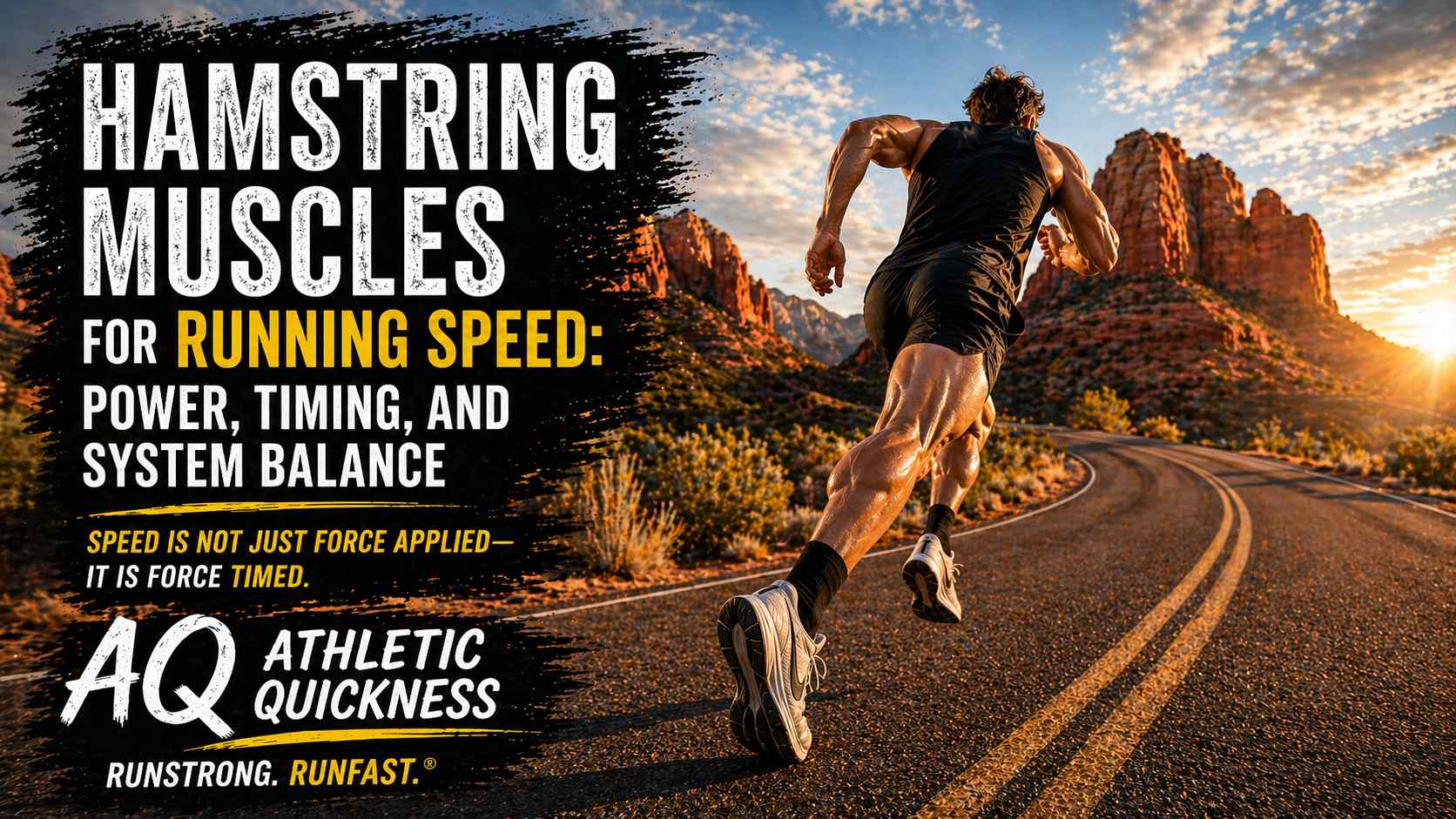
Home » Running Muscles for Speed » Hamstring Muscles for Running Speed: Power, Timing, and System Balance
🧠 Introduction
Most athletes think hamstrings matter for one reason:
👉 power.
Explosiveness.
Propulsion.
Speed.
And yes—
they contribute to all of those.
💥 But that may not be why they matter most.
Hamstrings may influence running speed not just through power—
⚡ but through how force is timed, transferred, and coordinated throughout the running stride.
And that changes the conversation.
⚠️ The Hamstring Myth Most Athletes Never Question
Many athletes assume stronger hamstrings automatically improve speed.
More force.
More propulsion.
More sprint power.
👉 But power alone does not guarantee faster movement.
Because speed is not just force applied—
⚡ it is force applied at the right time.
That may be where hamstrings become much more interesting.
🔑 Power Is Only Part of the Story
Hamstrings may help contribute to propulsion.
But they may also help govern:
• movement timing
• running rhythm
• force coordination
• balance across the stride cycle
💥 That is much more than “power.”
And much more than most training programs recognize.
⚡ Why Timing May Matter As Much As Strength
Power without timing can create inefficiency.
⚡ Even powerful force can disrupt movement if it is applied at the wrong time.
Power without timing does not create clean speed.
That may be one of the hidden principles of running.
Hamstrings may help support not just how much force is available—
👉 but when that force can be expressed.
That is a different role.
💥 A bigger one.
🔄 Hamstrings as Part of the Full Speed System
This is where many athletes miss the larger picture.
Hamstrings may contribute across the running cycle:
• rearward push (glutes)
• forward swing-thrust (hip flexors)
• draw-through into the next push (transition)
💥 Few muscles may touch the system this broadly.
Which may help explain why they matter so much.
Not as isolated power muscles—
but as system muscles.
🧩 Why Stronger Hamstrings Alone May Not Make You Faster
Stronger hamstrings can raise potential.
But potential is not automatically performance.
If timing breaks down…
If force transfer leaks…
If system balance is off…
👉 speed may still be limited.
Even with stronger hamstrings.
That surprises many athletes.
🚀 What This Means For You
Hamstrings should not be viewed only as propulsion muscles.
💥 They may be timing muscles too.
And possibly system-balance muscles.
That changes how they should be trained.
👉 Not just stronger—but better timed within the stride.
⚡ Speed may depend not just on how much force hamstrings help create—
but how well they help organize movement.
That is a very different model.
➡️ How to Run Faster: The Complete Guide to Improving Speed Step by Step
🧭 You Are Here (Within The AQ Speed Training System)
You are currently exploring:
👉 HAMSTRING MUSCLES FOR RUNNING SPEED: POWER, TIMING, AND SYSTEM BALANCE: why the hamstrings contribute to running speed by helping coordinate force, timing, and movement throughout the running stride.
🌐 See How This Fits Into The Complete AQ Speed Training System
👉 Explore how the hamstrings fit alongside the other major muscle groups involved in running speed.
➡️ RUNNING MUSCLES FOR SPEED: What Actually Matters (And What Doesn’t)
🪜 Continue Deeper Into Running Muscles for Speed
Learn why the quadriceps help direct and stabilize force rather than simply producing more power.
➡️ Quadriceps Muscles for Running Speed: Power, Stability, and Control
Learn how the calves influence ground contact, force transfer, and running efficiency.
➡️ Calf Muscles for Running Speed: Ground Contact, Timing, and Efficiency
🚀 Ready to Run Faster?
👉 When you’re ready to apply these principles to improve your running speed:
➡️ Run Faster With Isometric Training!
❓ Frequently Asked Questions
Do hamstrings make you faster?
👉 They can contribute—but not through power alone.
Timing matters too.
Are hamstrings more important for power or speed?
💥 That may be the wrong split.
They may help organize both.
Can strong hamstrings fail to improve speed?
✅ Yes.
If coordination and timing remain limited.
Why do hamstrings matter in sprinting?
Because they may influence more than propulsion—
⚡ they may help govern the rhythm of the system.








