Home » Isometric Training for Speed » Why Resistance Bands Work Better for Speed Training
If you’re serious about getting faster, understanding why resistance bands for speed training work better than traditional weights can completely change how you train.
Most athletes rely on:
- Weightlifting
- Sprint drills
- Plyometrics
And while those methods have value…
👉 They all rely on static resistance or repetitive movement
And that’s where the problem begins.
The Hidden Limitation of Weights for Speed
Weights depend on gravity, which means:
- Resistance is constant
- Movement is predictable
- Muscle activation follows a fixed path
That’s great for building:
- Strength
- Size
- Endurance
But speed is different.
👉 Speed depends on how fast your muscles can react, contract, and adjust to force
And static resistance simply doesn’t train that effectively.
👉 This is one of the main reasons athletes struggle to improve speed:
Why You’re Not Getting Faster (Even If You Train Hard)
What Makes Resistance Bands Different
This is exactly why resistance bands for speed training create a more effective stimulus than traditional weight-based methods.
Resistance bands rely on elastic tension, not gravity.
That means:
- Resistance increases as the band stretches
- Tension is always changing
- Muscles must constantly adapt
👉 Even the smallest movement changes the resistance
And this is where things start to separate from traditional training.
The Key Difference Most People Miss
At first glance, isometric training with bands might look like a completely still exercise.
But here’s what actually happens:
👉 As your muscles begin to fatigue, they start to lose strength
To compensate:
- Your body recruits more motor units
- Your muscles fight to maintain position
But eventually:
- The muscle weakens slightly
- The band length changes—sometimes only by a fraction
And when that happens:
👉 The resistance immediately changes
Now your muscles must:
- React
- Adjust
- Re-stabilize
All while trying to hold the same position.
There’s Another Layer Most Athletes Never Consider
It’s not just the length of the band that changes during an isometric hold.
👉 The angle of the band changes too
As your muscles fatigue:
- Your position shifts slightly
- Your ability to hold perfect alignment breaks down
Even if it’s only by a fraction…
👉 The angle of resistance changes along with the length
Why This Matters for Speed
Now your muscles aren’t just dealing with:
- Changing tension
They’re also dealing with:
- Changing direction of force
That means your body has to:
- Recalculate positioning
- Re-stabilize the joint
- Reapply force in a slightly different direction
👉 Instantly
This Is What Overwhelms (and Trains) the Muscle
When you combine:
- Changing band length
- Changing resistance level
- Changing angle of force
You create:
👉 A true dynamic stimulus inside a static position
This is something most athletes have:
- Never trained
- Never experienced
- Never adapted to
Why This Creates a Powerful Speed Stimulus
This subtle, almost invisible shifting creates something extremely important:
👉 A dynamic response inside a static position
Even though the exercise appears isometric:
- The resistance is not perfectly constant
- The muscle is not truly “resting”
Instead, your body is:
- Constantly correcting
- Constantly adapting
- Constantly re-engaging
This forces:
- Faster muscle activation
- Better coordination
- Increased motor unit recruitment
👉 Exactly what speed demands
Why Variable Resistance Builds Faster Athletes
Most training programs focus on force output.
But speed is more about:
👉 How quickly your muscles respond to changing force
With weights:
- No adjustment is required
- The resistance never changes
With bands:
- Every small deviation matters
- Every correction trains your nervous system
This improves:
- Reaction time
- Muscle firing speed
- Stability under movement
The Problem Most Athletes Don’t Know They Have
Here’s where this becomes a major advantage:
👉 Most athletes have never trained under these conditions before
And even more importantly:
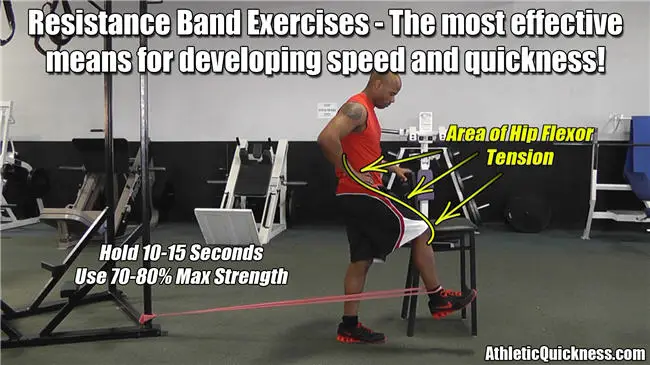
👉 Most athletes have never properly trained their hip flexors at all
Instead, they spend years training:
- Glutes
- Hamstrings
- Quadriceps
- Calves
Over and over again.
But the muscles responsible for:
- Pulling the leg forward
- Controlling stride speed
- Driving turnover
👉 Are often completely underdeveloped
Why This Matters More Than You Think
When you combine:
- Untrained muscles (hip flexors)
- With an unfamiliar training stimulus (variable resistance + isometrics)
You create:
👉 A massive opportunity for rapid improvement
Because now:
- New muscles are being activated
- New movement patterns are being trained
- New levels of speed become possible
Where Most Athletes Go Wrong With Bands
Most athletes use bands like this:
- Around the waist
- Sprinting forward
But this still trains:
- The same push-phase muscles
👉 Not the missing pieces
So even when bands are used…
👉 The real benefit is often never realized
The Right Way to Use Resistance Bands for Speed
To truly improve speed, bands must be used to:
👉 Target the exact muscles responsible for speed
👉 Train them in the exact positions used in running
And most importantly:
👉 Combine band resistance with isometric holds
This creates:
- Maximum tension
- Maximum activation
- Maximum speed adaptation
Why Bands + Isometrics Change Everything
When you combine:
- Variable resistance (bands)
- With isometric contraction (no visible movement)
You get:
👉 A constantly adapting system inside a controlled position
This leads to:
- Faster muscle contraction
- Improved neuromuscular coordination
- Greater explosive potential
This is where true speed development happens—at the level of muscle reaction, not just movement.
👉 If you want a deeper breakdown of how isometric training builds speed:
Isometric Training for Speed: The Right Way to Get Faster in Minutes a Day
⏱️ Why This Doesn’t Take Hours
Because this type of training:
- Targets speed directly
- Eliminates unnecessary repetition
- Focuses on quality over quantity
👉 You don’t need long workouts
Just short, focused sessions can produce:
- Faster muscle response
- Noticeable improvements
🔥 Final Takeaway
If your current training isn’t making you faster, it’s not because you’re not working hard enough.
👉 It’s because your muscles aren’t being trained the right way.
Resistance bands create:
- Changing resistance
- Constant adaptation
- Real speed-specific stimulus
And when combined with isometric training:
👉 They unlock speed potential most athletes never tap into.
⚡ Ready to Take the Next Step?
If you want to apply this system the right way:
👉 Discover the complete system for combining resistance bands and isometric training:
Isometric Training for Speed: The Complete System to Run Faster
🔗 Next Step in the Series
Now that you understand why resistance bands for speed training are so effective…
👉 The next step is applying this directly to the most important (and most neglected) muscles in running.
👉 Read Next: How to Train Hip Flexors for Maximum Speed
❓ FAQ: Resistance Bands for Speed Training
Do resistance bands still work during isometric exercises?
Yes. Even during an isometric hold, small changes in muscle strength cause slight shifts in band length, which changes resistance and forces your muscles to continuously adapt.
Why is this better than holding a weight?
Weights provide constant resistance, while bands change resistance with even the smallest movement. This creates a more dynamic and realistic training stimulus.
Can resistance bands improve muscle speed?
Yes. The constantly changing resistance forces muscles to react quickly, improving contraction speed and coordination.
Why are hip flexors important in this type of training?
Hip flexors control the forward movement of the leg during running. Since they are often undertrained, improving them can lead to significant speed gains.
How often should you train with resistance bands?
2–3 times per week with focused sessions is typically enough to see results.