 |
Hello everyone and welcome! I am Dr. Larry Van Such for AthleticQuickness.com. And, I am here to bring you another running speed challenge to see if we can make you even faster with, get this, just 9 minutes of exercise training time, spread out over the next 14 days. |
That’s right! Just 9 total minutes of training over the next 14 days! And, I am extremely confident that, for anyone trying the exercises that I am about to present in this video, it’s going to work for them.
But before I begin, I want to say that if you are new to our website and haven’t seen or taken our first speed challenge, (with over 2.4 million views!!), then you might want to watch that video, first, and I’ll post it on this page further down, below.
Now, you don’t have to watch that video to benefit from this video, but, the exercise shown there has already helped a lot of people get faster in just a few days and since that’s probably why you are here, why not take advantage of it.
A Literal Twist To These Exercises That You Haven’t Seen or Tried, Before!
Okay, so let’s get right to this running speed challenge.
I am going to show you two new hip flexor exercises but, unlike the one in our previous challenge and unlike any that you may have seen or done before, these two have a slight twist to them.
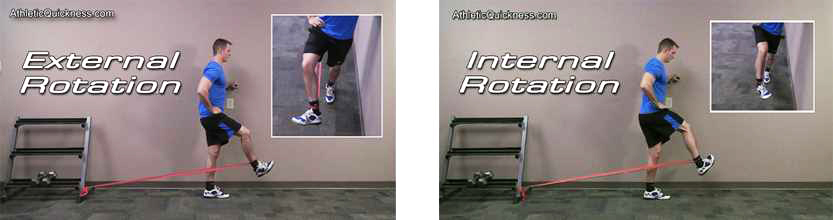
And the twist I am talking about is really a literal twisting, or, turning of the leg, externally, for one exercise and internally for the other. See images, below:
Targets All 7 Hip Flexors, Not Just The Psoas
And this external and internal twisting of your leg will allow you to target all 7 of your hip flexor muscles, not just the psoas(!), in completely different planes, or, angles than you are used to. And this should expose more of their weaknesses such that, when you begin to strengthen them the way I show you, the expectation is for you get even faster than you are right now.
Are You Up To The Challenge?
And that’s the challenge I have for you…to see if you can get even faster with just 9 minutes of training spread out over the next two weeks by doing the exercises in this video. So, what do you think? Are you up to the challenge? Do you have 9 minutes to give this a try? Do you have a need to get faster in your sport? Of course, you do!
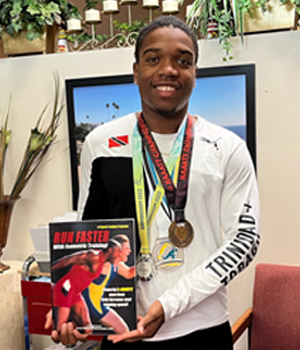
Before we go any further, I’d like to introduce you to Eric Harrison, pictured below. He is the current 2022 Big Ten 100m & 200m champion (from Ohio State), silver medalist representing Trinidad in the 2022 4x100m relay at the Commonwealth Games in Birmingham, England, Trinidad’s Fastest Man in 2022 (10.08 Legal Time in the 100m) and Silver Medalist in 4x100m at the 2022 Bahamas NACAC games. Plus, as you can see, he is also a proud user of the Run Faster Program which you are about to try a little bit, of! Great job, Eric!
Only $29.95!

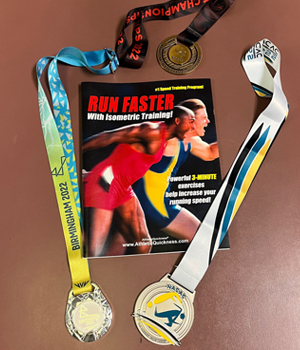
(Learn more about the Run Faster With Isometric Training program.)
Let’s get started!
Alright, I’m going to show you the exercises here in just a moment but before I do, I want to let you know that training instructions and other helpful tips will be given to you immediately after you see the last exercise so, make sure you look for it. Okay, Here We Go!
Important Notice: We always recommend that you consult with your physician before starting any exercise program, including the exercises shown below.
Next…Watch These Exercises.
Exercise #1. Hip Flexion With External Rotation
Exercise #2. Hip Flexion With Internal Rotation
Bonus 3rd Exercise
I want to include one more exercise in this speed challenge for you to do and that is the one from our previous challenge video, which you may have seen and tried, except the training schedule for it will be different, here. And the reason is it will provide a nice, complete balance for training your hip flexors that I believe will benefit you even more.
Exercise #3. Hip Flexion With No Rotation
Before continuing on, I want you to meet two of our previous speed challenge participants, Alison and Shawn. Both did remarkably well with the exercise and as you can see, were extremely pleased they found out about the Run Faster program. Maybe someday soon we may be fortunate enough to share your story on our website.

Only $29.95!
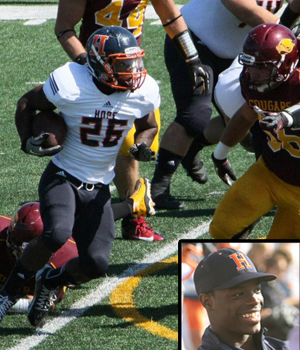
(Learn more about the Run Faster With Isometric Training program.)
*************** Training Instructions ***************
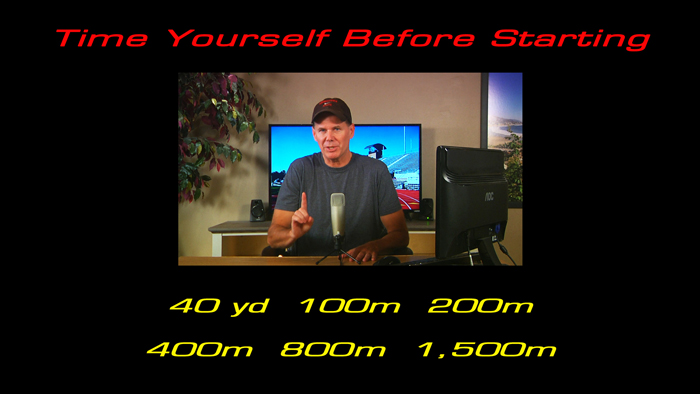
First, I want you to time yourself in whatever running event you are looking to improve upon, whether that be the 40 yard dash, 100m, 200m or maybe something a little longer like 400, 800 or 1,500m, before starting these exercises. And be sure to you write down the date you ran and your times.
Training Schedule, Overview
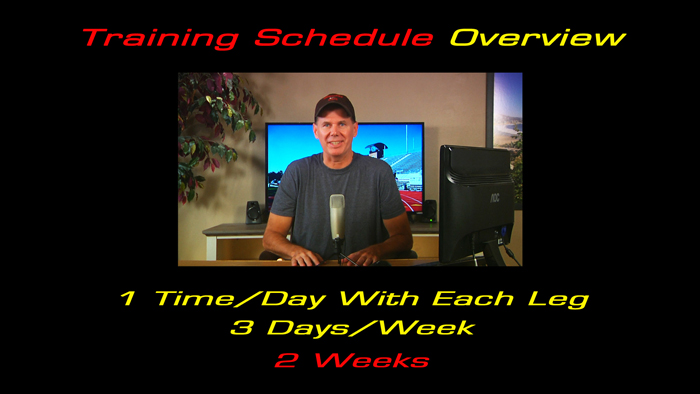
With regards to the training schedule for these exercises, it’s actually very easy. You are simply going to do the three exercises that you just saw, one time a day with each leg and, you’re going to do this three days a week for the next two weeks. That’s it. So, let’s talk a little more about your daily schedule, first.
Daily Schedule
On the days that you are going to train, you will start by doing exercise #1, just one time for the right leg and one time for the left. Then, you’ll do the same for the exercise #2, again, just one time for the right leg and one time for the left and finally, you’ll do exactly the same for the third exercise, one time for the right leg and one time for the left. That’s it. That’s all you will do for the day.
Now, if we put all of this in a chart, your daily schedule will look like this:
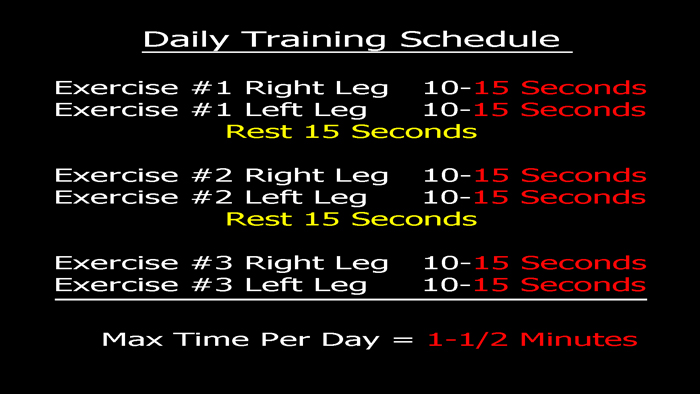
Looking at the image, above, you’ll see that if you do each exercise for the full 15 seconds with each leg, the most you’ll be training per day is just 90 seconds, or, 1-1/2 minutes.
Weekly Schedule

As far as the weekly schedule is concerned, I’d recommend Monday, Wednesday and Friday, but, you can choose any three days that you like just space them out as best as possible.
Now, since you’ll be on this schedule for two weeks, you’ll end up putting in 6 days of training, and so your total exercise time will be just 9 total minutes, maximum.
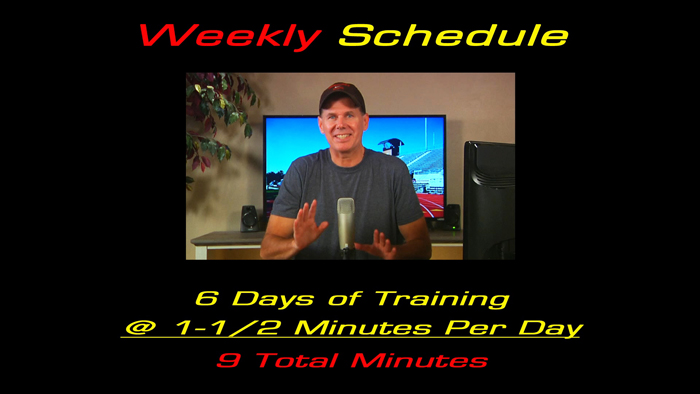
Yes, I know 9 minutes doesn’t sound like much, but, you’ll be surprised how well this works. In fact, I know you will!
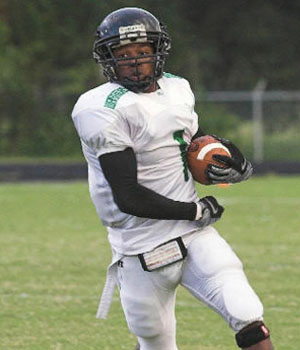
Before finishing up, I want you to meet Magan and Adam. These are two high school level athletes who have experienced some very impressive improvements while using the Run Faster program. Just look at their before and after times… amazing! This could be you, too, so give this a chance! Great job, guys!

Only $29.95!
(Learn more about the Run Faster With Isometric Training program.)
Time Yourself, Again, When You Are Finished

Finally, when you are finished with your last exercise at the end of the second week, I want you to wait a day or two, to rest up a bit, and then time yourself again in the same running events you did before you started these exercises, compare your times to see how much faster you got and then report back to me either in the comment section below or through email Support@AthleticQuickness.com and let me know how you did, because I want to know!
Helpful Tip #1: What Does Using Between70-80% of Your Max Strength, Mean?
When I say “Using between 70-80% of your maximum strength” for these exercises, what I mean is that you want put enough effort in to them such that at around the 10 second mark, you are looking to end the exercise because it’s getting too difficult for you to maintain a steady position.
And, if you can go past 15 seconds rather easily,then you probably don’t have enough resistance in your setup and I’ll show you how to fix that when I talk about what types of bands to use for these exercises, next.
Helpful Tip #2: What Types of Resistance Bands Should You Use?
I want you to use these types of resistance bands for the exercises.
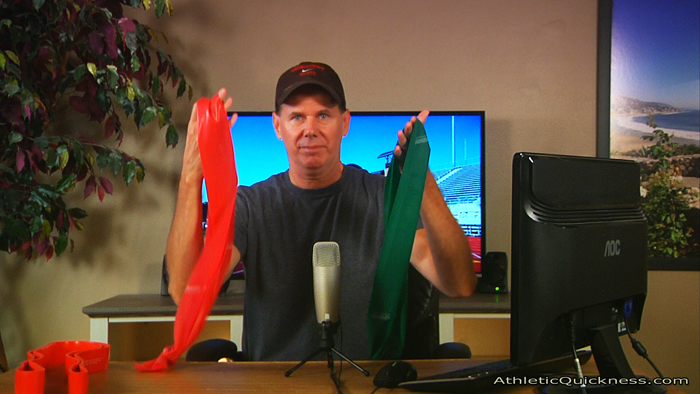
And not these thick, heavy body bands seen below as those are too strong and won’t very well. I like those band for other exercises, just not these as they will prove to be too stiff and you won’t get a good, dynamic pull with them.
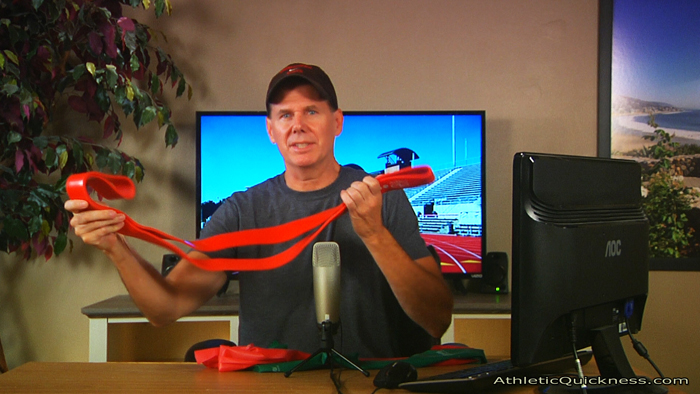
I’d also recommend you use the light or medium bands and if they are too weak, you can combine them, together to increase their strength.
An Encouraging Message
I want to finish up by saying that I encourage you to you give these exercises a chance, is simply this: “don’t let the simplicity of these exercises fool you. The results that hundreds of athletes have already gotten with them is absolutely staggering!”.
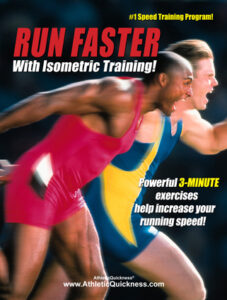
And the reason I can say with this with confidence is because these three exercises that you just saw, are actually a small part of our popular Run Faster program seen here.
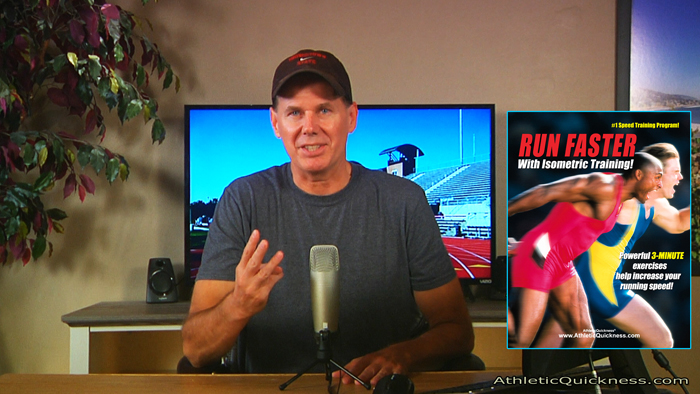
And if you are familiar with our website, then you’ve obviously seen the hundreds of testimonials we have received from athletes, perhaps just like yourself, who have already tried this program and became much faster.
A Sneak Peak Inside This Amazing Program!
So, you are essentially getting a sneak peek into that program with the opportunity to try a little of it before buying it to see if it works for you. And if it does, like I know it will, I hope that you’ll consider getting the full program really soon because, who doesn’t want more speed? Right. And it’s reasonably priced at only $29.95. So, that’s a pretty good deal!
Good Luck To You!
Okay, those are your instructions… Good Luck to you and please, report back to me either in the comment section below or by email and I’ll be sure to respond. And don’t forget
That’s it! For AthleticQuickness.com, I’m Dr. Larry Van Such.
❓ Frequently Asked Speed Training Questions
Q: How does this unweighted 9-minute speed challenge create an immediate stride turnover breakthrough?
A: Traditional weight room back squats, heavy leg presses, and field tire drags only condition a simple, straight-line pushing force through the hip joint. While your dominant stance leg detonates massive backward ground forces, our targeted isometric holds utilize light or medium bands to target all 7 hip flexor muscles simultaneously. This unweighted coordination schedule balances the intense rotational torque waves running across your pelvic grid, forcing the nervous system to release its active emergency brake so your linear pacing form can effortlessly accelerate.
Q: What deep core pathways are trained during these unweighted 15-second exercise holds?
A: Unlike ordinary gym weights that completely leave behind your deep swing-phase hip flexors, our protocol completely isolates your deep psoas and iliacus winches. By locking your skeleton into an authentic sprinting position against a fluctuating elastic band vector, your fast-twitch muscle fibers are forced to instantly coordinate under unstable shifts in band tension. This lifts the physical bottleneck keeping you stuck in first gear, allowing your sprint cycle to snap into a flawless net vertical torque equilibrium right from home.
Q: Can youth, high school, and pro athletes use this 6 days of training program?
A: Yes. This biomechanical target zone mapping applies universally across all track, court, and field sports. Whether you are an Olympian like Eric Harrison, a gridiron athlete like Shawn Jackson aiming to plummet your short-burst 40-yard dash marks to a pro-caliber 4.5s flat, or a competitor like Magan Hussain looking to shave massive ticks off your stopwatch timeline, committing to our 14-day speed challenge schedule creates game-breaking first-step acceleration down the track turf line.
Q: Will this specific resistance program help football players drop their short-burst 40-yard dash timeline?
A: Absolutely. Heavy weight room lifting builds an explosive engine on just one side of the pelvic axle, creating a severe strength-balance lopsidedness. If your deep hip flexor engine lacks the contraction velocity to match the massive forward torque of your pushing leg, your brain’s built-in neurological safety governor will actively throttle your speed downward to protect your skeleton. By strengthening the swing leg winches natively, you lift this neural restriction, secure an immediate get-off velocity evolution, and unlock elite trench and skill-position acceleration.
Q: How does targeting all 7 hip flexors translate to elite basketball court quickness and defensive redirection?
A: Basketball players are heavily bottlenecked by traditional conditioning drills that fail to isolate deep fast-twitch fibers at critical joint angles. True court acceleration depends on how quickly your central nervous system can reorganize your muscle mass instantly without a single millisecond of delay. Isolating your internal hip rotator mechanics alongside your psoas network builds the explosive lateral redirection capabilities needed to blow past defenders, lock down passing lanes, and maintain an out-of-body responsiveness all game long.
Q: Can soccer midfielders and strikers utilize these isometric holds to increase overall kicking power and pitch acceleration?
A: Yes. Forcing game-breaking quickness and crushing striking velocity requires building the skeletal transmission line that can handle your legs’ raw horsepower. When a soccer player uses our unweighted fast-twitch recruitment holds, they instantly activate the nervous system’s deep core pathways. This prevents your stride turnover from locking up under competitive pressure, allows you to beat your opponent to every loose ball, and directly doubles your long-distance striking power to smash crushing kicks past the goalie.
Q: Why do standard track overstriding drills fail to correct a stubborn mechanical plateau?
A: Standard dynamic exercises and superficial form drills cannot isolate deep fast-twitch fibers because your body naturally uses forward momentum to bypass your weakest joint angles. The Athletic Quickness system completely strips away momentum by forcing your muscles to detect unstable shifts in band tension. This removes your structural energy leaks down the straightaway track turf, raises your entire strength-balance ceiling, and allows your sprint mechanics to experience an immediate evolution without you ever having to consciously force the speed.
Q: Is this 90 second daily schedule safe for competitive masters track sprinters looking to recover top-end gear?
A: It is exceptionally safe. Because our isometric training strategy relies entirely on unweighted, high-tension resistance bands instead of high-impact jumping drills or slow gym machine lifts, it places zero compressive force on your joints. Masters sprinters like 67-year-old Glen Betts use these multi-planar pelvic torque balance holds to reclaim elite straightaway track dominance, bypass age-related speed decay, and set new personal records while keeping their lower limbs completely light and springy.
Q: What does using between 70-80% of your maximum strength mean during a high-velocity neural recruitment hold?
A: It means you must apply enough intense effort against the live elastic band vector that your target joint angles begin to tremble, making it highly difficult to maintain a steady skeletal position past the 10-second mark. If you can cruise through a 15-second exercise hold rather easily, your resistance bands are too weak. You must combine multiple light or medium bands together to scale up the tension, forcing your deep, neglected fast-twitch muscle fibers to instantly wake up and recruit maximum motor-unit power.
Q: How does this sneak peek connect directly to the full Flagship Run Faster Speed Package blueprint?
A: These three unweighted hip flexion exercises represent the foundational entry portal to our complete speed training system. While this 9-minute challenge targets your critical hip rotational speed variables, our full 38-page digital PDF manual and 10 high-velocity instructional exercise videos map out the complete multi-axis pelvic grid extension formula. Securing the full training package gives you the comprehensive step-by-step layout formulas utilized by national-caliber track, court, field, and gridiron athletes to shatter stubborn personal sprint plateaus permanently.
Q: How does this unweighted isometric protocol drop explosive start times in short-burst football combines like the 40-yard dash?
A: Initial acceleration out of a static stance depends heavily on overcoming resting inertia before forward momentum can assist your stride. While traditional heavy power lifts focus exclusively on the linear drive of your pushing leg, the Athletic Quickness bands target the simultaneous upward firing velocity of your swing leg flexors. Equalizing this force relationship at your very first step prevents an immediate get-off bottleneck, forcing a massive, pro-caliber timeline reduction on your short-burst 40-yard dash combine logs.
Q: Can short-space court and track competitors use these neural recruitment holds to break velocity plateaus in the 60m and 100m sprint?
A: Yes. Maximum velocity in short-space sprints like the 60m and 100m dash requires an extreme rate of fast-twitch motor unit recruitment. Traditional weight lifting and repetitive high-volume track laps cause your fast-twitch fibers to passively acquire slow-twitch traits, locking you into a stubborn mechanical plateau. Paired with high-tension bands, these 15-second unweighted holds force the nervous system to bypass its slow habits, raising your strength-balance ceiling so your turnover snaps forward natively down the straightaway track turf.
Q: How does balancing pelvic torque constants maintain late-race top-end velocity throughout the curve of a 200m and 400m dash?
A: Maintaining speed across the centrifugal forces of a 200m track curve or down the home stretch of a intense 400m dash requires a flawless pelvic torque equilibrium. When an athlete experiences late-race fatigue, the brain detects any underlying strength deficit across the pelvic axle and instantly triggers its built-in safety governor. Upgrading your front-side core winches ensures your upper-body torque multiplier stays perfectly aligned with your lower limbs, preventing early stride decay and allowing you to effortlessly maintain your top gear.
Q: In what way does upgrading your skeletal transmission fix the mid-race pace collapse inside an 800m run?
A: The sudden pace collapse frequently experienced by middle-distance runners during the critical second lap of an 800m run is a neurological protection reflex, not a lack of lung capacity. Traditional high-volume training laps hyper-develop your pushing engines while leaving your deep hip flexors dormant and starved of raw authority. Strengthening these front-side core winches lifts this neural restriction completely, correcting your stride reactivity phase so you can execute a devastating bell-lap kick without locking up.
Q: Will this 14-day speed challenge schedule drop stopwatch timelines for distance track athletes executing a finishing kick in the 1500m and 1600m mile?
A: Absolutely. Shaving critical ticks off your stopwatch timeline down the final straightaway of a grueling 1500m or a competitive 1600m mile requires instant access to high-velocity fast-twitch muscle fibers. Committing to our 6 days of training program over a 14-day speed challenge schedule systematically removes hidden structural energy leaks down the backstretch. It allows long-distance runners to seamlessly transition from slow-twitch pacing gears into an explosive, game-breaking finishing kick off the final turn.
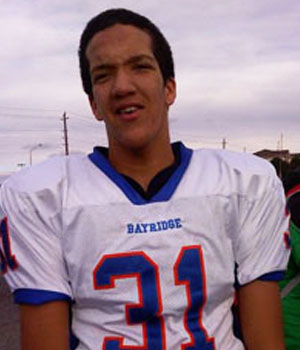
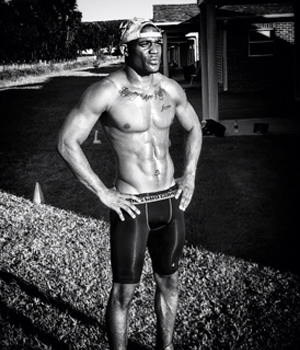
More great people who have taken our first speed challenge and eventually used the full program to achieve amazing results. Nice work Jordan and DJ!
Only $29.95!
Our First Speed Training Challenge Video is Below.
🚀 Choose Your Next Speed Breakthrough Phase:
👉 How to Run Faster: 7 Things That Actually Matter
👉 Isometric Training for Speed: The Complete System to Run Faster