Home » Running Muscles for Speed » Running Muscles for Speed: The Complete Guide to Sprint Faster
If you want to run faster, you need to understand one thing:
👉 Speed is not just about effort — it’s about which muscles you train.
Most athletes spend years working hard…
but unknowingly neglect the very muscles responsible for speed.
The result?
- Limited acceleration
- Poor top-end speed
- Plateaus that never seem to break
Let’s fix that.
⚡ Why Most Athletes Fail to Improve Speed
Traditional training focuses on:
- Squats
- Deadlifts
- Sprints
- Conditioning
These have value—but they miss a critical piece.
👉 Many of the muscles that control speed are:
- underdeveloped
- poorly activated
- rarely trained directly
Which means:
👉 You’re not using 100% of your speed potential
🧠 The Missing Link: Fast Twitch Muscle Activation
Speed comes from fast twitch muscle fibers.
These fibers control:
- explosive movement
- rapid contraction
- acceleration and stride turnover
But here’s the problem:
👉 Most training methods don’t properly target them
Instead, they:
- overload slow-twitch systems
- rely on repetition instead of contraction speed
🔑 The Most Important Running Muscles for Speed
When it comes to building real speed, your body must work as a coordinated system.
At the core of that system are:
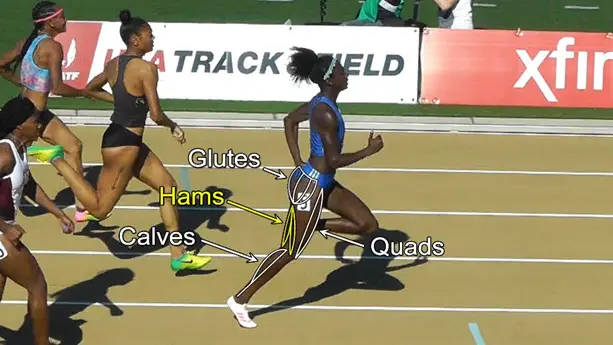
👉 glutes, hams, quads and calves
When these muscles are trained correctly—and in sync—speed becomes a natural result.
🦵 1. Hip Flexors (MOST IMPORTANT)
The hip flexors are responsible for:
- Driving your knee upward
- Controlling stride frequency
- Maintaining posture and balance
👉 There are 7 major hip flexor muscles on each side
Yet:
👉 Most athletes NEVER train them properly
This is one of the biggest reasons athletes struggle with speed.
🍑 2. Glutes
Your glutes are your primary power generators.
They:
- drive forward propulsion
- support acceleration
- stabilize your stride
Weak or poorly activated glutes = slower speed.
🦵 3. Hamstrings
The hamstrings:
- extend the hip
- assist in ground contact
- contribute to stride power
But they must work in coordination, not just strength.
🦿 4. Quadriceps
The quadriceps play a critical role in:
- Knee extension during push-off
- Supporting force production during acceleration
- Stabilizing the leg during ground contact
While many athletes train their quads heavily through traditional strength exercises, they often miss how the quads function in high-speed movement.
👉 It’s not just about strength
👉 It’s about timing, coordination, and speed of contraction
When trained properly alongside the glutes and hamstrings, the quads help:
- Improve stride efficiency
- Enhance force transfer through the leg
- Support faster turnover and acceleration
🦶 5. Calves
The calves:
- control foot strike
- contribute to push-off
- support rapid ground contact
Often trained for endurance—not speed.
🚨 Why Traditional Training Falls Short
Most programs rely on:
- weights (gravity-based resistance)
- repetitions
- endurance-style work
This creates a problem:
👉 Resistance is strongest at the end of movement, not throughout
Which means:
- muscles are not trained evenly
- coordination suffers
- speed-specific contraction is ignored
⚡ The Better Approach to Training Running Muscles
To truly improve speed, you need to:
👉 Train muscles at multiple points in their range of motion
👉 Focus on contraction speed, not just force
👉 Activate underused muscle groups (especially hip flexors)
🔁 Why Isometric Band Training Works
Resistance bands provide:
- variable resistance
- multi-angle force
- continuous muscle activation
Isometric training allows you to:
- target exact positions in movement
- activate fast twitch fibers
- improve neuromuscular coordination
🏁 What Happens When You Train the RIGHT Muscles
When you properly train:
👉 glutes, hams, quads and calves
👉 along with your hip flexors
You begin to see:
- Faster stride turnover
- Improved acceleration
- Greater efficiency with less effort
And often:
👉 Results appear in days or weeks — not months
🧠 The Big Takeaway
👉 Most athletes don’t need more training
👉 They need better targeted training
When you activate all the muscles involved in speed:
👉 You unlock performance that was already there
🚀 Start Training Smarter
If you’re serious about improving your speed:
👉 Focus on:
- muscle activation
- contraction speed
- full-body coordination
Because:
👉 Speed is built — not just earned
❓ Frequently Asked Questions About Running Muscles for Speed
🏃♂️ What muscles are most important for running faster?
The most important muscles for speed are the hip flexors, glutes, hamstrings, quadriceps, and calves.
These muscles work together to control:
- stride length
- stride frequency
- ground force production
👉 When properly trained as a system, they allow you to run faster with greater efficiency.
⚡ Why are hip flexors important for speed?
The hip flexors are critical because they control how quickly your knees drive upward during sprinting.
Faster knee drive = faster stride turnover.
👉 Most athletes neglect hip flexor training, which limits their ability to reach top speed.
🧠 What muscles do most athletes fail to train for speed?
Most athletes undertrain:
- hip flexors
- stabilizing muscles involved in coordination
- muscles responsible for rapid contraction
👉 Traditional workouts often focus on strength, not speed-specific muscle activation.
🏋️ Do stronger muscles automatically make you faster?
No. Strength alone does not guarantee speed.
👉 Speed depends on:
- how quickly muscles contract
- how well they coordinate
- how efficiently force is applied
You can be strong—but still slow if your muscles are not trained for speed.
🔁 How do glutes, hams, quads and calves work together?
These muscles form the primary lower-body chain for running:
- Glutes → generate power
- Hamstrings → assist in propulsion and control
- Quadriceps → stabilize and extend the leg
- Calves → control push-off and ground contact
👉 When trained together, they improve acceleration, efficiency, and speed.
⏱️ How quickly can you improve running speed?
When the correct muscles are activated and trained properly, improvements can happen quickly—sometimes within days or weeks.
👉 This is especially true when previously undertrained muscles (like hip flexors) are targeted.
🧪 What is the best way to train running muscles for speed?
The most effective approach includes:
- targeting muscles at multiple positions
- using variable resistance (like bands)
- focusing on contraction speed
- improving coordination between muscle groups
👉 This helps activate fast twitch muscle fibers and improve performance.
🚫 Why doesn’t traditional weight training improve speed as much?
Traditional weight training is often:
- gravity-based
- repetition-focused
- strongest at the end of movement
👉 This does not fully replicate how muscles work during sprinting.
Speed requires:
- consistent tension
- rapid contraction
- full-range coordination
🏃♀️ Can beginners improve speed by training these muscles?
Yes. Beginners often see rapid improvement because:
👉 many of their speed-related muscles are underdeveloped or unused
Once trained correctly, these muscles can produce quick and noticeable gains.
🎯 What is the biggest mistake athletes make when trying to run faster?
The biggest mistake is:
👉 focusing on effort instead of muscle function
Athletes often:
- train harder
- do more drills
- increase volume
But fail to train the muscles that actually create speed.