
Home » Running Muscles for Speed » RUNNING MUSCLES FOR SPEED: What Actually Matters (And What Doesn’t)
🧠 Introduction
Most athletes think getting faster comes down to building stronger running muscles.
• Stronger glutes
• Stronger hamstrings
• More power
And while those can help…
💥 that alone doesn’t explain speed.
Because speed is not determined by your strongest muscles.
👉 It is determined by how well your system produces, transfers, and organizes force.—
⚡ how well your entire system works together.
And for many athletes…
👉 that changes everything.
⚠️ The Mistake Most Athletes Make About Speed Muscles
Traditional training often treats speed like a force problem.
Push harder.
Produce more force.
Get stronger.
👉 But running speed is not just about producing force.
It is about:
• producing force
• transferring force
• coordinating force
• repeating that cycle rapidly
💥 That requires more than powerful muscles.
👉 It requires a coordinated system.
💥 And systems break at their weakest link.
⚡ That is often what limits speed.
Not effort.
Not motivation.
Not even strength.
💥 But a missing link in how the system functions and connects.
🔑 The Functional Roles That Matter Most for Speed
Running speed is not created by isolated muscles.
👉 It is created by functional roles working together.
Some muscles produce force.
Some transfer it.
Some organize how it is used.
💥 All matter.
🦵 1. Hip Flexors — The Hidden Speed Limiter
Most athletes think speed comes from how hard the stance leg pushes.
👉 But that is only part of the system.
💥 The other part is how fast the swing leg can drive the next step into position.
This is often referred to as the swing phase—
⚠️ but it is not passive.
⚡ The leg is actively accelerating forward into the next stride.
Most athletes focus on force production.
Very few focus on:
👉 how fast the system can cycle.
The push leg may help determine force output.
⚡ The swing leg may help determine speed ceiling.
And for many athletes…
💥 that is the hidden limiter.
➡️ Hip Flexor Muscles for Speed: What Actually Makes You Run Faster
🍑 2. Glutes — Force Producers, Not Speed By Themselves
Glutes help generate force.
Important?
👉 Absolutely.
But force alone does not guarantee speed.
Because force only helps…
👉 if the rest of the system can use it.
👉 otherwise, that force never becomes usable speed.
💥 That’s where many athletes get stuck.
➡️ Glute Muscles for Running Speed: Why Strength Alone Doesn’t Translate to Speed
🦵 3. Hamstrings — Where Power Meets Timing
Hamstrings do more than help propel you.
They help connect:
• force production
• movement control
Power…
⚡ plus timing.
👉 They help determine when force can be used—not just how much is created.
That combination matters.
➡️ Hamstring Muscles for Running Speed: Power, Timing, and System Balance
🦿 4. Quadriceps — Stability Most Athletes Misunderstand
The quads do more than produce force.
👉 They help stabilize how force is applied
👉 and help direct that force efficiently through the stride
Without stability…
💥 power leaks.
That’s a hidden performance limiter.
➡️ Quadriceps Muscles for Running Speed: Power, Stability, and Control
🦶 5. Calves — Where Speed Meets the Ground
Most athletes think speed is created by how hard you push.
💥 But speed also depends on what happens when your foot hits the ground.
That’s where the calves become critical.
They help govern:
• timing
• efficiency
• force transfer
⚡ Every step is a force exchange with the ground.
And the calves help manage how efficiently that exchange happens.
If ground contact is inefficient…
👉 energy leaks immediately.
If timing is off…
👉 speed suffers.
💥 Often more than athletes realize.
➡️ Calf Muscles for Running Speed: Ground Contact, Timing, and Efficiency
💪 6. Shoulder Flexors + Extensors — The Overlooked Coordinators
Running is not lower body only.
👉 Arm action helps organize the system.
Forward arm drive.
Backward arm drive.
💥 Both help organize how the system moves.
➡️ Shoulder Flexor Muscles for Running Speed
➡️ Shoulder Extensor Muscles for Running Speed
🧱 7. Hip Extensors — Powerful, But Often Overemphasized
Many programs overbuild the push phase.
And assume:
👉 more push = more speed
Often…
❌ it doesn’t.
Because strong push muscles can still be limited by the rest of the system.
💥 Because propulsion must be coordinated—not just produced.
➡️ Hip Extensor Muscles: Why They Don’t Make You Faster Alone
🔄 8. Spine Rotators — The Hidden Connector
This is where many athletes have never looked.
Rotation helps connect:
• upper body
• lower body
• force transfer
👉 helping connect upper and lower body actions
Without it…
⚠️ the system leaks energy.
And speed suffers.
💥 This may be one of the most overlooked speed factors of all.
➡️ Spine Rotator Muscles for Running Speed
⚖️ The Rule That Determines Your Speed
👉 Your speed is rarely determined by your strongest muscles.
👉 It is often determined by the factor limiting the system.
💥 The system does not outperform its weakest link.
👉 And it does not hide it for long.
That may be:
• undertrained hip flexors
• poor force transfer
• inefficient ground interaction
• weak rotational connection
• coordination breakdown
Fix the limiter—
⚡ and speed often changes quickly.
⚡ What Actually Improves Speed?
Not just stronger muscles.
👉 A better operating system.
👉 One that can use more of the force you already have.
Speed improves when your system can:
• coordinate more efficiently
• cycle faster
• transfer force better
• stay balanced at higher output
💥 That is different than simply getting stronger.
And often…
far more important.
🚀 Train Functional Roles — Not Isolated Parts
Most athletes train muscles.
👉 But performance is built by training functions.
• Force production
• Force transfer
• Coordination
• Timing
👉 This is the difference between training muscles and training performance.
That is a different model.
And it leads to different results.
🧭 You Are Here (Within The AQ Speed Training System)
You are currently exploring:
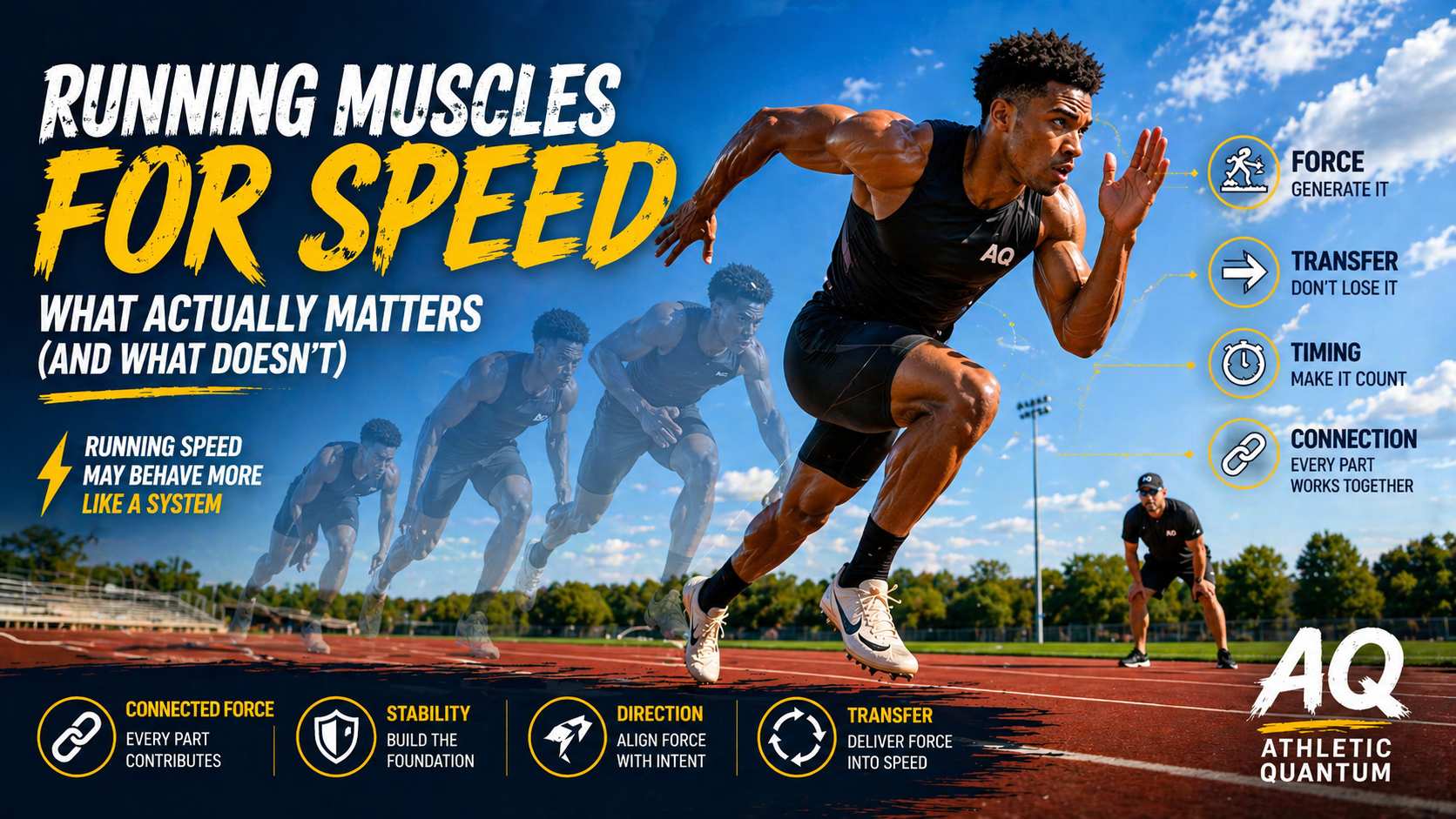
👉 RUNNING MUSCLES FOR SPEED: WHAT ACTUALLY MATTERS (AND WHAT DOESN’T): an overview of the major muscle groups involved in running speed and how AQ views their functional roles within the sprint system.
🌐 See How This Fits Into The Complete AQ Speed Training System
➡️ RUNNING MECHANICS EXPLAINED: The System That Makes You Faster
🚀 Ready to Run Faster?
👉 When you’re ready to apply these principles to improve your running speed:
➡️ Run Faster With Isometric Training
❓ Frequently Asked Questions
What muscles matter most for running speed?
👉 No single muscle determines speed.
Speed depends on how the system works together.
Do stronger legs automatically make you faster?
❌ No.
Strength helps.
💥 But coordination determines how much of that strength becomes speed.
What muscle limits speed the most?
👉 Often it is not one muscle…
but a weak link in system balance.
Are hip flexors important for speed?
✅ Yes.
For many athletes…
💥 they may be the missing piece.