
Home » Speed Training Science » Why Getting Bigger Can Actually Make You Slower (The Science Explained)
🧠 Introduction
Most athletes assume:
• more muscle means more speed
• more size means more power
• more strength means better performance
👉 And to a point, those can help.
A stronger athlete usually has greater speed potential.
💥 But sprint speed does not increase from size alone.
That surprises many athletes.
Because some athletes get:
• stronger
• more muscular
• more explosive in the gym
👉 yet sprint speed barely improves.
Sometimes sprinting even starts feeling:
• heavy
• restricted
• slower between steps
• harder to open up
Why?
Because the issue is often NOT that the athlete became “too muscular.”
💥 The issue is developing force in one part of the body faster than the rest of the body can continue supporting it.
That is a huge AQ distinction.
⚡ Sprint Speed Depends On More Than Muscle Size
Muscle can absolutely improve:
• force potential
• power output
• durability
• athletic capacity
👉 Those are valuable athletic qualities.
But sprint speed depends on more than producing force.
During sprinting:
• the pushing leg drives aggressively backward
• the swing leg attacks aggressively forward
• the arms twist to support movement
• the torso rotates to connect both sides of the body
👉 all continuously.
💥 Speed depends on how well all of these aggressive movements continue supporting each other while sprinting.
That is the key.
Because sprint speed is not simply about adding more muscle.
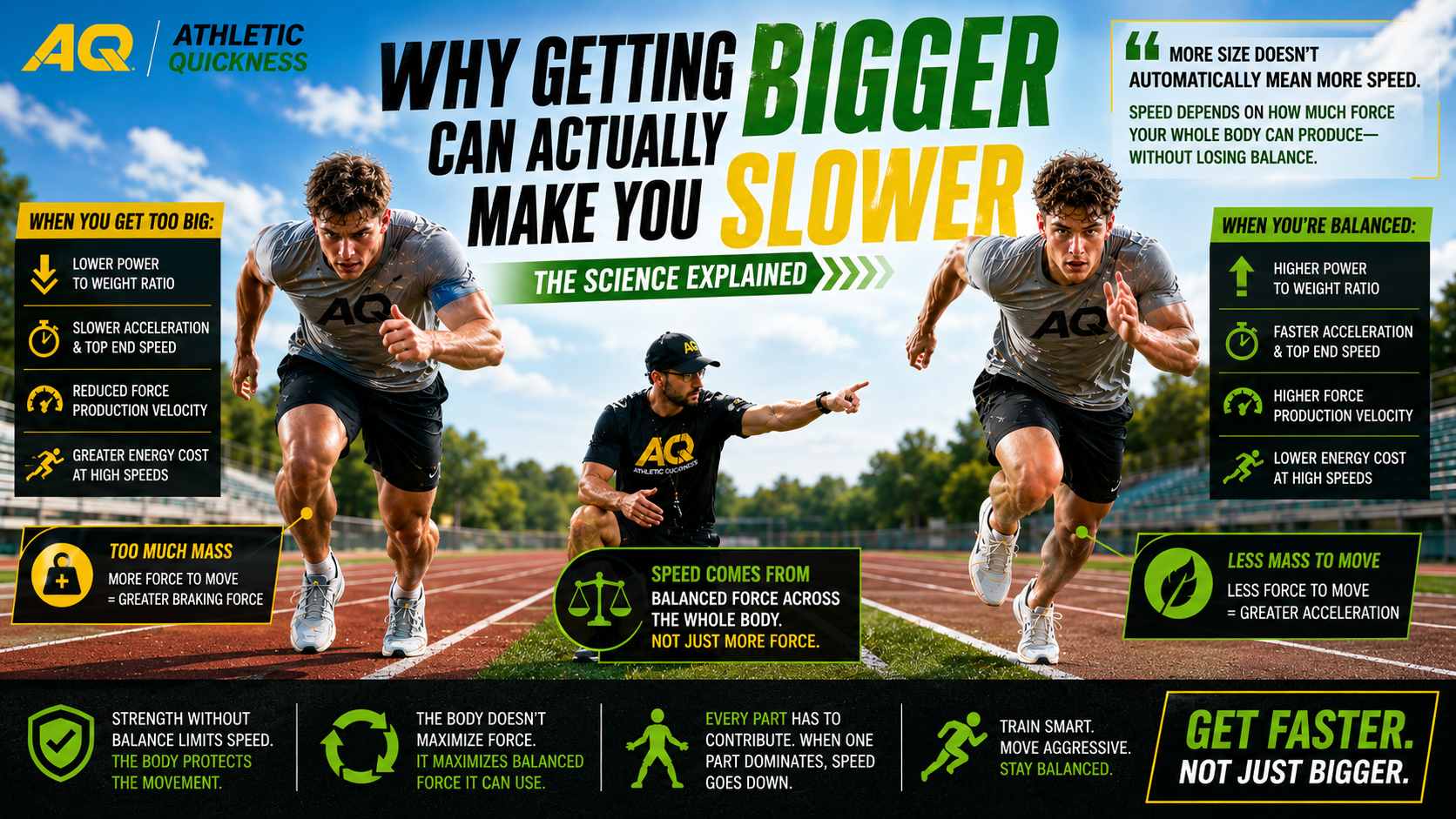
💥 Faster sprinting speed depends on how much force the body can produce while staying balanced during aggressive movement.
🔄 Why More Muscle Can Sometimes Reduce Speed
This is where many athletes get confused.
They assume:
👉 more muscle should automatically improve sprint speed.
Not necessarily.
Because if muscle growth improves force production faster than:
• movement balance
• swing-side support
• torso rotation
• arm-action timing
• movement continuity
👉 sprint movement can begin losing fluidity.
And when sprint movement loses balance,
👉 the body often suppresses aggressive movement to protect the system.
That can make sprinting feel:
• tight
• heavy
• forced
• less responsive
even while force potential improves.
💥 The body does not simply maximize force.
It maximizes force the sprint system can still balance safely and continuously.
That is one of the biggest AQ realizations.
🏃 Why Some Athletes Feel “Powerful But Slower”
You see this all the time.
An athlete gains:
• muscle size
• strength
• gym explosiveness
👉 but sprinting starts feeling worse.
Why?
Because sprint movement is not just about output.
It is about whether the entire body can continue supporting aggressive movement as force rises.
If one contributor begins overpowering the rest of the sprint movement:
• turnover may tighten
• rhythm may break down
• movement may feel restricted
• sprint fluidity may decrease
👉 even while strength improves.
This is why athletes often say:
• “I feel stronger but slower”
• “I feel heavy sprinting”
• “I can’t open up anymore”
• “my legs feel powerful but slow”
💥 The sprint system is protecting movement balance.
Not simply maximizing output.
Huge distinction.
🚨 Bigger Muscles Are Not The Problem
Important clarification.
This article is NOT anti-muscle.
Far from it.
Muscle can absolutely improve athletic performance.
💥 The issue is not muscle itself.
👉 The issue is developing force faster than the rest of sprint movement can continue supporting cleanly.
That is where many athletes run into problems.
Because sprint speed depends on whether:
• the pushing leg
• the swing leg
• the torso
• the arms
👉 can continue supporting each other as aggressive movement rises.
That is where many athletes finally realize:
👉 becoming bigger and becoming faster are not automatically the same thing.
🧠 Injuries Reveal This Principle Clearly
This becomes very obvious during injuries.
For example:
• shoulder injuries
• abdominal strains
• torso restrictions
• arm limitations
may not dramatically affect your squat.
👉 But they often affect sprint speed immediately.
Most athletes already know this intuitively.
Even without testing,
they can usually FEEL sprint movement becoming:
• restricted
• guarded
• disconnected
• less fluid
Why?
Because one movement contributor inside the sprint equation weakened.
And when one contributor weakens,
👉 the rest of the sprint movement often reduces output to protect balance.
That is a major URSE principle.
💥 Faster sprinting speed depends on how much force the body can produce while staying balanced during aggressive movement.
So when one contributor becomes compromised,
👉 the entire sprint system often reduces aggressive movement to preserve balance.
That is why athletes often feel:
• unable to fully open up
• unable to sprint naturally
• tight under speed
• restricted between steps
even when the injury seems “small.”
💥 Sprint speed depends on balanced aggressive movement support across the entire body.
Not isolated force alone.
🔑 What Speed Athletes Often Need Instead
If sprint speed depends on:
• movement balance
• aggressive swing action
• rotational support
• continuous movement timing
• force staying organized under speed
👉 then training should improve those qualities too.
Not just muscle size.
That changes priorities completely.
And it explains why some athletes improve speed dramatically:
👉 without massive increases in muscle mass.
Because sprint speed often improves from:
• better force organization
• better movement continuity
• better movement balance
• better aggressive movement support under force
💥 That is where many real speed breakthroughs happen.
💥 What This Means For Speed Training
This is the real takeaway.
The goal is NOT:
❌ avoid strength
❌ avoid muscle
❌ avoid force development
The goal is:
💥 increase force while preserving balanced aggressive movement.
That is a completely different target.
And honestly?
That is where AQ separates from many traditional speed discussions.
Because sprint speed is not just force production.
💥 Sprint speed depends on how much force the body can produce while staying balanced during aggressive movement.
That is the reframe.
That leads naturally into:
➡️ Why This Type of Speed Training Works (The Science Behind It)
🚀 What This Means For You
Most athletes chase more muscle hoping speed will automatically rise.
👉 But sprint speed often improves when the body becomes better at supporting aggressive movement balance as force rises.
That means:
• the swing side continues matching the push side
• torso rotation stays connected under speed
• arm timing continues supporting movement
• sprint rhythm stays fluid under increasing force
💥 Fast sprinting is not just about becoming more powerful.
💥 It is about becoming more balanced while expressing higher force.
That is where speed often changes.
🧭 You Are Here
You are currently exploring:
👉 WHY GETTING BIGGER CAN ACTUALLY MAKE YOU SLOWER: how sprint speed depends on whether aggressive movement can continue staying balanced and supported as force and muscle output rise.
🌐 See how this fits into the complete AQ speed system:
Learn how AQ approaches:
force production,
movement support,
timing between steps,
strength balance,
and sprint speed development.
➡️ SPEED TRAINING SCIENCE: Why Most Methods Fail (And What Actually Works)
🪜 Continue Deeper Into Sprint Force Balance:
Learn what actually creates sprint force and why sprint speed depends on more than isolated muscular output.
➡️ What Actually Creates Force in Running? (And Why Most Athletes Get It Wrong)
Learn why traditional strength improvements do not always transfer cleanly to sprint performance.
➡️ Why Traditional Training Can Make You Stronger—But Not Always Faster
Learn how rotational support relationships help maintain movement continuity and force balance during aggressive sprinting.
➡️ How Torque Through The Hips Creates Speed, Power, and Athletic Performance
🚀 Ready To Run Faster?
If you are ready to turn this information into real speed:
➡️ Run Faster With Isometric Training
❓FAQ
Does building muscle automatically make you slower?
No.
💥 The issue is whether sprint movement can continue supporting rising force while staying balanced.
Why do some athletes feel heavier after gaining muscle?
Because sprint movement may become less fluid if force rises faster than movement balance improves.
Can strong athletes still be fast?
Absolutely.
👉 The goal is increasing force while preserving movement balance and continuity.
Why does sprinting sometimes feel restricted after bulking?
Because the sprint system may begin suppressing aggressive movement to protect balance.
What should speed athletes prioritize?
👉 Force production,
movement balance,
continuous movement timing,
and aggressive movement staying supported under speed.