
Home » Running Muscles for Speed » Spine Rotator Muscles for Running Speed: How Rotation Connects Your Entire System
🧠 Introduction
Most athletes think speed is produced by pushing harder into the ground.
👉 more force
👉 more power
👉 more stride
And yes—
those matter.
💥 But what if speed may depend on more than force production alone?
What if part of running speed is organized through coordinated torso rotation?
That changes the conversation.
⚠️ The Missing Ingredient Many Speed Models Ignore
Most speed instruction focuses on:
push
stride length
turnover
All valuable.
And all incomplete on their own.
But many athletes rarely think about what may connect those things.
👉 coordination.
More specifically—
rotational coordination.
And that may matter more than most athletes realize.
🔑 Why Spine Rotators May Matter More Than You Think
Most people hear “rotation”
and think unwanted twisting.
Something to reduce.
Something inefficient.
💥 But what if effective rotation may help support speed?
💥 That is a very different model.
Because rotation may not simply be motion happening during running—
⚡ it may help organize how motion is expressed.
That matters.
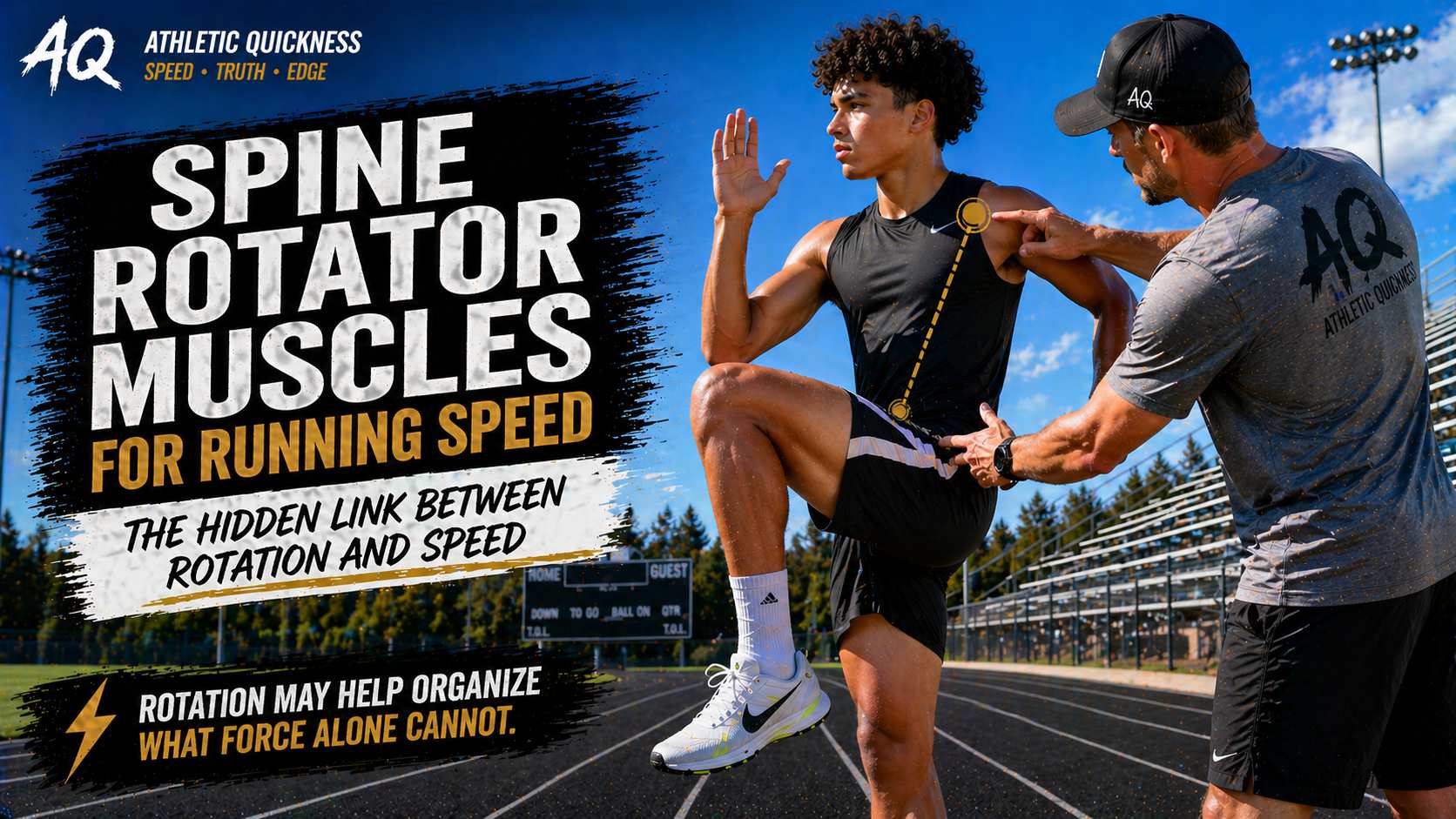
💥 What If Rotation Helps Organize What Force Alone Cannot?
This may be the hidden mechanism.
Force can create potential.
But what helps direct it—
coordinate it—
transfer it?
💥 What if rotation may help organize what force alone cannot?
That may be one hidden layer of speed.
🔄 Speed May Be Partly A Rotational Event
Many think speed is linear.
Straight ahead.
Forward only.
⚡ What if part of speed is rotational?
Not because athletes are spinning—
but because rotational relationships may help support how speed is expressed.
💥 That is a complete shift in how speed is understood.
🧩 Why More Force Alone May Not Solve Speed
More force can raise potential.
But if timing leaks…
If coordination breaks down…
If rotational transfer is inefficient…
👉 more force may not become more speed.
Many athletes live there.
⚡ Opposing Actions May Need A Hidden Organizer
Push (glutes) and swing (hip flexors).
Arm (shoulders) and leg.
Front side and back side.
These may not simply coexist independently.
They may need organizing.
💥 Spine rotators may help support that hidden organization.
And that may be overlooked.
🚀 What This Means For You
Train speed as more than propulsion.
👉 Train it as a coordinated system.
That means improving:
• rotational coordination
• force transfer
• torso-hip timing
• opposing action integration
👉 Not just stronger—but better connected across the entire system.
⚡ Rotation may help organize what force alone cannot.
➡️ How to Run Faster: The Complete Guide to Improving Speed Step by Step
🧭 You Are Here (Within The AQ Speed Training System)
You are currently exploring:
👉 SPINE ROTATOR MUSCLES FOR RUNNING SPEED: HOW ROTATION CONNECTS YOUR ENTIRE SYSTEM: why coordinated torso rotation may help organize force transfer, timing, and whole-body movement during running.
🌐 See How This Fits Into The Complete AQ Speed Training System
👉 Discover how the spine rotators fit alongside the other major muscle groups involved in running speed.
➡️ RUNNING MUSCLES FOR SPEED: What Actually Matters (And What Doesn’t)
🪜 Continue Deeper Into Running Muscles for Speed
Learn how the shoulder flexors help coordinate arm drive, torso rotation, and whole-body movement during running.
➡️ Shoulder Flexor Muscles for Running Speed: Arm Drive, Rotation, and Coordination
Learn why the shoulder extensors help support balanced arm action and coordinated running mechanics.
➡️ Shoulder Extensor Muscles for Running Speed
🚀 Ready to Run Faster?
👉 When you’re ready to apply these principles to improve your running speed:
➡️ Run Faster With Isometric Training!
❓ Frequently Asked Questions
Do spine rotator muscles affect running speed?
👉 Potentially—especially through coordination and force transfer.
Does rotation matter in sprinting?
💥 It may matter more than many athletes realize.
Isn’t rotation something runners should minimize?
⚠️ Uncontrolled motion may be a problem.
But effective rotational relationships may support speed.
Different idea.
Can coordination limit speed even when an athlete is strong?
Absolutely possible.
Strength and coordination are not the same.