

Home » Speed Training Science » SPEED TRAINING SCIENCE: Why Most Methods Fail (And What Actually Works)
🧠 Introduction
If you’ve been trying to get faster, you may have:
• lifted weights
• done sprint drills
• trained consistently
• worked extremely hard
👉 and still felt your speed plateau.
That is frustrating.
But often the issue is not:
❌ effort.
💥 The issue is misunderstanding what actually helps the body run faster.
Many athletes think running faster mostly comes from:
• stronger muscles
• pushing harder with one leg
• longer workouts
• more effort
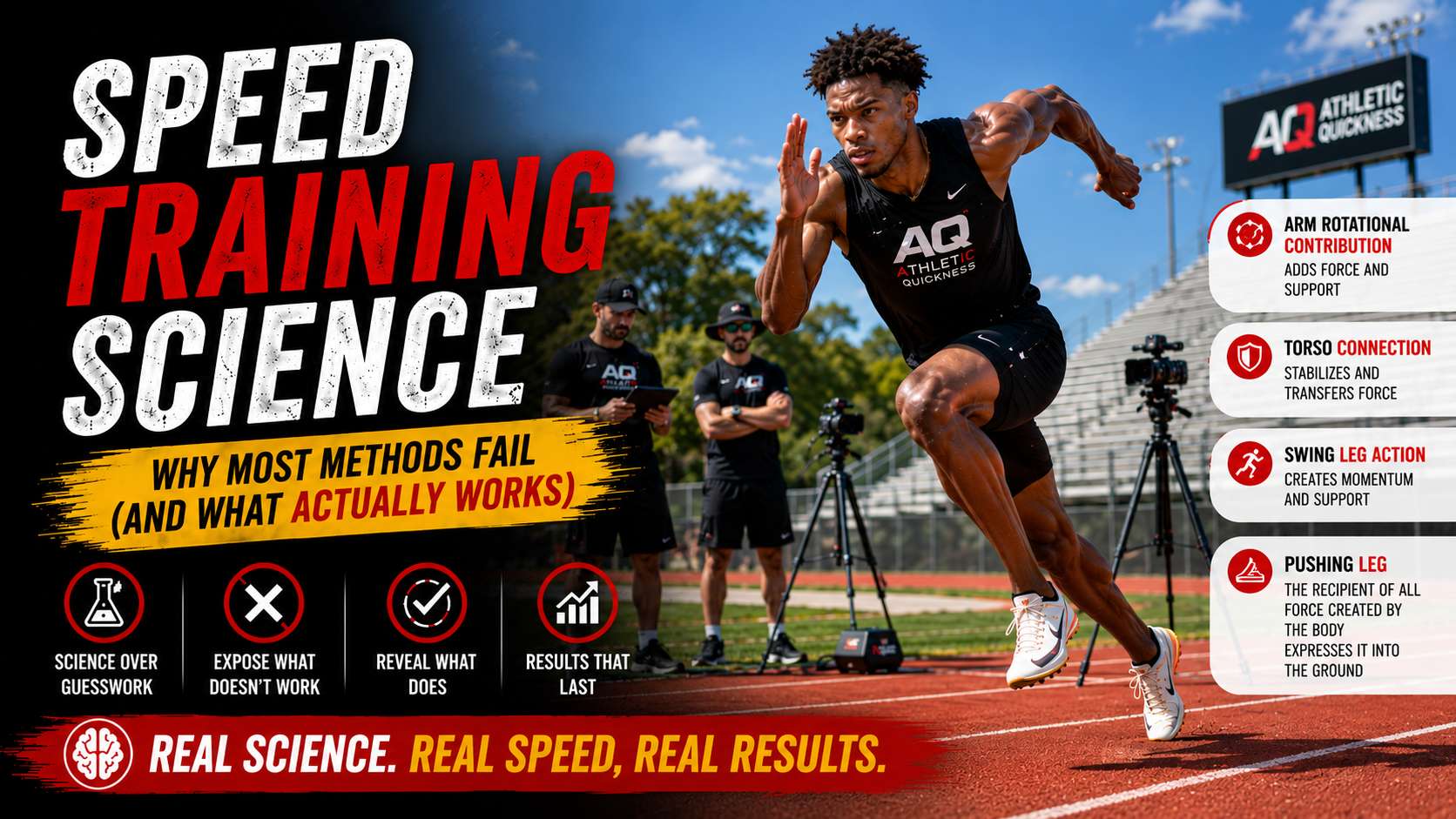
👉 But faster running speed also depends on how much support the pushing leg receives from the rest of the body (swing leg, arms, torso).
That is a massive distinction.
Because during running:
👉 not only does:
• the pushing leg aggressively drive backward into the ground
👉 but also:
• the arms must aggressively support this pushing-leg force
• the torso must rotate to support these force expressions even more
• while the swing leg thrusts forward keeping everything in balance
👉 all simultaneously.
And the faster you try to run,
👉 the harder it becomes for your whole body to continue supporting those aggressive movement relationships cleanly.
That is one of the biggest AQ principles overall.
Many athletes train:
• isolated muscles
• isolated drills
• isolated athletic qualities
💥 while missing how running speed actually functions as a connected whole-body movement system.
💥 The Pushing Leg Gets Most Of The Attention
Many speed programs focus heavily on:
• strength
• conditioning
• harder effort
• more explosive output
Helpful?
Absolutely.
Sufficient for maximum running speed?
👉 Not always.
Because running faster is not simply:
❌ producing more push force with one leg.
The pushing leg matters enormously.
👉 AQ absolutely believes that.
The pushing leg is still the final point where force enters the ground.
👉 But most athletes focus most of their speed training on improving the pushing leg itself.
So when they try to run faster,
👉 their reliance ends up being placed heavily on this one part of the body.
That is where many athletes get stuck.
💥 The Pushing Leg Does Not Work Alone
But AQ views running differently.
AQ separates:
• single-leg push force
from
• whole-body push support through the pushing leg
That distinction changes running completely.
💥 AQ believes the pushing leg depends heavily on support from the rest of the body in order to push harder successfully.
Which means:
• the swing leg matters
• the arms matter
• the torso matters
• balance relationships matter
• timing between steps matters
👉 because all of them contribute support into the pushing leg during running.
That is massively important.
Because the pushing leg becomes the final recipient of force generated not only by itself, but also that of the force supplied by the swing leg, arms, and torso during movement.
Huge distinction.
Because some athletes improve:
• strength output
• force potential
• muscular power
👉 while running speed barely changes.
👉 Why?
Because your body will still struggle to produce higher levels of pushing force needed to run faster, if:
• swing leg strength lags behind
• arm support strength lags behind
• torso support strength lags behind
👉 That is where many traditional methods fall short.
🧠 Why Stronger Legs Alone Do Not Always Create Faster Running
Many athletes assume:
👉 stronger pushing legs automatically create faster running.
But that is not always what happens.
Because stronger pushing legs alone do not automatically create faster running if:
• swing timing collapses
• arm support breaks down
• torso balance breaks down
• movement continuity breaks down
👉 under rising speed demands.
💥 Running faster is not only about generating more force from the pushing leg.
👉 it also depends on how much force the rest of the body can contribute into that pushing leg.
That is one reason athletes can become:
• stronger
• more explosive
• more powerful
👉 without their running speed rising equally.
🔄 Why Running Speed Is A System—Not Separate Parts
This is huge.
The body does not run in isolated pieces.
During running:
• the pushing leg aggressively creates a pushing force into the ground
• the arms rotate to support the pushing leg
• the torso helps transfer the arm support into the pushing leg
• while the swing leg thrusts forward keeping everything in balance
👉 continuously.
And all of those relationships must remain supported while force rises.
That is massively important.
Because the faster running becomes,
👉 the harder it becomes to continue supporting those aggressive movement relationships cleanly under force.
That is one reason athletes plateau.
Not because effort disappears.
💥 But because the strength contributions required to run faster by all members of the body may not rise high enough together to support faster running speeds.
And when that happens,
👉 the body often begins suppressing aggressive movement expression to protect balance and movement continuity.
That is hugely important.
Because many speed plateaus are not simply:
❌ “lack of effort.”
💥 They are often support limitations inside the body itself.
Related:
👉 To see how rotational relationships help organize movement through the body:
➡️ How Torque Through The Hips Creates Speed, Power and Athletic Performance
🚨 Why Traditional Methods Often Plateau
Many traditional methods rely heavily on:
• predictable resistance
• repeated movement patterns
• familiar stimulus
👉 Eventually the body adapts.
That does not mean the training stops helping completely.
But it may stop improving the specific movement-support qualities tied most closely to running speed.
Huge distinction.
Because running itself is not:
❌ perfectly stable force expression.
💥 Running is aggressive movement continuously supported under changing force conditions.
And when training becomes too predictable,
👉 the body may stop needing to continuously reorganize aggressive movement relationships under force.
That matters enormously.
Because running speed often improves when the body becomes better at continuously supporting:
• push force under movement
• swing-side timing
• arm rotational continuity
• torso balance under force
• movement continuity between steps
👉 while conditions constantly change.
That is one reason many athletes plateau despite continuing to work hard.
🔑 What Actually Works Better
This is where the conversation changes.
If running speed depends on:
• push-leg force production
• aggressive swing-leg action
• arm rotational contribution
• torso balance under force
• timing between steps
• continuous movement support during running
👉 then training should improve those qualities directly.
Not just:
❌ general fitness.
That is where system-based training becomes powerful.
Because the goal is not simply:
❌ producing more isolated force.
The goal is:
💥 improving how the entire body organizes,
supports,
and transfers aggressive movement under force.
That changes training completely.
Especially training that challenges:
• responsiveness under tension
• movement support relationships
• balance during aggressive movement
• force transfer continuity
• continuous adjustment under effort
💥 Those qualities can affect running speed very differently than traditional methods alone.
That is often the missing piece.
Related:
👉 To see why fluctuating resistance can improve these qualities differently:
➡️ How Resistance Bands Improve Speed (And What They Add Beyond Weights)
⚡ Why This Changes Everything
Once you stop viewing running speed as:
❌ “more effort”
or
❌ “one leg pushing harder”
and start viewing running speed as:
💥 the entire body continuously supporting aggressive movement relationships under force
everything changes.
Programming changes.
Training priorities change.
How you view running changes.
Because now the focus becomes improving:
• push-force support
• swing-leg arrival speed
• arm rotational continuity
• torso balance under force
• timing between steps
• aggressive movement continuity
👉 together.
That is where many athletes finally begin breaking plateaus.
🚀 What This Means For You
Most athletes are already working hard enough to run faster.
👉 The issue is often whether the body can continue supporting aggressive movement under rising force demands.
That changes how speed training should be viewed completely.
Because running speed depends on more than:
❌ muscular output alone.
And more than:
❌ one leg pushing harder alone.
💥 Running speed depends on how well the entire body continuously supports:
• push-force expression
• aggressive swing-leg action
• arm rotational contribution
• torso balance relationships
• timing between steps
• movement continuity under force
👉 together.
And the pushing leg becomes the final expression point for those force relationships into the ground.
That is the AQ difference.
🧭 You Are Here
You are currently exploring:
👉 SPEED TRAINING SCIENCE: the complete AQ framework explaining how sprint speed depends on whole-body aggressive movement support, timing between steps, force organization, and balance under rising sprint demands.
🌐 Explore The Complete AQ Speed Science System:
Learn how AQ approaches:
force production,
movement support,
timing between steps,
strength balance,
and sprint speed development.
➡️ What Actually Creates Force in Running? (And Why Most Athletes Get It Wrong)
➡️ Why Timing Between Steps Controls Sprint Speed
➡️ Why Faster Sprinting Feels Harder To Control
➡️ Why Running Form Breaks Down At Higher Speeds
🪜 Continue Deeper Into AQ Speed Development:
Learn why traditional strength gains do not always transfer directly into sprint speed.
➡️ Why Traditional Training Can Make You Stronger—But Not Always Faster
Learn how AQ training improves aggressive movement support differently than many traditional speed-training methods.
➡️ Why This Type of Speed Training Works (The Science Behind It)
🚀 Ready To Run Faster?
If you are ready to turn this information into real speed:
➡️ Run Faster With Isometric Training
❓ FAQ
Why do many speed programs fail?
Because many improve:
• general fitness
• strength
• conditioning
👉 but may not improve how the entire body supports aggressive movement under force.
Is running speed mostly about leg strength?
💥 No.
Running speed depends on:
• push-force support
• swing-leg speed
• arm rotational support
• torso balance
• timing between steps
👉 together.
Why do athletes plateau?
Often because the body stops improving:
• force-transfer continuity
• movement support relationships
• timing between steps
• balance during aggressive movement
• responsiveness under changing force conditions
👉 under rising speed demands.
What actually improves running speed?
Training that improves how the entire body continuously supports aggressive movement under force.
What should athletes focus on?
👉 Push-force support,
aggressive swing-leg action,
arm rotational contribution,
torso balance,
timing between steps,
and movement continuity under force.








