
Home » Speed Training Science » Why Faster Sprinting Feels Harder To Control
🧠 Introduction
Most athletes have felt this before.
As sprint speed increases:
• movement starts feeling rushed
• timing becomes harder to manage
• sprint rhythm feels less stable
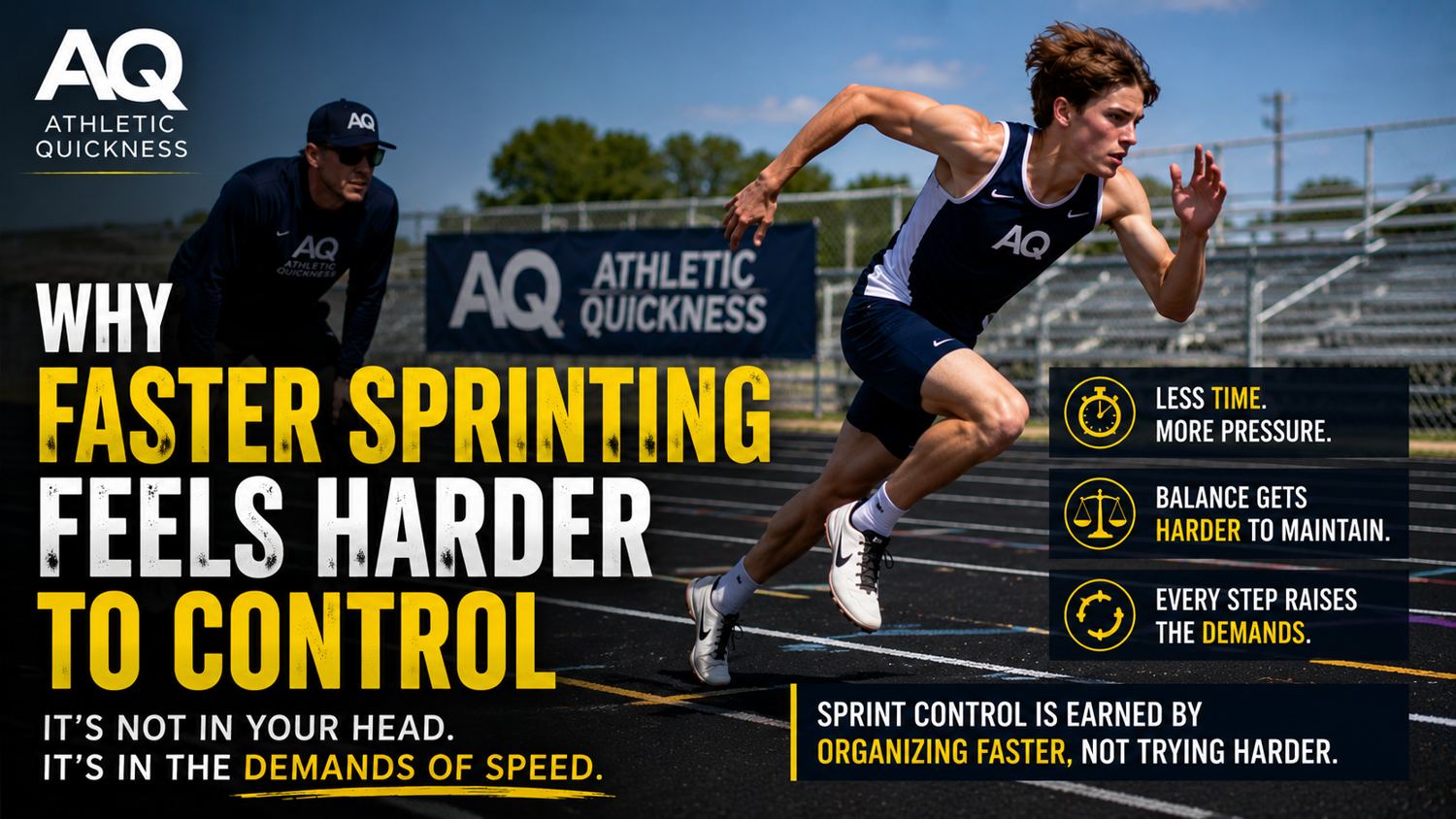
• balance becomes harder to maintain
• sprinting feels harder to organize
Some athletes describe it as:
• “everything starts happening too fast”
• “I lose control at top speed”
• “my sprinting gets chaotic”
• “I can’t organize my movement fast enough”
Traditional coaching often explains this as:
❌ lack of focus
❌ poor mechanics
❌ tension
❌ overthinking
But AQ sees something much deeper happening.
💥 Faster sprinting creates increasingly difficult timing and balance demands across the entire sprint movement.
That is a massive distinction.
⚡ Sprinting Faster Increases Timing Pressure
Many athletes think sprinting faster simply means:
👉 producing more force.
Force matters.
But sprinting faster also means:
👉 the entire sprint movement must organize itself faster.
That becomes extremely important at higher speeds.
Because during sprinting:
👉 not only does:
• the pushing leg aggressively drive backward into the ground
👉 but also:
• the arms must aggressively support this pushing-leg force
• the torso must rotate to support these force expressions even more
• while the swing leg thrusts forward keeping everything in balance
👉 all continuously.
💥 As sprint speed rises, these movement relationships must continue organizing and balancing faster and faster between steps.
That is where timing pressure begins building
🔄 Why Sprinting Starts Feeling “Chaotic” At Higher Speeds
This is where many athletes begin struggling.
As sprint speed rises:
👉 there is less and less time for the sprint movement to continue organizing force, timing, and balance relationships between steps.
That is hugely important.
Because sprinting is not:
❌ one isolated movement at a time.
It is:
💥 continuous whole-body aggressive movement happening under rapidly changing balance demands.
That changes how sprinting should be understood completely.
As speed rises:
• pushing-leg force rises
• swing timing speeds up
• arm contribution must organize faster
• torso rotation must match more quickly
• balance relationships must stabilize faster between steps
👉 all continuously.
That creates enormous movement pressure at high speeds.
🏃 Why Athletes Often Feel Less Smooth At Maximum Speed
This is one reason athletes often feel:
• less fluid
• more rushed
• more restricted
• less organized
as sprint speed rises.
Because the sprint movement is trying to manage:
👉 faster force production
👉 faster timing demands
👉 faster balance adjustments
👉 faster movement cycling
all simultaneously.
That is why sprinting often feels:
• easier at moderate speed
• harder to organize at maximum speed
even for experienced athletes.
💥 Higher sprint speeds dramatically increase movement organization demands.
🚨 Sprint Tightness Is Often A Protective Response
This is one of the biggest AQ realizations.
As timing and balance demands rise,
👉 the body often begins tightening movement to preserve control.
That is massively important.
Because many athletes think:
❌ tightening means they are simply “doing something wrong.”
But often:
💥 the sprint movement is becoming more guarded because balance and timing pressure are increasing faster than the movement can comfortably organize.
That is a completely different explanation.
This can create:
• restricted stride rhythm
• shorter movement freedom
• stiffness between steps
• guarded sprint mechanics
• reduced sprint fluidity
👉 especially at maximum speed.
⚖️ Balance Governs Control During Sprinting
This is extremely important to understand.
💥 Sprint control is not simply about conscious coordination.
👉 it depends on how well the sprint movement can continue organizing aggressive movement under rising balance demands.
That is a massive AQ distinction.
Because if:
• pushing-leg force rises too quickly
• swing timing begins falling behind
• arm contribution loses rhythm
• torso timing becomes restricted
👉 sprint control often begins tightening automatically.
Not because the athlete lacks effort.
But because balance relationships become harder to organize at rising speed.
That is why athletes often feel:
• out of rhythm
• unstable at top speed
• unable to fully open up
• smooth at lower speeds but restricted at higher speeds
👉 even while getting stronger and more explosive.
🧠 Injuries Often Increase Timing Pressure
This becomes especially obvious during injuries.
For example:
• shoulder injuries
• torso restrictions
• hip limitations
• abdominal strains
can immediately affect sprint timing and sprint fluidity.
Why?
Because weakening one movement contributor increases organization pressure on the rest of sprint movement.
That often causes:
• tighter sprint rhythm
• more guarded movement
• less fluid sprinting
• reduced movement freedom
👉 even before major strength loss occurs.
That is hugely important.
🔑 Sprinting Faster Requires Faster Organization
This may be one of the deepest AQ realizations overall.
Most athletes think sprinting faster simply means:
❌ producing more force.
But AQ increasingly sees sprint speed as:
💥 the ability to continue organizing aggressive whole-body movement under increasingly difficult timing and balance demands.
That is a completely different way to understand speed.
Because as sprint speed rises:
👉 the sprint movement must continue organizing:
• force
• timing
• balance
• rhythm
• movement cycling
faster and faster between steps.
That is what makes elite sprinting so difficult.
💥 What This Means For Speed Training
If sprint control depends on organization speed,
👉 then speed training should improve how quickly the sprint movement can continue organizing force and balance relationships under rising sprint demands.
Not simply improve isolated force production.
That changes how sprint training should be viewed.
Because faster sprinting depends on whether:
• the pushing leg
• the swing leg
• the arms
• the torso
👉 can all continue organizing together as sprint demands rise.
That is one of the deepest AQ speed principles.
🚀 What This Means For You
If sprinting feels harder to control at higher speeds,
👉 that does not automatically mean your mechanics are poor.
💥 Often, sprint speed is simply rising faster than the sprint movement can comfortably continue organizing force, timing, and balance relationships.
That means:
• movement begins tightening
• sprint rhythm changes
• balance becomes harder to maintain
• sprint freedom decreases
👉 especially at maximum speed.
💥 Faster sprinting is not simply more force.
💥 It is the ability to continue organizing aggressive movement under rising timing and balance demands.
That is one of the deepest AQ realizations.
🧭 You Are Here
You are currently exploring:
👉 WHY FASTER SPRINTING FEELS HARDER TO CONTROL: how rising sprint speed creates increasingly difficult timing, balance, and movement-organization demands across the entire sprint system.
🌐 See how this fits into the complete AQ speed system:
Learn how AQ approaches:
force production,
movement support,
timing between steps,
strength balance,
and sprint speed development.
➡️ SPEED TRAINING SCIENCE: Why Most Methods Fail (And What Actually Works)
🪜 Continue Deeper Into Sprint Timing And Organization:
Learn why sprint mechanics often tighten and change as force and balance demands rise at higher sprint speeds.
➡️ Why Running Form Breaks Down At Higher Speeds
Learn how timing between steps increasingly governs sprint speed as movement organization pressure rises.
➡️ Why Timing Between Steps Controls Sprint Speed
Learn why stronger athletes do not always become faster when aggressive sprint movement becomes harder to organize cleanly under force.
➡️ Why Traditional Training Can Make You Stronger—But Not Always Faster
🚀 Ready To Run Faster?
If you are ready to turn this information into real speed:
➡️ Run Faster With Isometric Training
❓FAQ
Why does sprinting feel harder to control at top speed?
Because sprint timing and balance demands rise dramatically as sprint speed increases.
👉 The sprint movement must organize itself faster between steps.
Why do I feel rushed at higher speeds?
Because there is less time to organize force, timing, and balance relationships between steps as speed rises.
Why does sprinting feel smoother at lower speeds?
Because lower sprint speeds create less timing pressure and less balance demand across the sprint movement.
Why do injuries affect sprint timing so much?
Because weakening one movement contributor increases organization pressure throughout the rest of sprint movement.
What should speed training improve?
👉 The ability to continue organizing force, timing, balance, and movement relationships as sprint speed increases.