
Home » Running Muscles for Speed » Hip Flexor Muscles for Speed: What Actually Makes You Run Faster
🧠 Introduction
Most athletes think speed comes from how hard the stance leg pushes.
👉 more force into the ground
👉 more power
👉 longer stride
And yes—
that matters.
💥 But that is only part of the running speed system.
What if speed also depends on how fast the next step can be driven into place?
That changes the conversation.
⚠️ The Hidden Half Of Speed Many Athletes Miss
Most athletes focus on force production.
Very few focus on:
👉 how fast the system can cycle.
And those may not be the same thing.
The push leg may help determine force output.
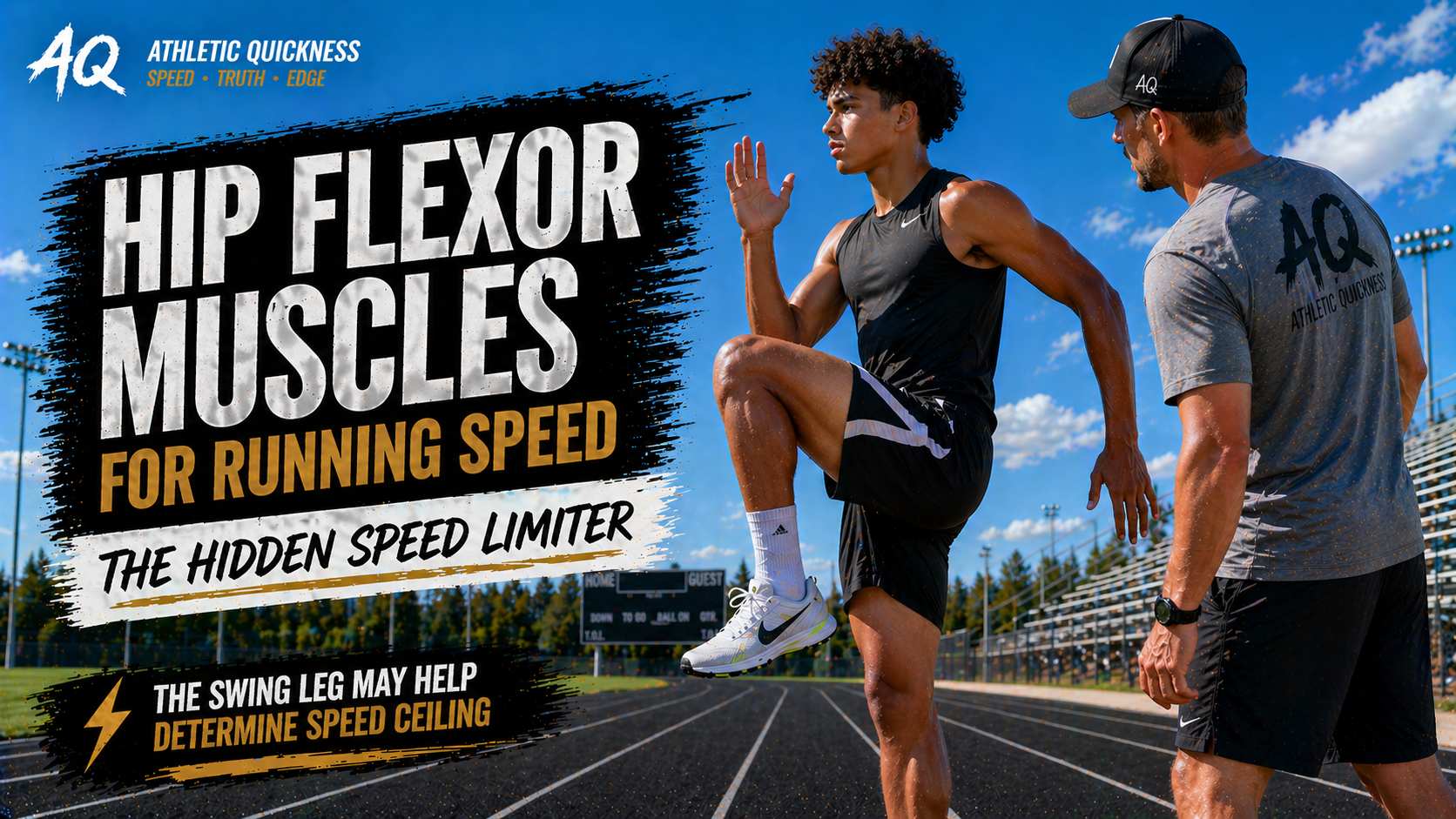
⚡ The swing leg may help determine the speed ceiling.
That is a very different idea.
🔑 Why Hip Flexors May Matter More Than You Think
The next step does not happen automatically.
💥 It has to be driven into position.
That forward-moving leg—
👉 the swing leg—
is not simply returning after a push.
It is being actively accelerated forward into the next stride.
That is not passive movement.
💥 That is next-step speed.
That forward acceleration is driven largely by the hip flexors.
⚡ What Happens If Stride Cycling Speed Becomes The Limiter?
Once this idea clicks, something important follows.
Athletes may produce plenty of force.
👉 But if the next step cannot be driven into place fast enough…
that force has nowhere to go.
If stride re-cycling slows…
If repositioning lags…
If timing breaks down…
💥 speed may stall—even when power is present.
⚡ In some cases, this may be where speed begins to plateau.
🔄 Speed May Depend On More Than Propulsion
This may be the re-frame.
Speed is not simply about:
👉 pushing harder.
What happens during the push phase matters—
💥 but what happens during the swing may matter just as much.
It may also involve:
• driving the swing leg forward faster
• cycling the stride more quickly
• repositioning the body for the next step
💥 And hip flexors may sit in the middle of that.
That matters.
🧩 Why More Power Alone May Not Solve Speed
More force can raise potential.
But if step re-cycling leaks…
If the next stride arrives too slowly…
If transition timing breaks down…
👉 more force may not become more speed.
Many athletes experience exactly that.
⚡ Speed May Be Partly A Repositioning Skill
Many think speed is about propulsion.
💥 What if part of speed is about repositioning?
That may be one hidden layer.
And an important one.
🚀 What This Means For You
Train hip flexors as more than “leg lift muscles.”
Think in terms of:
• next-step acceleration
• stride cycling
• front-side speed
• repositioning efficiency
Because those may influence speed more than many athletes realize.
👉 This is where understanding turns into performance.
➡️ How to Run Faster: The Complete Guide to Improving Speed Step by Step
🧭 You Are Here (Within The AQ Speed Training System)
You are currently exploring:
👉 HIP FLEXOR MUSCLES FOR SPEED: WHAT ACTUALLY MAKES YOU RUN FASTER: why hip flexors help drive the swing leg forward, support faster stride cycling, and may influence how quickly the next step can be brought into position.
🌐 See How This Fits Into The Complete AQ Speed Training System
👉 Explore how the hip flexors fit alongside the other major muscle groups that contribute to running speed.
➡️ RUNNING MUSCLES FOR SPEED: What Actually Matters (And What Doesn’t)
🪜 Continue Deeper Into Running Muscles for Speed
Learn why the glutes produce force but don’t create running speed by themselves.
➡️ Glute Muscles for Running Speed: Why Strength Alone Doesn’t Translate to Speed
Learn how the hamstrings help connect force production with timing during sprinting.
➡️ Hamstring Muscles for Running Speed: Power, Timing, and System Balance
🚀 Ready to Run Faster?
👉 When you’re ready to train these principles to improve your running speed:
➡️ Run Faster With Isometric Training!
❓ Frequently Asked Questions
Do hip flexors help you run faster?
👉 Potentially yes—especially in supporting fast stride re-cycling.
Are hip flexors important in sprinting?
💥 They may be far more important than many athletes assume.
Is the swing leg passive?
⚠️ It may not be passive at all.
It may be active next-step acceleration.
Can weak hip flexors limit running speed?
Potentially—if re-cycling speed becomes a bottleneck.