
Home » Running Muscles for Speed » Shoulder Flexor Muscles For Running Speed: Arm Drive, Rotation, And Coordination
🧠 Introduction
Most athletes think speed comes from the legs.
👉 stronger push
👉 faster turnover
👉 more power into the ground
And yes—
those matter.
💥 But what if running speed is organized by more than just the lower body?
What if part of what helps organize speed…
comes from above the waist?
That changes the conversation.
⚠️ The Arm Swing Myth Most Athletes Never Question
Most people think arm action does one thing:
balance the run.
Maybe help rhythm.
Maybe help posture.
👉 But many athletes treat the arms as secondary.
Almost passive.
💥 That may be a major mistake.
Because arm drive may influence much more than balance.
🔑 Why Shoulder Flexors May Matter More Than You Think
When the arm drives forward,
the shoulder flexors help power that action.
But this may be about more than moving the arm.
⚡ Forward arm drive may help support the larger running system.
It may influence:
• running rhythm
• torso coordination
• whole body coordination
• force transfer throughout the running speed system
That is far more than “arm pump.”
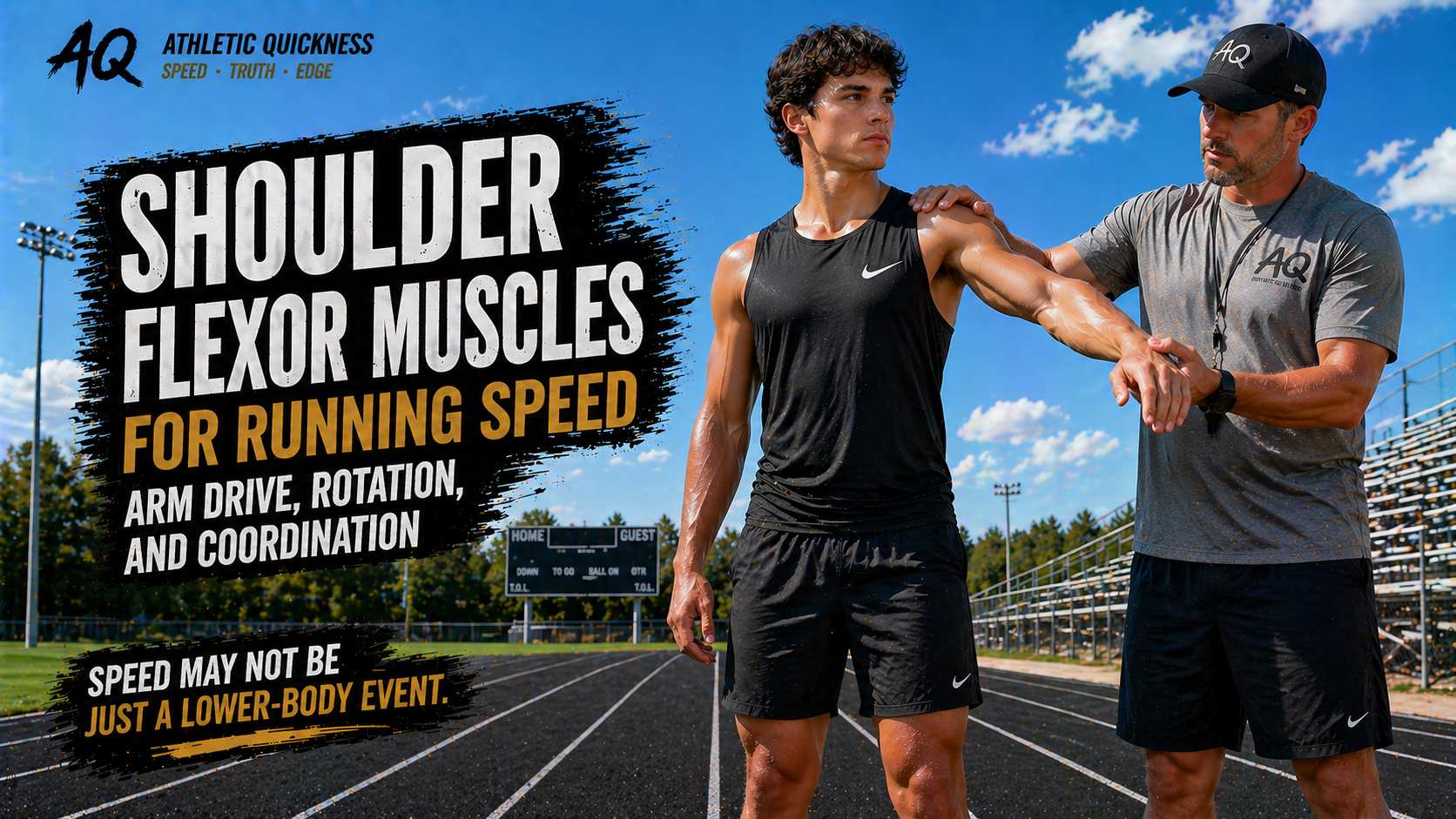
💥 Speed May Not Be Just a Lower-Body Skill
Running may not be purely a leg event.
It may also be:
• a coordination event
• a rotational event
• a system event
⚡ And arm drive may help shape what the legs can express.
That is a very different model.
🔄 Why Rotation May Matter For Speed
Many athletes think of speed as straight-line force.
Push harder.
Move faster.
👉 But speed may also depend on how the body organizes rotational forces.
And arm drive may be part of that organization.
💥 Shoulder flexors may contribute not just to movement—
but to how the running speed system coordinates movement throughout the stride.
That is a hidden mechanism many programs miss.
⚡ Arm Drive Is Not Just Motion — It May Be Timing
This may be the reframe.
Arm action is often taught mechanically:
“pump your arms.”
But what may matter is not merely moving the arms—
⚡ but timing how they contribute to the system.
That is different.
And much more interesting.
🧩 Why Stronger Legs Alone May Not Solve Speed
More force can raise potential.
But if coordination leaks…
If timing breaks down…
If rotational mechanics are weak…
👉 speed may still be limited.
Even with strong legs.
And many athletes experience exactly that.
🚀 What This Means For You
Train arm action as more than a side detail.
👉 Train it as part of how the running speed system organizes force and movement.
That means improving:
• forward arm drive
• rhythm
• rotational coordination
• system timing
👉 Not just faster—but better connected to the rest of the stride.
⚡ Running speed may depend on how well the upper and lower body work together—not just how much force the legs produce.
➡️ How to Run Faster: The Complete Guide to Improving Speed Step by Step
🧭 You Are Here (Within The AQ Speed Training System)
You are currently exploring:
👉 SHOULDER FLEXOR MUSCLES FOR RUNNING SPEED: ARM DRIVE, ROTATION, AND COORDINATION: why the shoulder flexors help support forward arm drive, torso rotation, and whole-body coordination during running.
🌐 See How This Fits Into The Complete AQ Speed Training System
👉 Discover how the shoulder flexors fit alongside the other major muscle groups involved in running speed.
➡️ RUNNING MUSCLES FOR SPEED: What Actually Matters (And What Doesn’t)
🪜 Continue Deeper Into Running Muscles for Speed
Learn how the shoulder extensors work with the shoulder flexors to support balanced arm action and coordinated running mechanics.
➡️ Shoulder Extensor Muscles for Running Speed
Learn why the hip extensors produce force but still depend on the rest of the running speed system to translate that force into speed.
➡️ Hip Extensor Muscles: Why They Don’t Make You Faster Alone
🚀 Ready to Run Faster?
👉 When you’re ready to apply these principles to improve your running speed:
➡️ Run Faster With Isometric Training!
❓ Frequently Asked Questions
Do arm muscles affect running speed?
👉 They may contribute more than many athletes think—especially through coordination.
Can arm drive make you faster?
💥 It may help support how efficiently speed is organized.
Not just how the arms move.
Are shoulder flexors important in sprinting?
✅ Potentially yes—especially in forward arm drive and timing.
Is running speed only about the legs?
⚡ Not necessarily.
Speed may be more of a whole-system skill.