
Home » Running Muscles for Speed » Force Transfer And Running Speed: Why Producing Force May Not Be Enough
🧠 Introduction
Most athletes think speed is built by producing force.
Push harder.
Drive harder.
Create more power.
And yes—
that matters.
💥 But what if how much of that force actually becomes speed depends on something else?
What if it depends on how well the system transfers that force?
That is a different way to think about speed.
⚠️ The Force Production Trap
Many athletes assume if they increase force production,
speed rises.
Simple.
Logical.
Fair.
But what if producing force and expressing that force are not the same thing?
👉 The system still has to be able to use it.
That may be overlooked.
🔑 Force Transfer Is Not A Separate Ability
Many athletes think of force transfer as something additional.
Something to train separately.
⚠️ But what if force transfer is not a separate skill at all?
What if it is simply the result of how well the system works together?
💥 That is a very different model.
👉 To see what actually affects how force moves through the system:
➡️ Adductor Muscles For Running Speed: The Overlooked Muscles That May Help Stabilize Speed
➡️ Antagonist Muscles For Running Speed: The Hidden Role Of Organized Opposition
💥 What If More Force Cannot Become Speed Without The System?
This may be the hidden mechanism.
More force may raise potential.
Fair.
But if the system cannot support it—
If timing is off…
If stability breaks down…
If direction is inefficient…
If coordination is disrupted…
👉 that force may never fully reach the ground as usable output.
💥 It may never become speed.
🔄 Speed May Depend On What The System Can Transfer
Many think speed depends on how much force is produced.
What if part of speed depends on how much force the system can actually transfer?
💥 That is a major shift.
Because it means:
👉 speed is not just created
👉 it is allowed by the system
🧩 Where Force Transfer Breaks Down
Force transfer is not one thing.
It depends on how the entire system works together.
Breakdowns may occur in:
• force transfer (calves)
• stability (adductors)
• direction (abductors)
• connector muscles (bi-articular)
• organized opposition (antagonists)
• movement timing (hamstrings)
💥 Transfer does not fail in isolation—it fails when the system is not aligned.
👉 That is why fixing one part does not always fix performance.
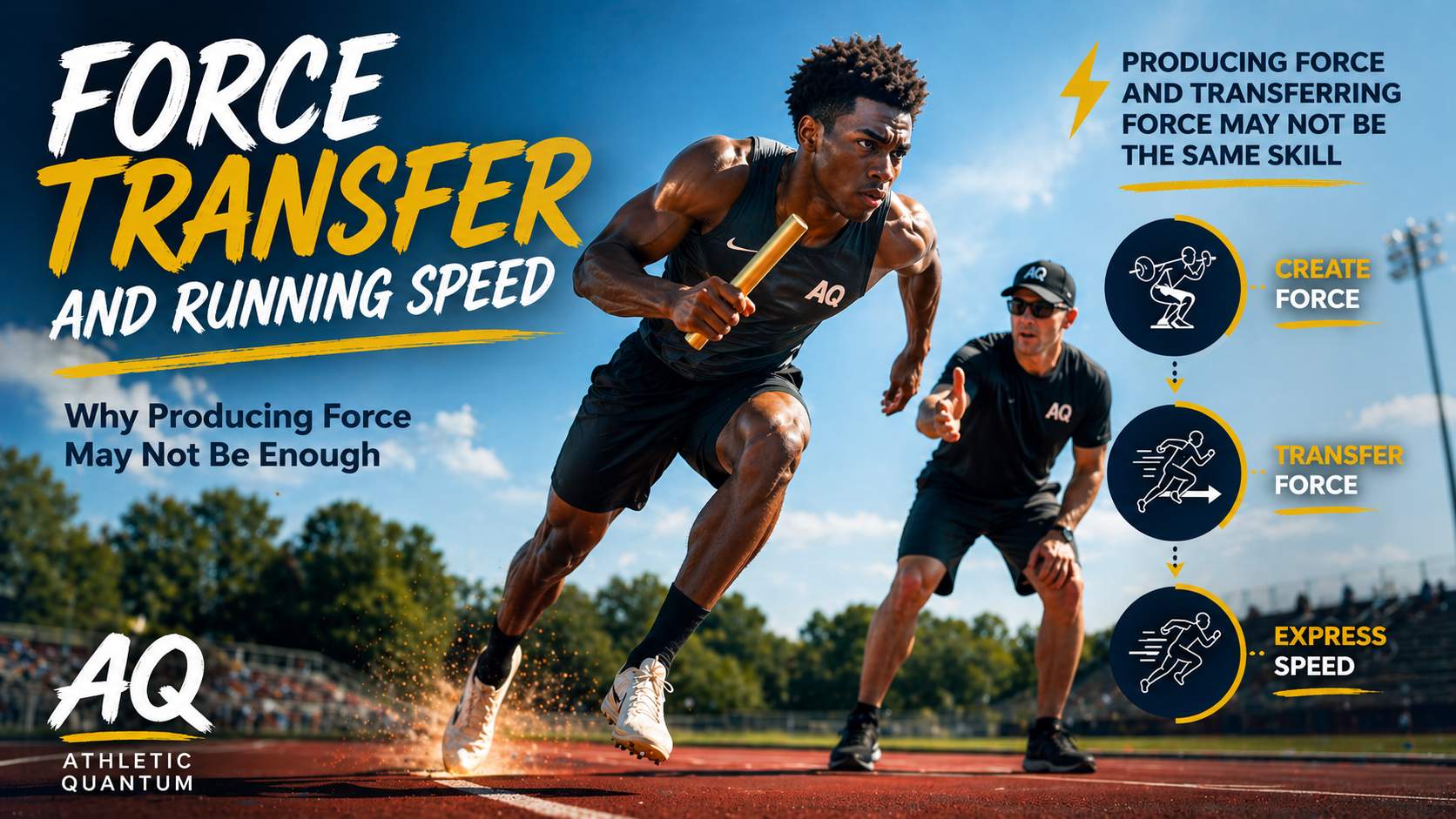
⚡ Producing Force And Transferring Force Are Not The Same Outcome
Some athletes improve by creating more force.
💥 Others improve by allowing more of that force to be used.
That is a major distinction.
Because:
👉 one builds potential
👉 the other expresses it
🚀 What This Means For You
Think beyond producing force.
👉 Train the system that allows force to move.
That means improving:
• timing
• stability
• direction
• coordination
• system balance
👉 Not just stronger—but more efficient in how force flows.
⚡ Force transfer is not something you add—it is what happens when the system works.
➡️ How to Run Faster: The Complete Guide to Improving Speed Step by Step
🧭 You Are Here (Within The AQ Speed Training System)
You are currently exploring:
👉 FORCE TRANSFER AND RUNNING SPEED: WHY PRODUCING FORCE MAY NOT BE ENOUGH: why force only becomes running speed when the entire running speed system can successfully transfer, organize, and express it.
🌐 See How This Fits Into The Complete AQ Speed Training System
👉 Discover how force transfer fits alongside the other major muscle groups and functional relationships involved in running speed.
➡️ RUNNING MUSCLES FOR SPEED: What Actually Matters (And What Doesn’t)
🪜 Continue Deeper Into Running Muscles for Speed
Learn why the Weakest Link Principle explains how one limiting factor can prevent the running speed system from expressing its full potential.
Learn how the calves contribute to efficient ground contact, timing, and the transfer of force into each running step.
➡️ Calf Muscles for Running Speed: Ground Contact, Timing, and Efficiency
🚀 Ready to Run Faster?
👉 When you’re ready to apply these principles to improve your running speed:
➡️ Run Faster With Isometric Training!
❓ Frequently Asked Questions
What is force transfer in running speed?
Force transfer refers to how effectively force moves through the body and contributes to movement.
Can poor force transfer limit speed?
👉 Yes—if the system cannot support how force is applied.
Does more force always make you faster?
Not necessarily—if the system cannot express that force efficiently.
How can force transfer affect sprint performance?
It influences how much of your potential force actually becomes usable speed.