
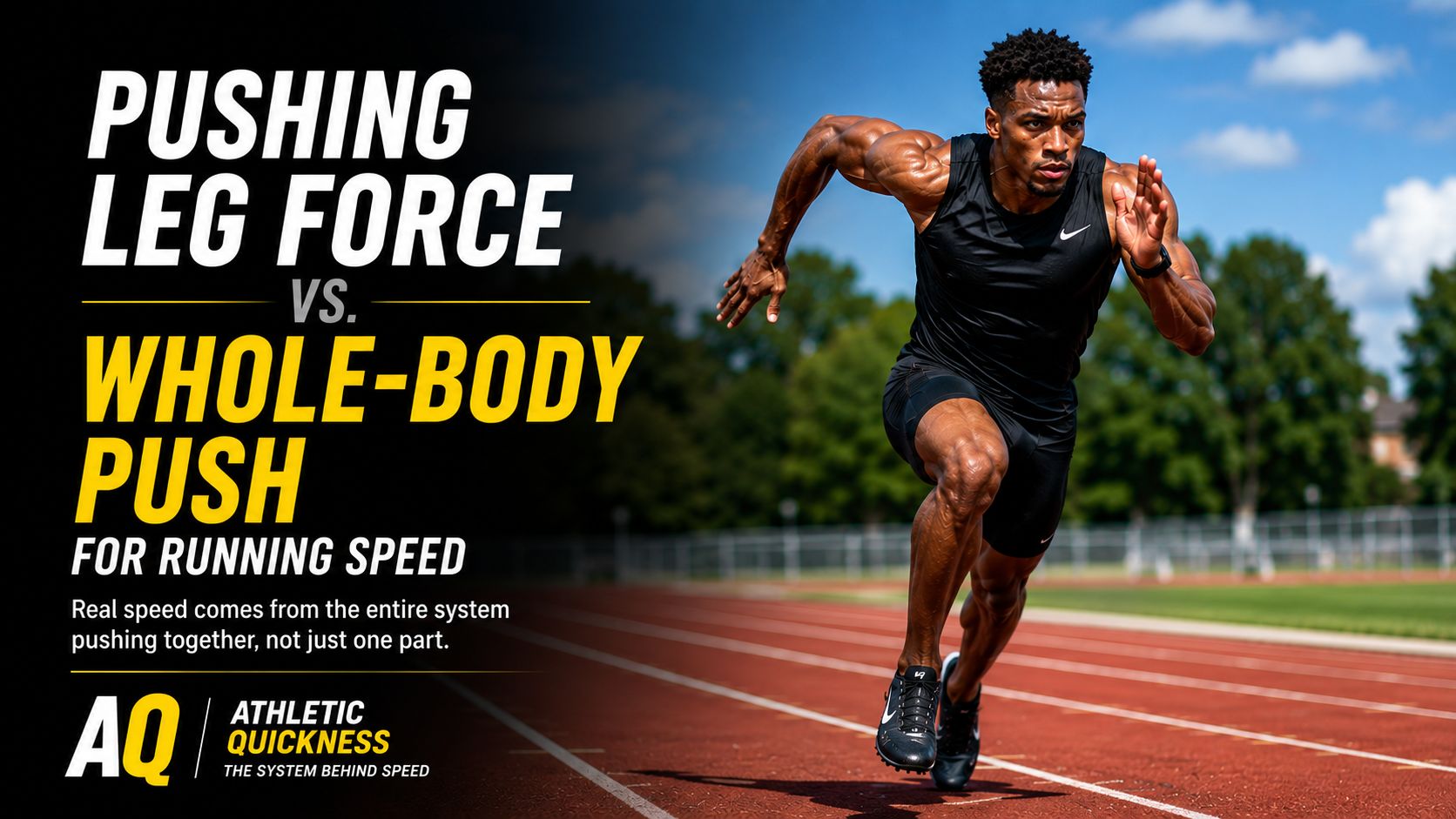
Home » Running Mechanics Explained » Pushing Leg Force vs. Whole-Body Push for Running Speed
🧠 Introduction
Traditional sprint thinking usually says:
👉 stronger leg = more push = faster speed
But Athletic Quickness (AQ) says:
👉 stronger system support = more usable push expression through the leg = faster speed
💥 That is a VERY different equation.
Because AQ is NOT saying:
❌ the pushing leg does not matter
👉 It absolutely matters.
The pushing leg is still the point where force enters the ground.
But AQ also says something else is happening:
💥 the rest of the body helps amplify how much usable push the pushing leg can express.
That changes the interpretation of sprinting completely.
Because now speed is no longer just:
👉 single-leg force production
It ALSO involves:
👉 whole-body push support (swing leg + arms + torso) through the pushing leg.
👉 Huge difference.
⚡ The Traditional View Of Push Force
Most sprint training still focuses heavily on:
👉 improving the pushing leg itself:
• glutes
• hamstrings
• quads
• calves
👉 The idea is simple:
💥 stronger pushing muscles = more push force.
And yes…
👉 that absolutely matters.
Stronger legs improve:
👉 force production
👉 projection
👉 acceleration ability
👉 ground force application
But AQ says:
🚨 The entire body helps the pushing leg create MORE usable push than the leg could produce alone.
That is where the framework changes.
🔄 The Difference Between Single-Leg Force And Whole-Body Push
AQ separates two different ideas:
1️⃣ Single-Leg Force Production
👉 This is the pushing leg working mostly through its own muscular force production:
• glutes driving
• hamstrings extending
• quads stabilizing
• calves helping transfer force
👉 This is traditional push-phase thinking.
👉 The leg produces force into the ground.
👉 Simple.
2️⃣ Whole-Body Push Support
👉 This is where the body helps amplify push THROUGH the pushing leg itself.
👉 That includes:
• aggressive swing-leg action
• arm-drive contribution
• torso rotation and stopping action
• momentum transfer
• rotational support
• timing support between steps
💥 The pushing leg is still applying force.
👉 But now the REST of the body helps increase how much usable push can actually be expressed.
💥 That is VERY different.
👉 And far more powerful.
🚨 Why This Changes Sprint Mechanics Completely
This is where AQ separates from traditional sprint explanations.
Because sprinting is not simply:
👉 one leg pushing harder.
It is:
💥 the entire body helping the pushing leg express force more effectively.
That changes everything.
Because now the swing leg is not:
❌ “just recovering”
👉 it actively helps support push expression.
Now the arms are not:
❌ “just balancing”
👉 they help organize rotational force support.
Now the torso is not:
❌ passive structure
👉 it helps transfer and stabilize force exchange across the system.
Everything suddenly becomes:
💥 interconnected.
💥 Everything is involved.
👉 Everything.
⚡ Why Stronger Legs Alone Sometimes Plateau
This explains something many athletes experience:
👉 getting stronger
without
👉 getting proportionally faster.
Many athletes improve:
• squat strength
• deadlift strength
• explosive output
• pushing-leg force
👉 Yet sprint speed stalls.
Why?
Because single-leg force production may improve…
👉 while whole-body push support remains limited.
That is a HUGE distinction.
The athlete may create more force locally…
BUT:
• timing between steps may still lag
• swing aggression may still be weak
• torso support may still be incomplete
• arm action may still be inefficient
• force transfer may still break down
💥 Meaning the body cannot fully SUPPORT higher-speed push expression.
That is very different from:
❌ “the legs are weak.”
🧩 Why The Swing Leg Suddenly Matters More
This is one reason AQ views the swing phase differently.
Traditional sprint language often describes the swing leg as:
• recovery
• repositioning
• bringing the leg back through
👉 Almost like an afterthought.
👉 But AQ sees something much more aggressive happening.
While one leg pushes…
💥 the other leg aggressively swings forward to help support ongoing push expression through the pushing leg.
👉 Not afterward.
👉 During the current stride itself.
That changes the role of the swing leg completely.
Because now the swing side influences:
• momentum transfer
• rotational balance
• timing between steps
• force continuity
• whole-body push support
👉 That is much bigger than:
❌ “leg recovery.”
💥 And now it deserves far more attention if you want to get faster.
⚖️ Why Sprinting Can Feel Lighter Without Becoming Harder
This is where many athletes notice something strange.
👉 When the system begins working together better:
• running may feel smoother
• turnover may feel easier
• strides may feel cleaner
• force may feel more connected
• speed may feel less forced
👉 But this does NOT mean sprinting became less aggressive.
💥 It means the entire system became better at supporting push expression together.
That is a huge distinction.
Because sprinting is not simply:
👉 harder pushing
It increasingly becomes:
💥 cleaner whole-body push support through the pushing leg.
🛠️ What This Means For Speed Training
👉 speed training is more than:
• stronger legs
• bigger force production
• more pushing exercises
Because athletes also need to improve:
• swing-leg aggression
• arm-drive contribution
• torso force organization
• timing between steps
• rotational support
• uninterrupted system cycling
💥 In other words:
👉 improving the body’s combined ability to support push expression through the pushing leg.
That is a completely different sprint model.
🚀 What This Means For You
Most athletes think sprinting is mainly about:
👉 how hard the pushing leg works.
But AQ shows something bigger is happening.
💥 The body itself helps amplify how much usable push the pushing leg can express.
That changes how sprinting is understood.
👉 And how speed should be trained.
Because speed is not simply:
❌ stronger legs alone
It increasingly involves:
• better force transfer
• stronger swing support
• cleaner torso organization
• more aggressive front-side action
• faster system cycling
• uninterrupted whole-body push support
💥 That is a very different interpretation of running speed.
🧭 Go Deeper
👉 These articles connect directly into the larger AQ speed framework:
➡️ Push Phase vs Swing Phase: Why Most Runners Train Only Half of Speed
➡️ Hip Flexors for Running Speed
➡️ Running Mechanics Explained: The System That Makes You Faster
👉 Together, these articles explain:
• simultaneous push + swing action
• force transfer across the body
• timing between steps
• whole-body push support
• system cycling speed
🎯 Start Here
👉 Want to see how AQ applies these ideas into actual speed training?
💥 Start here:
➡️ Run Faster With Isometric Training
👉 This is where the AQ system connects:
• sprint mechanics
• force expression
• timing
• system support
• resistance-band isometrics
• aggressive front-side action
❓ Frequently Asked Questions
What is whole-body push in sprinting?
👉 Whole-body push refers to the body helping amplify push expression through the pushing leg using swing action, arm drive, torso support, timing, and force transfer.
Is AQ saying the pushing leg does not matter?
❌ No.
👉 AQ still views the pushing leg as the point where force enters the ground.
Why don’t stronger legs always create more speed?
👉 Because single-leg force production can improve without improving the body’s ability to support and transfer force across the sprint system.
Does the swing leg help the pushing leg?
👉 Yes. AQ views aggressive swing action as helping support ongoing push expression during the current stride itself.
Why can sprinting feel smoother at higher speeds?
👉 Because improved whole-body support allows force to transfer more continuously and cleanly through the pushing leg.