

Home » Speed Training Science » 3 Types of Muscle Tissue and Why Only One Matters for Speed
🧠 Introduction
Most athletes hear the word:
👉 “muscle”
and immediately think about:
• sprinting
• jumping
• explosiveness
• athletic movement
But the body actually contains:
💥 three major types of muscle tissue.
And only one directly drives sprint speed.
That matters enormously.
Because sprinting is not simply:
❌ “using muscles.”
💥 Sprinting is aggressive movement continuously supported across the body under force.
Which means during sprinting:
• the pushing leg drives aggressively backward
• the swing leg attacks aggressively forward
• the arms rotate to support movement
• the torso connects both sides of the body
👉 all continuously.
And only one muscle tissue type directly creates those sprint actions.
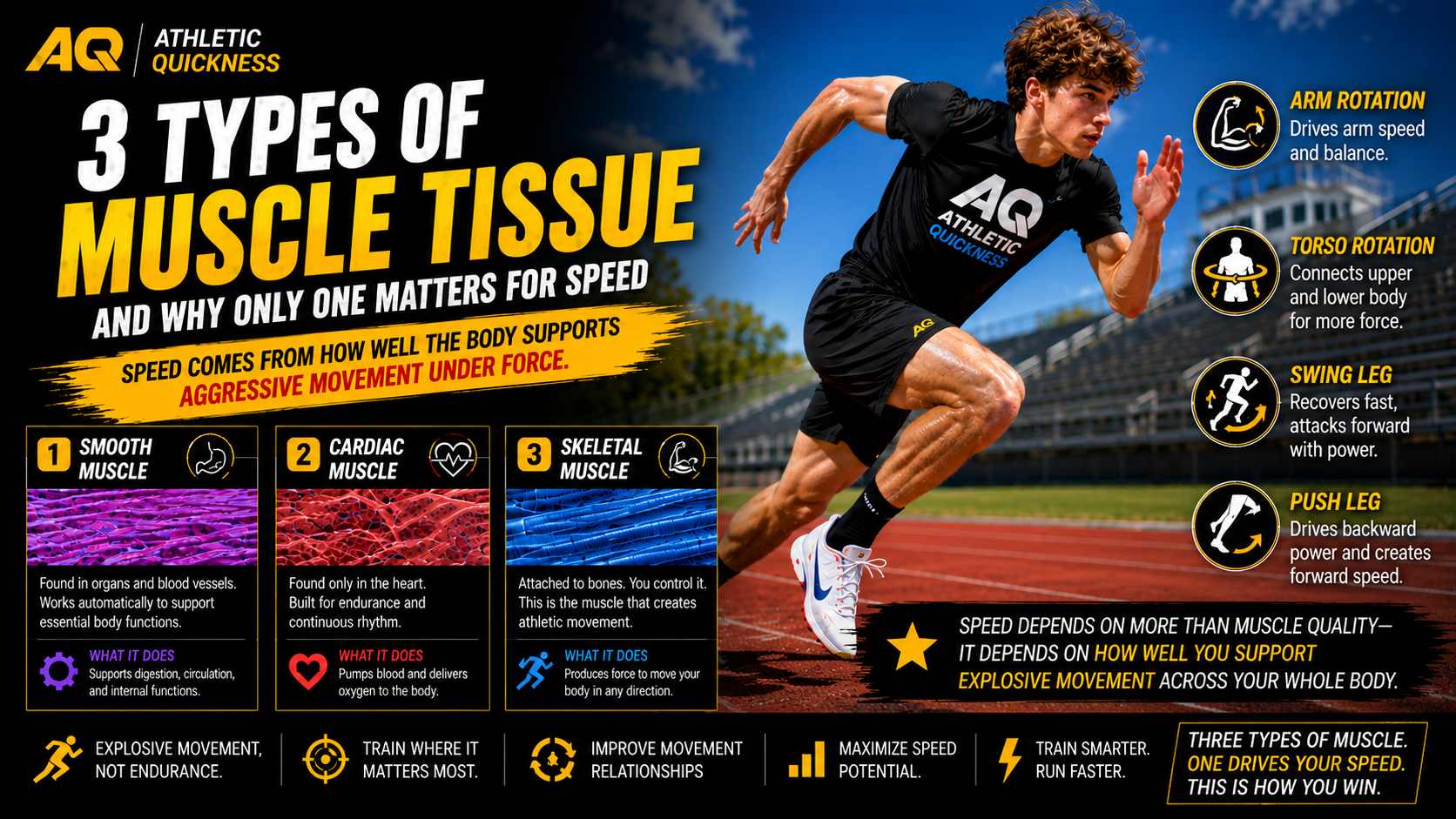
⚡ The Three Main Types Of Muscle Tissue
The body contains three major muscle tissue types:
• smooth muscle
• cardiac muscle
• skeletal muscle
👉 each serves a different purpose.
But only one directly creates sprint movement.
🔄 Smooth Muscle
Smooth muscle controls involuntary functions such as:
• digestion
• blood vessel activity
• organ function
Obviously important.
💥 But smooth muscle does not directly drive sprint movement.
It does not create:
• push leg force
• swing leg speed
• arm rotation
• torso-driven sprint movement
That is not its role.
❤️ Cardiac Muscle
Cardiac muscle makes up the heart.
👉 Essential for life.
And obviously important for endurance and conditioning support.
But cardiac muscle also does not directly create sprint speed.
It helps support:
• circulation
• oxygen delivery
• recovery capacity
Important qualities.
💥 But it does not directly produce aggressive sprint movement.
🏃 Skeletal Muscle Is Where Sprint Speed Lives
This is where sprint speed actually comes from.
💥 Skeletal muscle produces voluntary athletic movement.
Which means skeletal muscle directly creates:
• push leg force
• swing leg acceleration
• arm rotational support
• torso movement during sprinting
👉 continuously.
This is massively important.
Because sprinting is not:
❌ isolated force production.
💥 Sprinting is aggressive movement continuously supported across the body under force.
And skeletal muscle is what allows that movement to occur.
That is why skeletal muscle matters most for speed training.
🚨 Why Fast Twitch Qualities Matter So Much
Now we go one level deeper.
Inside skeletal muscle,
there are different fiber qualities.
And this is where fast twitch qualities matter enormously.
👉 Fast twitch muscle qualities are associated with:
• explosive push leg force
• rapid swing leg repositioning
• faster arm movement
• aggressive sprint movement under speed
That is why they matter so much in sprinting.
Because sprinting happens:
👉 fast,
violently,
and continuously.
And the faster sprinting becomes,
👉 the harder it becomes for the body to continue supporting those aggressive movement relationships cleanly under force.
That is a huge AQ principle.
Fast twitch qualities help support:
• faster contraction speeds
• higher force expression
• more explosive movement capability
But AQ now understands something deeper:
💥 explosive capability alone does not automatically create sprint speed.
The body still has to support those aggressive movements continuously under force.
That distinction matters enormously.
🧠 Why This Changes How You Think About Speed
Many athletes hear:
👉 “train your muscles for speed”
but rarely stop to ask:
Which muscle tissue actually creates sprint movement?
And within that muscle tissue…
👉 which qualities matter most for explosive sprinting?
Those questions completely change how speed should be viewed.
Because understanding skeletal muscle means understanding:
• push leg force
• swing leg speed
• arm rotational contribution
• torso support relationships
• timing between steps
👉 together.
💥 Sprint speed depends on how well the body supports all of those aggressive movement relationships simultaneously under force.
That is much more specific than:
❌ “just train your muscles.”
🔑 Not All Muscle Tissue Matters Equally For Speed
This may be the biggest realization in the article.
Smooth muscle?
Important.
Cardiac muscle?
Essential.
👉 But neither directly creates sprint speed.
Skeletal muscle does.
Because skeletal muscle directly produces:
• aggressive push leg force
• explosive swing leg movement
• arm rotation under sprinting
• torso movement support
👉 continuously.
And within skeletal muscle,
fast twitch qualities matter enormously for explosive sprint movement.
💥 That is the distinction many athletes miss.
🚀 What This Means For Training
If skeletal muscle directly creates sprint movement,
👉 training should prioritize qualities that improve explosive movement support.
Such as:
• aggressive push leg force
• rapid swing leg repositioning
• arm rotational speed
• torso movement continuity
• timing between steps
• force support under speed
That changes training priorities completely.
Because sprint speed is not:
❌ just muscular output.
💥 Sprint speed depends on how well the body supports aggressive movement relationships under rising force.
That is the AQ reframe.
🧭 You Are Here
You are currently exploring:
👉 3 TYPES OF MUSCLE TISSUE: how skeletal muscle directly creates sprint movement and why explosive muscle qualities matter for aggressive movement under speed.
🌐 See how this fits into the complete AQ speed system:
Learn how AQ approaches:
force production,
movement support,
timing between steps,
strength balance,
and sprint speed development.
➡️ SPEED TRAINING SCIENCE: Why Most Methods Fail (And What Actually Works)
🪜 Continue Deeper Into Sprint Muscle Function:
Learn how fast twitch qualities contribute to explosive sprint movement and why explosiveness alone does not automatically create speed.
➡️ How to Train Fast Twitch Muscle Fibers for Speed (Without Adding Bulk)
Learn what actually creates sprint force and why sprint speed depends on more than isolated muscular output.
➡️ What Actually Creates Force in Running? (And Why Most Athletes Get It Wrong)
Learn why stronger athletes can still struggle to sprint faster when aggressive movement relationships cannot continue organizing cleanly under force.
➡️ Why Traditional Training Can Make You Stronger—But Not Always Faster
🚀 Ready To Run Faster?
If you are ready to turn this information into real speed:
➡️ Run Faster With Isometric Training!
❓FAQ
What are the three major types of muscle tissue?
👉 Smooth muscle,
cardiac muscle,
and skeletal muscle.
Which muscle tissue matters most for sprint speed?
💥 Skeletal muscle.
Because it directly creates voluntary sprint movement.
Why do fast twitch qualities matter?
Because they help support:
• explosive push leg force
• faster swing leg movement
• rapid arm rotation
• aggressive sprint movement under speed
Do smooth or cardiac muscle matter for athletic performance?
Yes.
👉 They support important body functions.
But skeletal muscle directly creates sprint movement.
What should speed athletes prioritize?
👉 Explosive movement support,
force application,
swing leg speed,
arm rotation,
torso connection,
and timing between steps.








