
🧠 Introduction
Walk onto almost any competitive track facility or read through any advanced middle-distance conditioning protocol, and you will find athletes striving to be completely “steeplechase fit.”
Mainstream conditioning culture has spammed a single, cosmetic message for decades: “Elite hurdle clearance and water pit pacing are entirely byproducts of high-volume aerobic conditioning. Spend your speed and endurance drills running grueling aerobic intervals to force your body to survive the lap volume.”
Players and coaches operate under the flawed, two-dimensional assumption that if an athlete’s stride frequency collapses or they look heavy clearing a barrier in the final laps, their lower body simply lacks raw cardio capacity.
But trying to force an elite track breakthrough by continuously overloading your nervous system with high-volume endurance training is a severe biological fallacy.
The human body is a precise machine governed by the unyielding laws of structural physics and motor-unit recruitment math.
You aren’t slow because your cardiorespiratory gas exchange is poor; your velocity is stalling because high-volume endurance training forces your fast-twitch muscle fibers to take on slow-twitch characteristics, triggering an internal safety brake that chokes your natural top gear.
⚡ The Age-Defying Masters Sprint Proof
Look at the exact, verified national competition tracking data from 67-year-old masters sprinter Glen Betts:
- The Stagnant Baseline: Trapped at a persistent track speed plateau while relying entirely on traditional conditioning methods.
- The Neural Activation: Integrated the targeted fast-twitch resistance bands program for 15 minutes a day, 4 days a week.
- The Absolute Receipt: Slashed a full second off his 100m sprint time (13.99s) and dropped his 200m time by 0.26 seconds in a single meet.
The exact millisecond he activated his overlooked fast-twitch pelvic muscle networks, his late-race leg turnover accelerated effortlessly without extra volume laps.
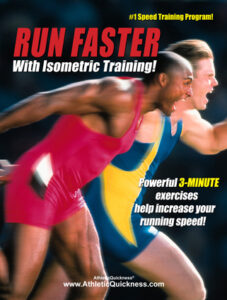
 Learn more about the exact Run Faster Speed Training Protocol used to activate fast-twitch muscle networks and shatter speed plateaus in just 14 days here.
🔄 The Physics: Left Hip Flexion Torque Dynamics
To understand why elite aerobic fitness fails to protect your match velocity, you must look past superficial coaching folklore and look at the unyielding engineering laws of the Ultimate Running Speed Equation (URSE).
Human locomotion and hurdle acceleration are a strict battle of balancing rotational torque across your pelvis where Net Torque must equal exactly Zero.
Sprinting and clearing a solid wooden barrier utilize an asymmetric, split-legged physical architecture.
Look at the dynamic alignment of an elite steeplechaser in mid-flight: when the left hip explodes upward into intense flexion to drive the airborne lead leg forward, it throws a massive, concentrated wave of Clockwise (CW) rotational torque across the pelvis.
This single extremity is working completely alone on its side of the algebraic ledger, functioning as the high-velocity tail rotor generating pure CW force.
This layout should be an immediate red flag for astute researchers to question. In the real world, the arms and legs operate in completely different system constraints.
Both arms are entirely free in the air, completely unweighted and unbound by external forces.
The legs, however, face a brutal asymmetry: only one leg is free in the air, while the other leg is completely bound to the ground as a fixed mechanical pivot.
Because the arms are not subject to the same external forces as the legs, they cannot run a symmetrical mirrored loop.
To balance out that data column’s CW blast, your right pushing leg and your upper body flywheel must dynamically unify their forces.
The right leg drives the right hip forward past its fixed axis, throwing a massive wave of Counter-Clockwise (CCW) torque (remember the R in counterclockwise locks the Right side constant).
Simultaneously, the shoulders twist aggressively Counter-Clockwise, driving the right arm forward and left arm back to reinforce that exact same CCW wall.
High-volume endurance loops completely blind this relationship, training your fast-twitch fibers to take on slow-twitch traits by building up capillary density to survive the exhaustion, leaving your deep, flat psoas and iliacus winches dead and unconditioned during traditional speed and endurance drills.
🛑 The Neurological Governor: The Final Lap Safety Lock
Your brain is a master safety engineer. The central nervous system runs a non-stop, subconscious mathematical calculation, monitoring the structural torque balance across your pelvis to protect your joints from injury.
When an athlete attempts to transition out of a wet hurdle landing and explode back into a full track stride, their hyper-developed pushing engine tries to dump force into the track.
If your brain detects that your flat, unconditioned swing-leg hip flexor winches lack the high-velocity contraction speed required to cleanly counter that combined forward blast because your slow conditioning habits have starved the transmission, it instantly introduces a negative multiplier known as the Neurological Governor.
To protect your spine, hips, and joints from a catastrophic mechanical tear under these uneven forces, your nervous system actively clamps down—throttling your ground force production downward.
You strain, pump your arms harder, and try to force a faster tempo, but your body is actively pulling its own emergency brake to protect your frame.
You stay stuck at a slow barrier pace because your body refuses to let you use your pushing power without a matching counter-weight—and until you know how to fix it and actually do, there is nothing you can do about it.
🚀 Releasing the Governor: Waking Up the Transverse Winch
You cannot fix a high-velocity structural torque crisis by running more slow road miles or performing traditional weight-room machine extensions.
Piling more workload onto a lopsided system only increases joint strain, creates chronic hamstring tightness, and deepens the structural imbalance.
That’s not to say they don’t have value, it’s just that you’re not likely to gain any more speed from them until you correct the actual problem.
The smaller, flat swing muscles can easily match the torque of the giant jackpot engine because of a strict 4:1 inertial weight displacement ratio.
The pushing leg must move 85% of your total body mass forward, while the airborne swing leg only has to move one single extremity through empty air.
Because its load is so light, your swing-phase hip flexors are built to contract at extreme, instantaneous fast-twitch velocities to multiply their counter-torque exponentially.
The Athletic Quickness protocol activates this network safely by pairing high-tension resistance bands with short, 15-second isometric holds locked into your authentic, upright sprinting posture [source: 0.1.4].
By applying 70-80% of your maximum strength instantly against a dynamic elastic vector, you hot-wire the biological software.
Your brain immediately bypasses the sequential order, upgrading your deep psoas and iliacus winches into high-velocity steel joints.
The brain’s internal calculator realizes the system is balanced, the safety governor lifts the emergency brake, and your stride frequency effortlessly accelerates on the clock, permanently changing how you approach speed and endurance drills.
 Let Us Prove the Fast-Twitch Science To You
Click here to take the free 9-Minute Running Speed Challenge and witness your leg turnover effortlessly accelerate right at home.
🚀 Choose Your Next Speed Breakthrough Phase:
👉 Why Volume Track Laps Fail the 400m Dash (The 400m Training Velocity Fix)
👉 How to Shatter an 800m Stride Plateau (The 800m Training Workouts Fix)
👉 How to Run Faster: 7 Things That Actually Matter
👉 Isometric Training for Speed: The Complete System to Run Faster