
🧠 Introduction
If you are a competitive rugby winger or outside back fighting to improve your sideline acceleration, you are likely feeling a massive amount of structural pressure.
Along the touchline, your first-step quickness and closing speed are your ultimate currency. You can possess flawless positional awareness and great handling skills, but if an opposing defender tracks you down or beats you to the corner by even half a step, your team loses a critical scoring opportunity.
Wingers need explosive lateral and linear burst to counter-attack and pin defenders deep.
To drop those critical tenths of a second off your clock, traditional rugby conditioning culture has spammed a single, linear message for decades: “Wingers need quick, nimble feet to escape tacklers. Spend your off-season shuffling through plastic agility ladders and running through high-frequency cone setups to build elite field quickness.”
Coaches operate under the assumption that if your first-step burst feels heavy and sluggish out of a turn, your frame simply lacks rapid, visual foot coordination.
But treating a rugby winger’s touchline speed as a superficial foot-shuffling drill is a severe logical fallacy.
Sprinting, evading, and accelerating are not linear footnotes; they are unyielding mathematical equations governed by the laws of structural engineering.
You aren’t losing your sideline battles because your feet are slow; your acceleration is stalling because your traditional foot drills completely ignore the biological calculator running your hip flexors and internal rotators, forcing your body to put on its own brakes.
⚖️ The Elite Athlete’s Verified Mechanical Proof
Look at the exact tracking data from a high-level competitive athlete who completely balanced his system’s equation using this protocol:
- Before Rugby Speed Status: Heavy and sluggish out of sidesteps, consistently getting tracked down along the boundary line.
- After Rugby Speed Status: Effortless touchline range and immediate, explosive acceleration that leaves defenders out of bounds.
- The Timeline: Exactly 14 days
This competitor spent years trying to build field speed through traditional team workouts, adding physical muscle mass through heavy weights but gaining zero explosive quickness out of his stance.
The moment he activated the missing fast-twitch muscle link inside an upright posture, his touchline velocity and side-stepping agility completely transformed.
 Learn more about the exact Football Speed Training Protocol used to activate fast-twitch muscle networks and slash your forty time in just 14 days: skill-position acceleration
🔄 The Physics: The Touchline Hip-Flip Turn Crisis
To unlock elite recovery and closing speed on the pitch, you must look past the superficial look of fast feet and look at the unyielding engineering laws of the Ultimate Running Speed Equation (URSE).
Human locomotion is a strict battle of balancing rotational torque across your pelvis where Net Torque must equal exactly Zero.
Consider the exact mechanical crisis that happens when tracking a play from a deep wing alignment or cutting inside to evade a tackler.
A winger side-steps, reads the space, and must instantly open up their hips to transition into a full recovery sprint.
To execute this sudden turn, the left stance foot plants into the turf to form a stationary axis. Simultaneously, the right leg violently lifts into hip flexion via the hip flexors and externally rotates in mid-air to swing the body wide.
The instant that right foot strikes the turf, the mechanics shift from a pushing movement to a high-tension transverse pull.
The right foot locks into the ground, stretching the deep internal hip rotators on that right hip socket. These hidden muscles must contract at extreme velocity to act like a motorized winch—violently pulling and snapping the massive outer crest of your pelvis around that stationary thigh bone to face the try line.
If your hip flexors lack the velocity to lift the leg, and your internal rotators lack the power to act like a winch, your turn delays by a fraction of a second, letting the defender close the gap and force you into touch.
Learn more about the role the hip flexors and other muscles have on your running speed here: extreme fast-twitch velocities
🛑 The Neurological Governor: The Boundary Line Brake
When a winger attempts to transition out of a break and explode into a full sprint, their hyper-developed pushing engine dumps maximum force into the ground.
If your brain detects that your flat, unconditioned hip flexors and internal rotators lack the high-velocity contraction speed required to cleanly counter that intense forward rotational torque, it instantly introduces a negative multiplier known as the Neurological Governor.
To protect your spine and lower back from a catastrophic mechanical breakdown under uneven forces, your nervous system actively clamps down—throttling your ground force production downward.
You strain, pump your arms, and try to force a faster burst, but your body is actively pulling its own emergency brake to protect your frame. You stay stuck at a slow field plateau because your body refuses to let you use your pushing power without a matching counter-weight, and until you know how to fix it and actually do, there is nothing you can do about it.
🚀 Releasing the Governor: Balancing the Equation
You cannot fix a high-velocity structural torque crisis by shuffling through agility ladders or performing more traditional weight-room leg presses.
Piling more volume onto a lopsided system only increases joint strain, creates chronic hamstring tightness, and deepens the structural imbalance.
That’s not to say they don’t have value, it’s just that you’re not likely to gain any more speed from them until you correct the actual problem.
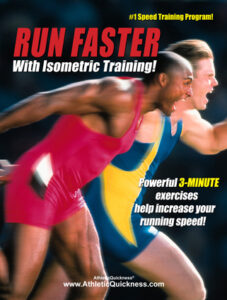
The Athletic Quickness protocol removes this bottleneck safely by pairing high-tension resistance bands with short, 15-second isometric holds locked into your authentic, upright sprinting posture.
By completely eliminating momentum, your nervous system is forced to instantly wake up, bypass its lazy habits, and flood your deep, ignored fast-twitch hip flexion and internal rotation fibers with recruitment data.
The moment your plastic hinges are upgraded into high-velocity steel joints that match your pushing engine, your structural strength-balance ceiling rises.
The brain’s internal calculator updates the equation, realizes that the system can now safely handle maximum velocity, and automatically removes the negative multiplier.
The emergency brake lifts, and your legs naturally snap forward with elite responsiveness, giving you effortless, explosive closing speed on the field.
 Flip Your Fast-Twitch Muscle Switch
Click here to take the free 9-Minute Running Speed Challenge and experience the fast-twitch science for yourself: live elastic band🚀 Choose Your Next Speed Breakthrough Phase:
👉 Why Gym Strength Fails Field Athletes (And the 14-Day Soccer Acceleration Fix)
👉 The Discus Winch System: How Internal Hip Rotation Drives Elite Throwing Distance
👉 How to Run Faster: 7 Things That Actually Matter
👉 Isometric Training for Speed: The Complete System to Run Faster