
🧠 Introduction
Walk onto almost any local park diamond or look at corporate recreational softball tournaments, and you will find players trying to build an explosive first step using old-school lower body grinds.
Mainstream fitness culture has spammed a single, cosmetic message for decades: “Elite base-stealing burst and defensive perimeter quickness are born from raw thigh size. If you want to know how to run faster, you must spend your workouts loading up heavy machine weights inside a commercial gym.”
Recreational league base-runners, tournament outfielders, and shortstops operate under the flawed, two-dimensional assumption that moving a slow, static weight-room load can automatically translate into immediate basepath velocity on weeknights.
But trying to force an elite diamond burst by overloading your skeleton with heavy machine weights is a severe biological fallacy. The human body is a precise machine governed by the unyielding laws of structural physics and motor-unit recruitment math.
You aren’t getting thrown out at second base because you lack willpower or muscle size; your velocity parameters are stalling because traditional gym routines violate the absolute physical laws running your pelvis, forcing your central nervous system to put on its own brakes.
🔄 The Physics: The High-Velocity Stride Reconnection Law
To understand why traditional weight-room routines completely fail to protect your late-inning velocity, you must look past superficial coaching ad slogans and look at the unyielding engineering laws governing the player’s skeleton.
Under the rules of fast-twitch neural activation, sprinting and basepath acceleration are a violent, high-velocity battle of balancing rotational forces across the pelvis.
Every single stride splits an athlete’s body into two distinct running alliances that must perfectly balance to keep their spine moving straight forward down the baseline.
👣 The Pushing Team
The planted stance leg forcefully drives downward into the dirt, firing the glutes and hamstrings to propel the hip socket forward.
This massive thrust represents the athlete’s raw locomotive horsepower.
Actively supporting and increasing this drive is their upper body unit, which includes the free-swinging arms and torso rotators.
Their movements directly align with that active pushing leg, adding to its ability to produce maximum force into the ground.
👟 The Swing Team
Operating completely opposite to that downward drive sits the front-side swing-phase engine.
This engine consists of the deep swing-leg hip flexors, which function as the body’s true speed transmission.
At the exact same millisecond the stance leg is forcefully driving downward into the dirt, these front-side core winches on the other side must violently contract at extreme fast-twitch velocities.
This simultaneous effort explosively pulls the unweighted airborne limb forward through thin air, maintaining the critical strength balance across the pelvic axle needed to maximize total forward speed.
🏋️♂️ The Symmetrical Weight-Room Blind Spot
Here is the exact structural blind spot keeping softball players slow: as pushing power increases through traditional training, the requirement for high-velocity swing-phase counter-force scales up exponentially.
When an athlete anchors themselves into a heavy, symmetrical squat rack, leg press, or linear machine loop, they are forcing their body to fight a locked, vertical load.
This bidirectional weight heavily stresses the pushing team on the backside, forcing the glutes and quadriceps to work significantly harder to grind through a flat plane.
As a result, the player spends years hyper-developing their backside muscles against the iron stacks, building an incredibly thick, powerful steel door and a solid steel frame.
But because the gym machine is a locked, symmetrical anchor that applies a static linear load across both hips simultaneously, it completely bypasses the deep swing-phase hip flexors on the front side.
Coaches are trying to hang that massive steel door onto a fragile pair of hinges made of plastic.
Those plastic hinges are the deep, front-side hip flexor winches, which typical heavy lifting workouts completely ignore and leave entirely unconditioned to handle high-velocity diamond workloads.
Because a fixed weight stack cannot communicate with your central nervous system or force dormant core motor units to fire in an independent forward loop, an athlete’s body lacks the sub-second contraction speed required to match their developing backside engine.
Reconnecting and conditioning this missing fast-twitch swing link is the ultimate mechanical key to unlocking explosive sprint velocity, shattering training plateaus, and optimizing running efficiency for the basepath pelvic winch secret.
👉 Learn more about these torque networks, pushing team, swing team, and strength balance governing your running speed here: Ultimate Running Speed Equation
⚖️ Shawn’s Verified Youth and Field Performance Proof
Look at the exact tracking data from Shawn, a highly competitive young player who completely re-engineered his pelvic acceleration math to shatter the traditional weight-room speed deception:
- The Baseline Bottleneck: Despite possessing an incredible work ethic, constant practices, and intense dedication to traditional weight lifting and generic speed drills, his explosive first-step velocity remained completely stagnant.
- The Rapid Shift: Bypassed the slow weight-room illusions and exhausting high-volume conditioning laps, instead targeting his fast-twitch neuro-muscular transmission lines right at home using the bands.
- The True Velocity Receipt: Integrated this specialized isometric protocol for just 14 days and witnessed an immediate, massive surge in his high-speed turnover and explosive acceleration, completely resetting his athletic baseline.
Shawn explicitly proved that when an athlete hot-wires the missing fast-twitch muscle link to the front of their pelvis—specifically targeting the hidden psoas and iliacus winches—the central nervous system instantly lifts its protective safety brakes, forcing immediate transfer directly onto the dirt or turf lane.
 Learn more about the exact Run Faster Speed Training Protocol used to activate fast-twitch muscle networks and shatter speed plateaus in just 14 days here.
🛑 The Neurological Governor: The Basepath Safety Brake
Your brain is a master safety engineer. The central nervous system runs a non-stop, subconscious mathematical calculation, monitoring the structural torque balance across your pelvis to protect your joints from injury.
When an adult league player attempts to transition out of a hard secondary lead and explode toward the next base, their hyper-developed pushing engine tries to dump maximum force into the turf.
If your brain detects that your flat, unconditioned swing-leg hip flexor winches lack the high-velocity contraction speed required to cleanly counter that combined forward blast because your gym habits have starved the transmission, it instantly introduces a negative multiplier known as the Neurological Governor.
To protect your spine, hips, and lower back from a catastrophic mechanical breakdown under uneven forces, your nervous system actively clamps down—throttling your ground force production downward.
You strain, grunt harder, pump your arms harder, and try to force a faster tempo, but your body is actively pulling its own emergency brake to protect your framework.
You stay stuck a step behind the throw on a critical steal because your body refuses to let you use your pushing power without a matching counter-weight—and until you know how to fix it and actually do, there is nothing you can do about it.
🚀 Releasing the Governor: The Fast-Twitch Iliopsoas Activation
You cannot fix a high-velocity structural torque crisis by pumping heavier gym weights or running extra conditioning loops. Piling more workload onto a lopsided system only increases joint strain, creates chronic hamstring tightness, and deepens the structural imbalance.
That’s not to say they don’t have value, it’s just that you’re not likely to gain any more speed from them until you correct the actual problem.
The smaller, flat swing muscles can easily match the torque of the giant jackpot engine because of a strict 4:1 inertial weight displacement ratio.
The pushing leg must move 85% of your total body mass forward, while the airborne swing leg only has to move one single extremity through empty air.
Because its load is so light, your swing-phase hip flexors are built to contract at extreme, instantaneous fast-twitch velocities to multiply their counter-torque exponentially.
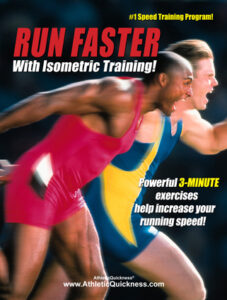
The Athletic Quickness protocol activates this network safely by pairing high-tension resistance bands with short, 15-second isometric holds locked into your authentic, upright sprinting posture.
By applying 70-80% of your maximum strength instantly against a dynamic elastic vector, you hot-wire the biological software. Your brain immediately bypasses the sequential order, upgrading your deep psoas and iliacus winches into high-velocity steel joints.
The brain’s internal calculator realizes the system is balanced, the safety governor lifts the emergency brake, and your legs naturally snap forward with elite responsiveness, permanently solving the question of how to run faster.
⚡ Stop Training Your Fast-Twitch Fibers to Be Slow
Every single day you spend grinding through endless cardio laps, dragging heavy bungees, or loading slow gym machines, you are actively coding your body to pull its own emergency brake.
You do not need more muscle size. You do not lack willpower. Your pushing engine already has all the raw horsepower it needs—your nervous system is simply refusing to let you use it because your pelvic transmission is completely out of balance.
Give us less than 90 seconds a day for the next 14 days. We will safely isolate your deep iliopsoas winches, hot-wire your fast-twitch motor units, and force your brain’s internal calculator to permanently lift the Neurological Governor.
The math always outlasts the training calendar. Stop guessing on your stopwatch and take the challenge today.
 Unlock Your Fast-Twitch Muscle Speed Instantly
Stop trying to solve a high-velocity mechanical problem with slow, heavy weight room routines that only build bulky, slow-twitch mass.
If your stopwatch times are stuck at a performance plateau, your nervous system simply isn’t firing your explosive muscle networks.
Click here to take the free 9-Minute Running Speed Challenge and witness your leg turnover effortlessly accelerate right at home.
🚀 Choose Your Next Speed Breakthrough Phase:
👉 Why Gym Strength Fails Field Athletes (And the 14-Day Soccer Acceleration Fix)
👉 The Discus Winch System: How Internal Hip Rotation Drives Elite Throwing Distance
👉 How to Run Faster: 7 Things That Actually Matter
👉 Isometric Training for Speed: The Complete System to Run Faster