
Home » Running Mechanics Explained » Why Running Speed May Depend On What Peaks Together
🚨 What If Speed Depends On More Than Force?
Most athletes think speed depends primarily on one thing.
👉 force
Produce more force.
Run faster.
Reasonable.
And force absolutely matters.
But what if speed depends on more than how much force is produced?
Interesting thought.
Because during sprinting, multiple contributors are working aggressively at the same time.
Not only does:
👉 the pushing leg aggressively drive backward into the ground
but also:
👉 the arms aggressively support that pushing action
👉 the torso supports those force expressions even more
👉 the swing leg aggressively attacks forward and balances the pushing action
💥 ALL AT THE SAME TIME
AQ refers to these relationships working together as the sprint system.
The sprint system consists of the muscles in the pushing leg, swing leg, arms, and torso working together during sprinting.
That creates an interesting question.
Because if all of those contributors are actively involved in sprinting, what actually determines how much speed gets expressed?
Most athletes immediately focus on one contributor.
Usually:
👉 the pushing leg
Reasonable.
Because the pushing leg is easy to see.
💥 But speed is not being created by the pushing leg alone.
During sprinting, multiple contributors are working aggressively at the same time.
What if that matters more than most athletes realize?
💥 What if running speed depends heavily on all contributors reaching their greatest strength contribution together?
That is a very different way of looking at sprinting.
Because the question may not simply be:
👉 How much force can one contributor produce?
It may also be:
👉 Can all contributors reach their greatest strength contribution together?
That possibility changes the entire conversation.
And it may explain why some athletes continue getting faster while others eventually reach a speed ceiling.
Later in this article, we will return to the title and explore why AQ often views running speed as depending heavily on what peaks together.
Because maximum speed may depend on much more than one contributor becoming stronger.
⚡ Why One Contributor May Not Be Enough
Most athletes naturally focus on the pushing leg.
Reasonable.
Because the pushing leg is the contributor most visibly interacting with the ground.
It is easy to see.
Easy to measure.
Easy to train.
As a result, many athletes assume speed depends primarily on what the pushing leg can produce.
Interesting.
Because during sprinting, the pushing leg is not working alone.
While the pushing leg is aggressively driving backward into the ground:
👉 the arms are aggressively supporting that pushing action
👉 the torso is supporting those force expressions even more
👉 the swing leg is aggressively attacking forward and balancing the pushing action
💥 ALL AT THE SAME TIME
That creates an important realization.
Because increasing the capability of one contributor does not automatically guarantee the other contributors increased with it.
For example:
👉 the pushing leg may become capable of contributing more
while:
👉 the arms do not increase their contribution equally
Or:
👉 the pushing leg may become capable of contributing more
while:
👉 the swing leg does not become capable of attacking forward more aggressively
Or:
👉 the pushing leg may improve
while:
👉 the torso does not continue supporting increasingly aggressive movement at the same rate
Interesting thought.
Because if all contributors are actively involved in sprinting, speed may depend on more than one contributor becoming stronger.
It may depend on whether the contributors responsible for speed continue becoming capable of contributing more together.
That creates a very different way of looking at running performance.
Because the question is no longer:
👉 Which contributor became stronger?
The question may become:
👉 Which contributor is no longer keeping up?
And that question may completely change how athletes think about speed development.
🔄 Why Speed May Depend On Contributors Reaching Their Greatest Strength Contribution Together
At this point, another question naturally appears.
If multiple contributors are involved in sprinting:
👉 does speed depend on one contributor becoming dramatically stronger?
Or:
👉 does speed depend on multiple contributors becoming capable of contributing more together?
Interesting question.
Because sprinting does not occur as isolated actions.
During sprinting:
👉 the pushing leg is driving backward
👉 the arms are supporting that pushing action
👉 the torso is supporting those force expressions even more
👉 the swing leg is attacking forward and balancing the pushing action
💥 ALL AT THE SAME TIME
That means speed is being created while multiple contributors are working simultaneously.
Interesting.
Because if speed is being expressed through multiple contributors working simultaneously, then maximum speed may depend on more than one contributor reaching a higher level.
It may depend on multiple contributors reaching a higher level together.
Think about what happens if one contributor becomes capable of contributing more.
That contributor may improve.
But if the other contributors do not continue increasing with it, the overall sprint system may not improve as much as expected.
That creates an important realization.
Because maximum speed may depend on more than how much one contributor is capable of doing.
Maximum speed may depend on how much all contributors are capable of doing together.
💥 In other words:
The question may not simply be:
👉 How much can the pushing leg contribute?
The question may become:
👉 Can the pushing leg, arms, torso, and swing leg all continue contributing more together?
That is a very different way of looking at sprinting.
And it may help explain why some athletes continue getting faster while others eventually reach a speed ceiling.
Imagine trying to sprint with your hands in your pockets.
Or imagine a shoulder injury limiting arm movement.
Your pushing leg may still be capable of contributing aggressively.
Yet most athletes immediately recognize that speed would be affected.
Interesting.
Because the limitation did not originate in the pushing leg.
The limitation originated somewhere else within the sprint system.
Now imagine something even more significant.
Imagine a swing-side injury.
Or a swing-side contributor that can no longer continue increasing its strength contribution.
The effect may be much larger.
Because the swing leg is responsible for aggressively attacking forward and balancing increasingly aggressive pushing-side expression.
If the swing side can no longer continue increasing its contribution:
👉 step arrival may slow
👉 timing between steps may suffer
👉 aggressive pushing may become increasingly difficult to support
As a result, the sprint system may eventually be forced to reduce contribution elsewhere in order to maintain balance.
Interesting.
Because the athlete may continue improving somewhere within the sprint system.
Yet speed may still become limited by the contributor that is no longer capable of keeping up.
Think about something as simple as a tiny pebble in your shoe.
The pebble may be small.
Yet many athletes immediately notice:
👉 speed changes
👉 rhythm changes
👉 movement changes
Interesting.
Because the pebble did not suddenly make the athlete weaker.
The pushing leg may still be capable of contributing aggressively.
But ask yourself a question.
If the pushing leg is now dealing with a pebble inside the shoe…
do you think the swing leg is going to continue attacking forward as aggressively?
Do you think the arms are going to continue supporting the push as aggressively?
Do you think the torso is going to continue supporting those force expressions as aggressively?
Probably not.
Why?
Because the sprint system must remain balanced.
The body immediately recognizes that something has changed.
As a result, the sprint system begins reorganizing itself around the problem.
The pushing leg may contribute slightly less aggressively.
The swing leg may attack slightly less aggressively.
The arms may support slightly less aggressively.
The torso may support slightly less aggressively.
💥 In other words, the entire sprint system may begin scaling down contribution in order to maintain balance.
Interesting.
Because the pebble itself is tiny.
Yet the effect may spread throughout the entire sprint system.
Not because the athlete suddenly became weaker.
But because the sprint system is constantly adjusting what each contributor is capable of supporting while maintaining balance.
The body does not simply allow one contributor to continue becoming more aggressive while the rest of the sprint system falls behind.
Instead, the sprint system continually adjusts the contribution of all contributors to match what can currently be supported.
💥 In other words, the entire sprint system may eventually be forced to scale itself down to the level of contribution that can be supported by all contributors together.
Now imagine replacing the pebble with:
👉 a shoulder injury
👉 a swing-side weakness
👉 a hip-flexor limitation
👉 a contributor that can no longer continue rising with the others
The effect may become much larger.
Because the sprint system is still trying to accomplish the same thing.
💥 Maintain balance while supporting aggressive movement.
AQ often refers to this larger relationship as Strength Balance.
Strength Balance may be viewed as the ability of the muscles responsible for the pushing side and swing side of sprinting to continually rise in strength together while remaining balanced with one another.
The contributors discussed throughout this article—the pushing leg, arms, torso, and swing leg—are all participating in that larger pushing-side and swing-side relationship.
And when one contributor can no longer continue rising with the others, the sprint system may eventually be forced to reduce contribution elsewhere in order to maintain that balance.
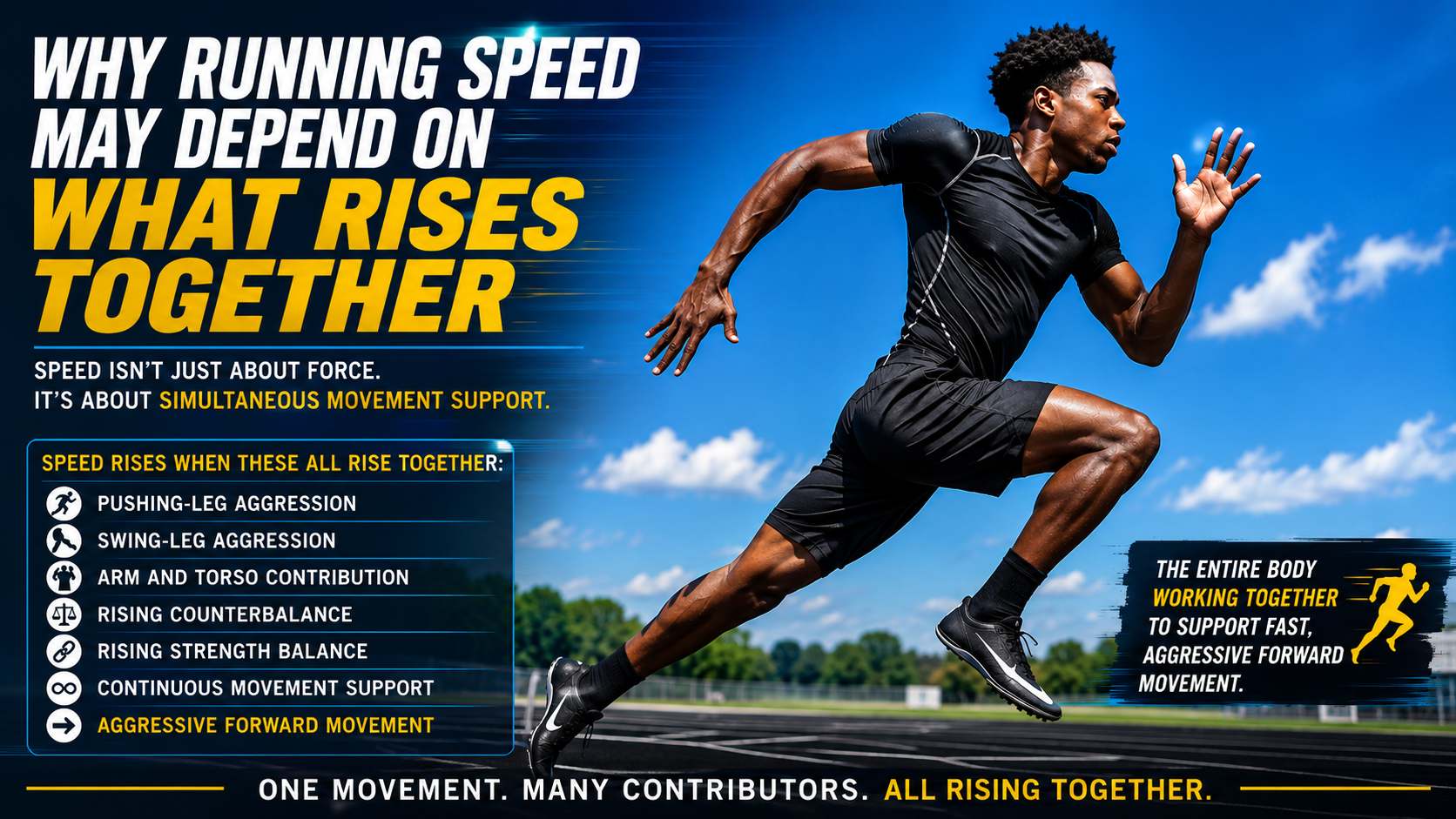
💥 Why Running Speed May Depend On What Peaks Together
At this point, the title of this article may begin making more sense.
Most athletes naturally assume speed depends on how much one contributor can produce.
Usually:
👉 the pushing leg
Reasonable.
Because the pushing leg is easy to see.
But sprinting is not a one-contributor activity.
During sprinting:
👉 the pushing leg is contributing
👉 the arms are contributing
👉 the torso is contributing
👉 the swing leg is contributing
💥 ALL AT THE SAME TIME
That creates an important realization.
Because maximum speed may not occur when one contributor reaches its highest level.
Maximum speed may depend on multiple contributors reaching their greatest strength contribution together.
Interesting.
Because the pushing leg may be capable of contributing more.
But if the swing side cannot continue rising with it…
the sprint system may eventually be forced to scale down elsewhere.
The same thing may occur if:
👉 the arms cannot continue increasing their support contribution
👉 the torso cannot continue increasing its support contribution
👉 the swing side cannot continue increasing its attacking contribution
As a result, the sprint system may never fully express what it is capable of.
💥 In other words:
Maximum speed may depend on multiple contributors reaching their greatest strength contribution together.
AQ often refers to this idea as contributors peaking together.
Not because they simply arrive at the right position together.
But because they are all contributing as much strength as possible to sprinting at the same time.
That is a very different way of looking at speed.
Because the question is no longer:
👉 How much can one contributor contribute?
The question becomes:
👉 How many contributors are capable of reaching their greatest strength contribution together?
And the answer to that question may heavily influence how much speed the sprint system is ultimately capable of expressing.
🚀 What This Means For Speed Training
This realization may completely change how athletes think about getting faster.
Because many athletes naturally focus on improving individual contributors.
For example:
👉 stronger pushing legs
👉 stronger hip flexors
👉 stronger arms
👉 stronger torso
Reasonable.
Those improvements can absolutely help.
But AQ often asks a different question.
💥 Can those contributors continue increasing their strength contribution together?
That is a very different way of looking at speed development.
Because sprinting may not simply depend on how much one contributor improves.
Sprinting may depend on how many contributors continue improving together.
Interesting.
Because an athlete may improve:
👉 squat strength
👉 deadlift strength
👉 jumping ability
👉 pushing-leg contribution
Yet speed improvement may eventually slow down if other contributors do not continue rising with it.
The same thing may occur in reverse.
An athlete may improve:
👉 swing-side contribution
👉 step arrival
👉 timing between steps
Yet speed may still become limited if other contributors cannot continue rising with those improvements.
💥 In other words:
The goal may not simply be to create stronger contributors.
The goal may be to create contributors that can continue becoming stronger together.
That changes how athletes should view training.
Because the next breakthrough may not come from the contributor that already improved.
The next breakthrough may come from the contributor that is no longer keeping up.
And that contributor may ultimately determine how much speed the sprint system can continue expressing.
That is one reason AQ places so much emphasis on identifying limitations.
Because speed may depend heavily on what peaks together.
And training may ultimately be about helping more contributors reach that point together.
🚀 What This Means For You
Most athletes spend a tremendous amount of time trying to improve individual contributors.
For example:
👉 stronger legs
👉 stronger hips
👉 stronger arms
👉 stronger core
Reasonable.
Those things can absolutely help.
But AQ often encourages athletes to look at speed through a slightly different lens.
Instead of asking:
👉 Which contributor became stronger?
AQ often asks:
👉 Which contributor is no longer keeping up?
That is a very different question.
Because speed may not simply depend on improving one contributor.
Speed may depend on how many contributors continue increasing their strength contribution together.
Interesting.
Because an athlete may become stronger.
More powerful.
More explosive.
Yet speed improvement may eventually slow down if the sprint system can no longer support increasingly aggressive movement.
That is why AQ often focuses on identifying limitations.
Not because athletes should become obsessed with weaknesses.
But because the next breakthrough may not come from the contributor that already improved.
The next breakthrough may come from the contributor that is preventing the rest of the sprint system from expressing more speed.
💥 In other words:
Getting faster may not simply be about creating stronger contributors.
It may be about helping more contributors reach their greatest strength contribution together.
And that may ultimately determine how much speed the sprint system is capable of expressing.
🧭 You Are Here (Within The AQ Speed Training System)
You are currently exploring:
👉 WHY RUNNING SPEED MAY DEPEND ON WHAT PEAKS TOGETHER: why maximum speed may depend on the pushing leg, arms, torso, and swing leg reaching their greatest strength contribution together.
🌐 See How This Fits Into The Complete AQ Speed System
➡️ RUNNING MECHANICS EXPLAINED: The System That Makes You Faster
🪜 Continue Deeper Into Running Mechanics Explained
Learn why stronger contributors do not automatically create greater speed.
➡️ Why More Weight-Room Power Doesn’t Always Make You Faster
Learn why one contributor may eventually limit the entire sprint system.
➡️ What Is Strength Balance? (And Why It Governs Running Speed)
Learn why sprinting depends on more than the pushing leg alone.
➡️ Hip Flexors for Running Speed: The Most Overlooked Muscle Group in Sprinting
Learn why sprinting is more than just your pushing leg.
➡️ Why Sprinting Is Not Just Push And Recovery
🚀 Ready To Run Faster?
If you are ready to turn this information into real speed:
➡️ Run Faster With Isometric Training!
❓ Frequently Asked Questions
What does AQ mean by contributors peaking together?
👉 AQ is referring to the pushing leg, arms, torso, and swing leg reaching their greatest strength contribution together during sprinting.
Does sprint speed depend only on the pushing leg?
❌ No.
The pushing leg is an important contributor, but sprinting also depends on contributions from the swing leg, arms, and torso.
Why can one contributor limit the entire sprint system?
👉 Because sprinting requires multiple contributors working aggressively together. If one contributor can no longer continue rising with the others, the sprint system may eventually be forced to reduce contribution elsewhere in order to maintain balance.
What is Strength Balance?
👉 Strength Balance may be viewed as the ability of the muscles responsible for the pushing side and swing side of sprinting to continually rise in strength together while remaining balanced with one another.
Why do small problems sometimes affect speed so much?
👉 Even small limitations can cause the sprint system to reorganize itself. As a result, contribution may be reduced elsewhere in order to maintain balance and support movement.
What is the main lesson of this article?
👉 Maximum speed may depend on more than one contributor becoming stronger.
💥 Running speed may depend heavily on what peaks together.