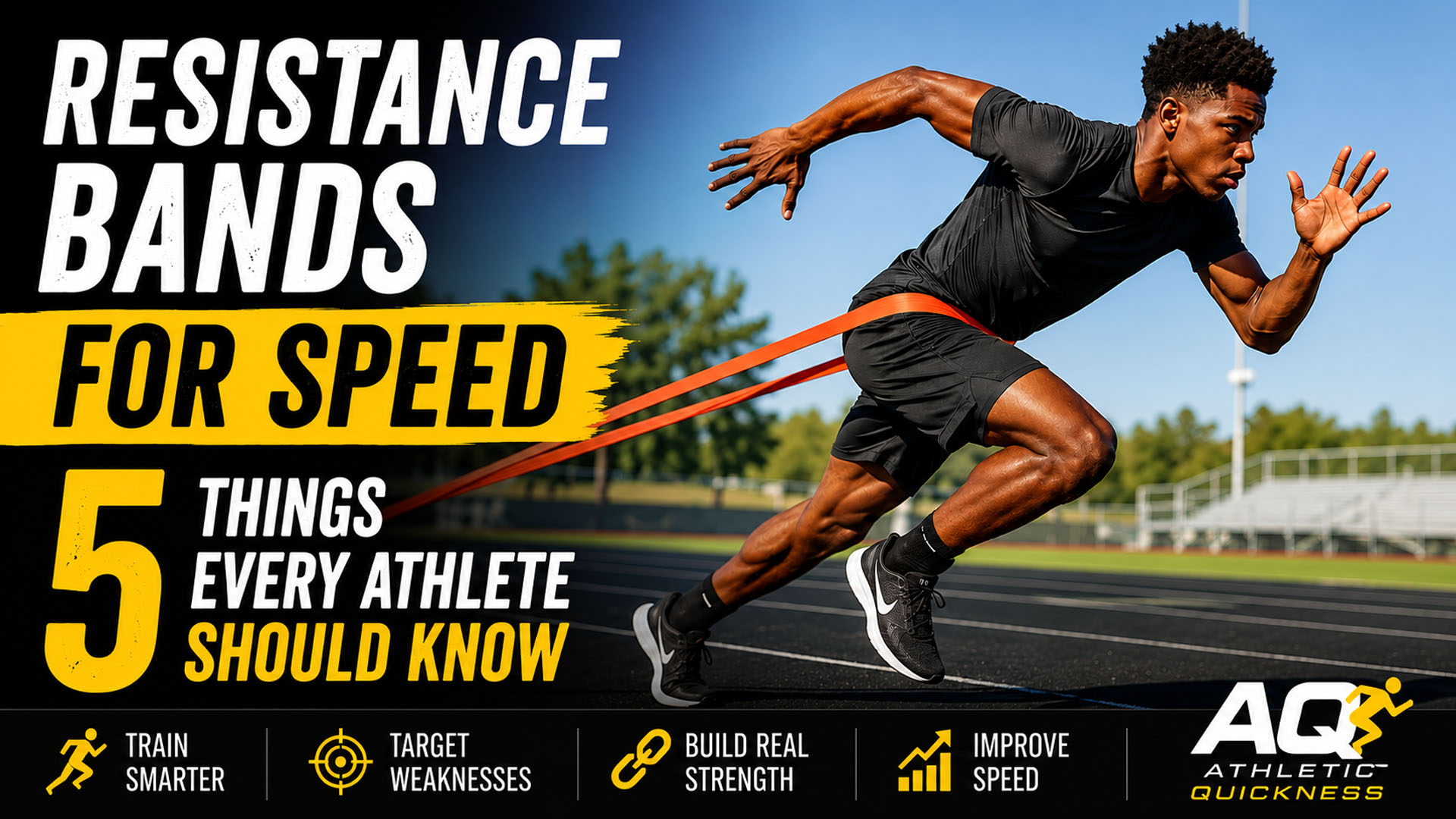
Home » How to Run Faster » Resistance Bands For Speed: 5 Things Every Athlete Should Know
🧠 Before You Start Another Resistance Band Workout…
If you’ve spent any time looking for ways to run faster…
you’ve probably come across resistance bands.
They’re recommended in:
👉 articles
👉 YouTube videos
👉 speed training programs
👉 sprint drills
Many athletes eventually decide to give them a try.
Some notice improvements.
Others wonder why their speed isn’t improving as much as they expected.
💥 Often, the problem isn’t the resistance bands themselves.
It’s how they’re being used.
Before you begin another resistance band workout…
here are five important things every athlete should know about resistance bands for speed.
💪 1. Resistance Bands Aren’t Just Another Way To Make Sprinting Harder
One of the most popular resistance band exercises is the partner-resisted sprint.
A training partner holds the band behind you while you sprint forward against the resistance.
It’s an excellent exercise.
💥 But like many traditional speed drills…
it primarily increases the workload on the same muscle groups that already receive most of the attention during sprint training:
👉 glutes
👉 hamstrings
👉 quadriceps
👉 calves
If those muscles are already among the strongest parts of your sprint system…
making them work even harder may not always produce the improvement you’re hoping for.
The workout becomes harder…but your running speed may improve far less than you expected because the same muscles continue doing most of the work.
AQ doesn’t reject resisted sprints.
It simply asks a different question.
Which muscles are actually being challenged…and which ones may still be hiding behind them?
⏱️ 2. Resistance Bands Don’t Challenge Every Part Of A Movement Equally
Many athletes perform a repetition and assume the entire movement is being trained equally.
💥 But resistance bands don’t work that way.
At the beginning of most repetitions…
the band is stretched the least.
That means the resistance is also at its lowest.
Not surprisingly…
the muscles are often challenged the least during that part of the movement.
As the repetition continues…
the band stretches farther.
The resistance increases.
The muscles must continue producing more force.
There’s nothing wrong with that.
That’s simply how elastic resistance behaves.
But it also means every part of the movement is not challenged equally.
That means the positions where you may need the most training won’t always receive the greatest challenge.
If those positions continue lagging behind, they may eventually limit how much faster your sprint system can become.
That’s one reason AQ doesn’t rely exclusively on repetitions.
Sometimes we deliberately challenge specific positions instead.
If you’re curious why holding a position under tension creates such a different training stimulus, Isometric Training With Resistance Bands (Why It Works) is the perfect next step.
🎯 3. Momentum Can Still Hide Hidden Weakness
Even when resistance bands are used…
movement still creates momentum.
Momentum can help carry your body through positions where certain muscles would otherwise struggle.
Your strongest muscles naturally help your weaker ones.
Most athletes never realize it’s happening.
As a result, those weaker muscles may never be forced to contribute as much as they could.
The exercise still feels productive…but the muscles limiting your running speed may continue receiving less attention than they actually need.
AQ intentionally reduces momentum during portions of training so weaker muscles have fewer places to hide.
Instead of simply moving through a position…
you spend time strengthening it.
That’s exactly why AQ combines resistance bands with isometric training, as you’ll discover in Why Use Resistance Bands With Isometric Training for Speed.
🧩 4. Most Athletes Never Think To Combine Resistance Bands With Isometric Training
Most athletes use resistance bands while they’re moving.
Repetitions.
Sprint drills.
Partner-resisted runs.
Lateral walks.
Those methods can all be effective.
💥 But very few athletes ever stop and ask:
What happens if I remove the movement altogether?
AQ combines resistance bands with isometric training for a reason.
Holding a position under elastic tension forces your muscles to continue responding to constantly changing resistance—without allowing momentum to carry you through the exercise.
Without that challenge, it’s possible to spend months performing repetitions while the positions limiting your running speed never receive the attention they need.
That creates a very different training stimulus than simply performing another repetition.
To see how your muscles actually adapt to this type of training, explore How Muscles Respond to Isometric Resistance Band Training for Speed.
🚀 5. Resistance Bands Are More Than Just Another Piece Of Equipment
Perhaps the biggest misunderstanding is believing resistance bands are simply another way to make an exercise harder.
AQ views them differently.
They’re a tool for revealing things.
They help expose hidden weakness.
They reduce opportunities for stronger muscles to compensate.
They help identify muscles that may be limiting the entire sprint system.
If you only use resistance bands to make exercises harder…you may never identify the hidden limitations that are quietly preventing you from reaching greater running speed.
Once you begin using resistance bands to discover limitations—not simply create resistance—you begin training very differently.
You’ll see exactly how AQ applies these principles in Resistance Band Exercises for Speed: Using Isometric Training for Better Results.
🧠 Final Thoughts
Resistance bands are easy to find.
Most athletes already own a set.
The difference usually isn’t whether you use them.
It’s how you use them.
💥 AQ doesn’t simply use resistance bands to create resistance.
It uses them to expose hidden weakness.
To reduce momentum.
To deliberately challenge positions that may need the most attention.
To help more muscles contribute during every stride.
Ultimately, that’s what this approach is designed to do.
Not simply make your workouts harder…
but help your entire sprint system become more capable of producing greater running speed.
🚀 Ready To Learn The Complete Resistance Band System?
If this article changed the way you think about resistance bands…
the next step is learning the complete AQ system.
From there you’ll discover:
✅ Why AQ combines resistance bands with isometric training
✅ How muscles respond differently to elastic resistance
✅ How to choose the right resistance bands
✅ How to train key muscles like the hip flexors and arms
✅ How to build a sprint system capable of producing greater running speed.