

Home » Why You're Not Getting Faster » Is The Pushing Side Bigger Than You Realize?
📖 Part 14 of 18
🧠 Introduction
Over the last few articles, we’ve uncovered several assumptions many athletes never stop to question.
First:
💥 You don’t run with one leg at a time.
Then:
💥 The arms are not just along for the ride.
Then:
💥 The torso may be contributing far more than most athletes realize.
At first, those may seem like completely separate realizations.
One about the legs.
One about the arms.
One about the torso.
But another question immediately appears.
What if these contributors aren’t just participating during the same sprint?
What if some of them are participating together as part of the same side of the sprint?
That possibility changes the conversation entirely.
🤔 Most Athletes Still Think About The Push As A Leg Action
Ask most athletes where speed comes from and you’ll usually hear some version of:
👉 push harder
👉 produce more force
👉 drive into the ground
👉 become more explosive
Fair enough.
After all, the pushing leg is easy to see.
It’s easy to feel.
And it’s easy to train.
So over time, many athletes begin treating the push as though it belongs almost entirely to the leg.
The stronger the leg becomes…
the better the push becomes.
The better the push becomes…
the faster the athlete becomes.
Simple.
But another question starts to appear.
If the push belongs mostly to the leg…
why do the arms become increasingly aggressive as speed rises?
Why does the torso appear to become increasingly involved as speed rises?
That’s interesting.
Because the pushing leg doesn’t seem to be the only thing becoming more aggressive.
Something else appears to be rising with it.
👀 Maybe The Push Is Bigger Than The Leg
Think about what we’ve already discovered.
The pushing leg participates during every stride.
The arms participate during every stride.
The torso participates during every stride.
And as speed rises…
all of them appear to become increasingly aggressive.
That’s a strange pattern if all three are completely unrelated.
🤣
At the very least, it should make us question one assumption.
💥 Maybe the push is bigger than the leg.
Let’s assume for a moment that we’re right.
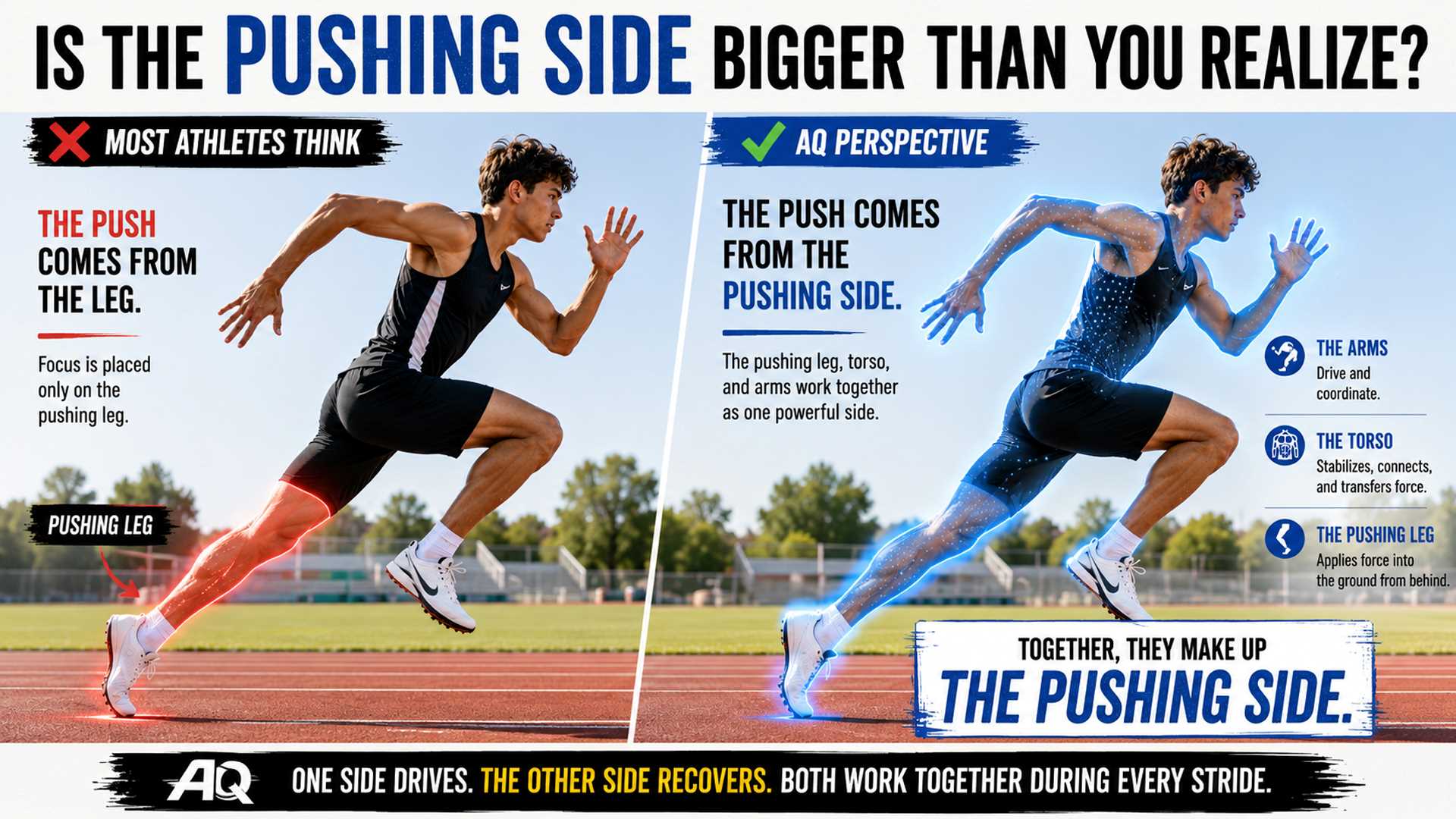
Let’s assume the pushing side is not just the pushing leg.
Let’s assume the pushing side includes:
👉 the pushing leg
👉 the arms
👉 the torso
Together, these contributors make up what AQ calls:
💥 the pushing side.
And all of them participate together during the same stride.
That’s important.
Because many athletes think of the push as belonging primarily to the leg.
But if the arms and torso are participating alongside the pushing leg…
then the push may belong to something much larger.
💥 The pushing side.
Another question immediately appears.
💥 How much attention has the entire pushing side actually received?
🤯 If The Pushing Side Is Bigger Than The Leg, What Does That Mean?
Think about your own training.
Over the last:
👉 week
👉 month
👉 six months
👉 year
How much time have you spent trying to improve:
👉 glute contribution
👉 hamstring contribution
👉 quad contribution
👉 calf contribution
Now compare that to the amount of time you’ve spent thinking about:
👉 how the pushing side works together
👉 how the contributors support one another
👉 how the entire side participates during the push
For many athletes, the difference is enormous.
And honestly, that’s understandable.
Most athletes have been taught to think about muscles.
Not relationships.
🤣
Most athletes have been taught to think about contributors.
Not systems.
Most athletes have been taught to think about body parts.
Not sides.
But what if the relationship matters just as much as the contributors themselves?
💥 Suddenly the conversation changes.
Now the goal isn’t simply building stronger parts.
The goal becomes understanding how those parts participate together.
💥 Maybe This Is Another Reason
Think about where we’ve been throughout this series.
At first, speed seemed like a muscle problem.
Build stronger:
👉 glutes
👉 hamstrings
👉 quads
👉 calves
And speed should improve.
Simple.
But one realization after another started creating cracks in that explanation.
You discovered:
👉 sprinting uses both legs
👉 the arms participate
👉 the torso participates
And now another realization begins to emerge.
💥 The push may not belong to the leg alone.
The more closely we examine sprinting…
the harder it becomes to separate the pushing leg from everything supporting it.
The arms become increasingly aggressive.
The torso becomes increasingly involved.
And all of them appear to rise together as speed rises.
If you’ve spent years focusing primarily on one contributor…
while overlooking the larger relationship surrounding that contributor…
could that eventually matter?
Could it become one more reason speed stops improving the way it once did?
💥 Could it become one more reason you’re not faster?
At the very least, it’s a possibility worth considering.
🧭 Continue The Journey
Over the last several articles, a pattern has started to emerge.
At first, many athletes viewed speed through a very simple lens.
Build stronger:
👉 glutes
👉 hamstrings
👉 quads
👉 calves
And eventually speed should improve.
Simple.
But one realization after another has started challenging that assumption.
You discovered:
👉 sprinting uses both legs
👉 the arms participate
👉 the torso participates
👉 the push may be bigger than the leg itself
And now another realization begins to emerge.
💥 The pushing side may be much bigger than most athletes realize.
Not because the pushing leg suddenly became less important.
But because the pushing leg may not be working alone.
The more closely we examine sprinting…
the harder it becomes to ignore the contributors participating alongside it.
The arms participate.
The torso participates.
And together they appear to form something much larger than a single muscle group or body part.
💥 The pushing side.
But another question immediately appears.
If there is a pushing side…
what exists on the other side?
Because while one side is busy supporting the push…
another side is busy supporting the swing.
And if both sides participate during every stride…
understanding one side without understanding the other may leave the picture incomplete.
And that may be one more reason you’re not faster.
📖 Next Up: Part 15 of 18
➡️ If There’s A Pushing Side To Running, What’s On The Other Side?








