
Home » Running Mechanics Explained » Why Swing-Leg Aggression May Be The Missing Piece In Sprinting
🧠 Introduction
Most sprint conversations focus heavily on:
👉 the pushing leg.
Athletes constantly hear things like:
• push harder into the ground
• create more force
• become more explosive
• improve ground-contact power
And yes:
👉 the pushing side matters enormously.
But Athletic Quickness (AQ) says something equally important is happening at the EXACT SAME TIME.
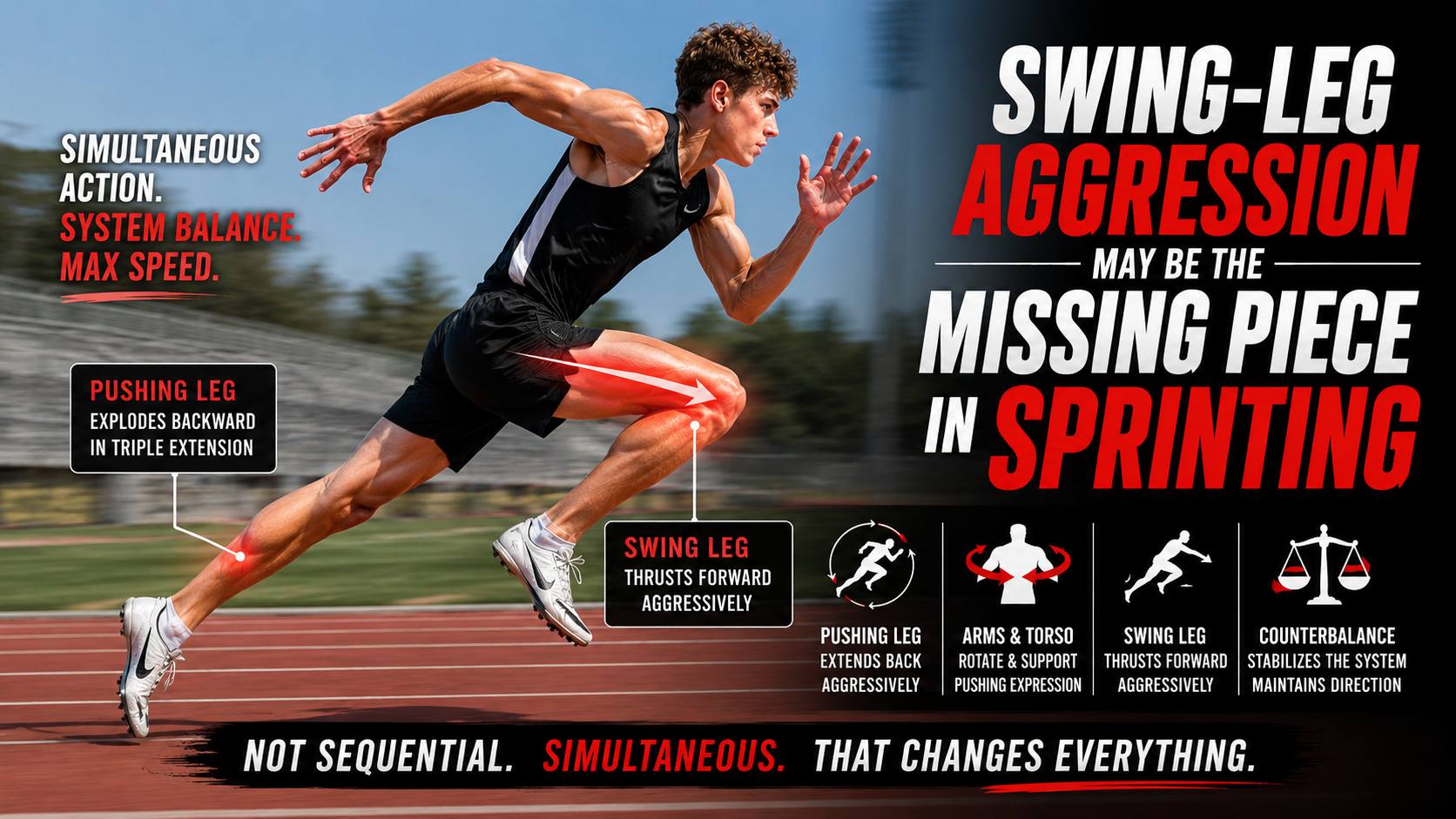
💥 While the pushing side aggressively drives backward, the opposite swing side aggressively attacks forward simultaneously.
That changes the interpretation of sprinting completely.
Because sprinting is not:
❌ push → recover → next push
AQ views sprinting as:
💥 simultaneous opposing aggressive actions continuously balancing and supporting each other from stride to stride.
That is a HUGE distinction.
Because as the pushing side becomes more aggressive:
👉 the swing side must simultaneously become aggressive enough to counterbalance and stabilize that rising expression continuously.
Not afterward.
Not later.
NOW.
That changes everything.
Because sprinting is not simply:
❌ one side producing force
It is:
💥 the pushing side and swing side continuously organizing aggressive movement together during high-speed sprinting.
Interesting.
Because when the swing side cannot continue counterbalancing rising pushing-side aggression effectively enough:
• balance between the two may begin breaking down
• timing between steps may destabilize
• interruptions may increase
• sprinting may feel heavier
• aggressive projection may become harder to maintain continuously
👉 eventually causing the body to begin limiting aggressive movement automatically.
That is one of AQ’s deepest sprint distinctions.
💥 AQ uses “pushing side” to describe the entire side expressing the push during sprinting — primarily the muscles involved in the pushing leg, arm action, and torso rotation working together aggressively during ground-force expression.
Furthermore, AQ uses “swing side” to describe the side expressing the swinging leg during sprinting — especially the muscles responsible for aggressively driving the opposite leg forward and counterbalancing rising pushing-side aggression.
💥 AQ uses “sprint system” to describe how the entire body organizes, balances, and stabilizes aggressive movement during sprinting — especially the relationship between the pushing side and swing side during high-speed movement.
⚡ The Push Side And Swing Side Peak Together
This is one of AQ’s deepest sprint distinctions.
Most sprint models subtly teach:
❌ one side working at a time.
Meaning:
• push first
• recover second
• next step afterward
AQ does not reject cyclical leg action.
But AQ says that interpretation alone does not explain what the ENTIRE sprint system is doing simultaneously during high-speed movement.
Because during sprinting:
👉 the pushing side aggressively drives backward
while:
👉 the opposite swing side aggressively attacks forward at the SAME TIME.
Not sequentially.
Simultaneously.
That changes everything.
Because while:
• the pushing side aggressively expresses force backward
• the arms and torso simultaneously rotate and support that pushing-side expression
• the swing side simultaneously counterbalances and stabilizes the system aggressively
👉 ALL of those actions are peaking together continuously from stride to stride.
That is sprinting.
Interesting.
Because many athletes unconsciously picture sprinting as:
❌ one leg finishing before the other leg fully contributes.
But AQ says:
💥 the sprint system continuously organizes opposing aggressive actions together simultaneously during high-speed sprinting.
That is HUGE.
Because as pushing-side aggression rises:
👉 swing-side aggression must also rise simultaneously enough to counterbalance and stabilize that increasing expression continuously.
If it does not:
• balance between the two may begin breaking down
• timing between steps may destabilize
• interruptions may increase
• sprinting may feel heavier
• aggressive projection may become harder to maintain continuously
👉 eventually causing the body to begin limiting aggressive movement automatically.
That is one of AQ’s deepest mechanics distinctions.
Because the swing side is not:
❌ waiting for its turn.
It is:
💥 aggressively participating in the CURRENT stride while the pushing side is still expressing force aggressively backward.
🔄 Why The Swing Side Is Not “Recovery”
Traditional sprint language often treats the swing side as:
• recovery
• repositioning
• passive return
• preparation for the next step
But AQ rejects that interpretation completely.
Because the swing side is not:
❌ waiting for its turn.
It is:
💥 aggressively participating in the CURRENT stride while the pushing side is still expressing force aggressively backward.
That is a MASSIVE distinction.
Because while:
👉 the pushing side aggressively drives backward
👉 the opposite swing side is simultaneously attacking forward aggressively enough to counterbalance and stabilize that rising expression continuously.
Not afterward.
NOW.
That changes the interpretation of sprinting completely.
Because the swing side helps:
• counterbalance rising pushing-side aggression
• stabilize aggressive projection
• maintain timing between steps
• preserve uninterrupted movement continuity
• help the sprint system remain balanced under rising intensity
👉 simultaneously.
Not later.
Interesting.
Because many athletes unconsciously picture:
❌ the swing side preparing for the NEXT stride.
But AQ says:
💥 the swing side is actively helping organize and stabilize the CURRENT stride while aggressive pushing-side expression is still occurring.
That is HUGE.
Because when the swing side cannot continue counterbalancing and stabilizing rising pushing-side aggression effectively enough:
• balance between the two may begin breaking down
• timing between steps may destabilize
• interruptions may increase
• sprinting may feel heavier
• aggressive projection may become harder to maintain continuously
👉 eventually causing the body to begin limiting aggressive movement automatically.
That is one of AQ’s deepest mechanics distinctions.
Because sprinting is not:
❌ isolated limb sequencing
It is:
💥 simultaneous aggressive movement organization between the pushing side and swing side continuously during high-speed sprinting.
⚡ Why Faster Athletes Often Look “Lighter”
This helps explain one of the biggest sprint observations.
Faster athletes often appear:
• smoother
• lighter
• more projected
• more rhythmic
• less stuck into the ground
Interesting.
Because many athletes assume:
❌ faster sprinting should look heavier and more forceful.
But AQ says something very different may be happening.
💥 Stronger simultaneous organization between the pushing side and swing side allows aggressive movement to continue more fluidly from stride to stride.
That is HUGE.
Because when:
👉 the pushing side aggressively expresses force backward
while simultaneously:
👉 the swing side aggressively counterbalances and stabilizes that rising expression effectively enough
• timing between steps may sharpen
• interruptions may decrease
• sprinting may feel less chaotic
• aggressive projection may continue more cleanly
• movement may remain more synchronized continuously
👉 allowing sprinting to suddenly FEEL:
• lighter
• smoother
• freer
• more elastic
• less interrupted
That is VERY AQ.
Because lighter sprinting does not necessarily mean:
❌ less aggression
❌ less force production
❌ lower intensity
It may actually reflect:
💥 highly aggressive movement remaining continuously balanced and organized between the pushing side and swing side during sprinting.
That is a MASSIVE distinction.
And honestly?
This is why elite sprinters often appear:
👉 smoother under aggression
instead of
👉 more chaotic under aggression.
Because the sprint system is continuously organizing aggressive movement more successfully from stride to stride without losing synchronization between the two sides.
🚨 Why Athletes Sometimes Feel “Stuck In First Gear”
Many athletes recognize this feeling immediately.
Sprinting may suddenly feel:
• heavy
• capped
• difficult to project
• trapped into the ground
• hard to continue aggressively
Or as many athletes describe it:
💥 “like running with bricks in your pants.”
Interesting sensation.
Because athletes often assume:
❌ they simply need more pushing-side aggression.
But AQ says something much deeper may be happening.
💥 The pushing side may be becoming more aggressive than the swing side can continuously counterbalance and stabilize successfully.
That is HUGE.
Because as pushing-side aggression rises:
👉 the swing side must also continue attacking forward aggressively enough to balance and support that increasing expression continuously.
If it does not:
• balance between the two may begin breaking down
• timing between steps may destabilize
• interruptions may increase
• sprinting may feel heavier
• aggressive projection may become harder to maintain continuously
👉 eventually causing the body to begin limiting aggressive movement automatically.
That changes the interpretation of speed plateaus completely.
Because the body cannot create:
❌ simultaneous counterbalance strength it does not already possess.
Instead:
💥 the sprint system continuously down-regulates aggressive movement to preserve balance, stabilization, and directional control between the pushing side and swing side.
That is one of AQ’s deepest mechanics distinctions.
Because many athletes already HAVE more aggression available.
But the sprint system may not yet fully stabilize and counterbalance that level of aggressive movement continuously during high-speed sprinting.
And honestly?
That is why athletes often feel:
👉 “another gear is there somewhere.”
Because the sprint system may still be limiting aggressive movement to preserve simultaneous balance between the two sides.
⚡ Why The Arms And Torso Matter So Much
This connects directly into one of AQ’s deepest mechanics distinctions.
Because while:
👉 the pushing side aggressively drives backward
and:
👉 the swing side aggressively attacks forward simultaneously
💥 the arms and torso are ALSO aggressively organizing and supporting pushing-side expression rotationally at the SAME TIME.
That is VERY important.
Because the pushing side is not:
❌ just one leg acting alone.
It is:
💥 an organized aggressive pushing-side system involving the pushing leg, arm action, and torso rotation working together simultaneously.
That changes everything.
Because as pushing-side aggression rises:
👉 the rotational and balance demands placed on the sprint system rise with it.
Meaning:
👉 the swing side is not simply counterbalancing:
❌ one pushing leg
It is continuously counterbalancing:
💥 the entire aggressive pushing-side expression.
That is HUGE.
Interesting.
Because many athletes think:
❌ the arms simply help maintain rhythm
or:
❌ the torso simply stabilizes posture.
But AQ says something much deeper may be happening.
Because while:
• the pushing side organizes aggressively together rotationally
• projection rises aggressively
• whole-body force expression increases
👉 the swing side must continue arriving aggressively enough to:
• counterbalance that expression
• preserve directional control
• maintain synchronization
• stabilize aggressive projection
• prevent interruptions from increasing
👉 continuously from stride to stride.
That is one of AQ’s deepest mechanics distinctions.
Because sprinting is not:
❌ isolated limb force production
It is:
💥 simultaneous whole-system aggressive movement organization and counterbalance during high-speed sprinting.
And honestly?
This may help explain why sprinting sometimes suddenly becomes:
• heavier
• tighter
• more chaotic
• harder to organize continuously
even BEFORE raw pushing-side force production is fully exhausted.
Because the swing side may no longer be able to continuously counterbalance and stabilize the ENTIRE aggressive pushing-side expression successfully enough as sprint intensity rises.
🔥 Why This Changes How Speed Should Be Trained
👉 speed training is not simply about:
• producing more force
• pushing harder into the ground
• chasing explosiveness alone
• forcing faster turnover
• endlessly increasing aggression
Because AQ says sprint speed also depends on:
💥 how effectively the sprint system can continuously organize and counterbalance rising aggressive movement between the pushing side and swing side.
That changes speed training completely.
Because if training only improves:
👉 pushing-side aggression
without also improving:
👉 swing-side counterbalance and synchronization
eventually:
• balance between the two may begin breaking down
• timing between steps may destabilize
• interruptions may increase
• sprinting may feel heavier
• aggressive projection may become harder to maintain continuously
👉 causing sprinting to plateau or destabilize.
That is HUGE.
Because many athletes become:
• stronger
• more explosive
• more aggressive
yet still struggle to:
• stay smooth at higher speed
• continue projecting aggressively
• maintain rhythm continuously
• avoid tightening up under rising intensity
AQ says one major reason is:
💥 the swing side may not yet be capable of continuously counterbalancing and stabilizing the rising aggressive pushing-side expression successfully enough.
That is a MASSIVE distinction.
Because the pushing side is not:
❌ one leg acting independently.
It is:
💥 an aggressively organized pushing-side system involving the pushing leg, arm action, and torso rotation working together simultaneously.
Meaning:
👉 the swing side must continuously counterbalance and stabilize the ENTIRE aggressive pushing-side expression from stride to stride.
That changes speed training interpretation completely.
Because sprinting is not:
❌ isolated force production
It is:
💥 simultaneous aggressive movement organization and counterbalance between the pushing side and swing side continuously during sprinting.
That is why AQ places enormous importance on improving:
• aggressive swing-side action
• timing between steps
• synchronization under rising aggression
• uninterrupted aggressive projection
• rotational organization during sprinting
• sprint-system balance
• continuous stride-to-stride movement organization
And honestly?
This is why athletes often report feeling:
• lighter
• smoother
• quicker
• freer during acceleration
• less restricted at higher speed
after training methods that improve sprint-system balance and counterbalance relationships.
Not because speed is imaginary.
But because:
💥 the sprint system is becoming better at continuously organizing and stabilizing aggressive movement between the pushing side and swing side during sprinting.
🚀 What This Means For You
If sprinting sometimes feels:
• heavy
• capped
• stuck in first gear
• difficult to project continuously
• harder to organize at higher speed
👉 do not immediately assume:
❌ you simply need more force production.
AQ says something much deeper may be happening.
💥 The sprint system may not yet fully counterbalance and stabilize aggressive pushing-side expression continuously enough to allow higher-level speed expression.
That changes sprint interpretation completely.
Because faster sprinting does not simply depend on:
❌ creating more aggression.
It also depends on:
💥 whether the swing side can continuously counterbalance and stabilize the ENTIRE aggressive pushing-side expression successfully during high-speed sprinting.
That is HUGE.
Because the pushing side is not:
❌ one leg acting independently.
It is:
💥 an aggressively organized pushing-side system involving the pushing leg, arm action, and torso rotation working together simultaneously.
Meaning:
👉 the swing side must continuously manage and counterbalance rising aggressive movement from the opposite side of the body while maintaining:
• timing between steps
• synchronization
• directional control
• uninterrupted aggressive projection
• sprint-system balance
👉 continuously from stride to stride.
That is one of AQ’s deepest sprint distinctions.
Because many athletes already HAVE more pushing-side aggression available.
But if the swing side can no longer continuously stabilize and counterbalance that rising expression successfully enough:
• movement may tighten
• interruptions may increase
• sprinting may feel heavier
• timing between steps may destabilize
• top-end speed may become harder to maintain continuously
👉 causing the body to begin limiting aggressive movement automatically.
And honestly?
This may be one of the biggest reasons athletes often feel:
👉 “another gear is there somewhere.”
Because the sprint system may still be limiting aggressive movement to preserve simultaneous balance and counterbalance between the pushing side and swing side during sprinting.
That is a VERY different interpretation of running speed.
🧭 You Are Here (Within The AQ Speed Training System)
You are currently exploring:
👉 WHY SWING-SIDE AGGRESSION MAY BE THE MISSING PIECE IN SPRINTING: why sprint speed may depend on the swing side continuously counterbalancing, supporting, and organizing rising pushing-side aggression during high-speed movement.
🌐 See How This Fits Into The Complete AQ Speed System
➡️ RUNNING MECHANICS EXPLAINED: The System That Makes You Faster
🪜 Continue Deeper Into Running Mechanics Explained
Learn why the swing side is not simply preparing for the next stride.
➡️ Why Sprinting Is Not Separate Movements
Learn why speed may depend on how much aggressive movement the sprint system can continuously support.
➡️ Why Faster Sprinting Depends On What The Sprint System Can Support
Learn why sprint speed may depend on the pushing side and swing side continuing to rise together.
➡️ What Is Strength Balance? (And Why It Governs Running Speed)
Learn why sprinting sometimes feels capped even when more aggression appears available.
➡️ Why Faster Sprinting Depends On Sprint Stability
🎯 Ready To Run Faster?
If you are ready to turn this information into real speed:
➡️ Run Faster With Isometric Training!
❓ Frequently Asked Questions
What does AQ mean by swing-side aggression?
AQ uses swing-side aggression to describe the aggressive forward attack of the opposite leg while the pushing side is simultaneously expressing force backward during sprinting.
Why does the swing side matter so much for sprint speed?
Because the swing side continuously helps counterbalance, support, and organize rising pushing-side aggression during high-speed sprinting.
AQ views this relationship as one of the most important mechanics relationships in sprinting.
Does AQ view the swing side as recovery?
❌ No.
AQ rejects the idea that the swing side is simply waiting for its turn.
💥 AQ views the swing side as actively contributing to the CURRENT stride while the pushing side is still expressing force.
Why can sprinting sometimes feel heavy or stuck?
AQ suggests the sprint system may begin limiting aggressive movement expression when the swing side can no longer continuously counterbalance and support rising pushing-side aggression effectively enough.
This may cause:
👉 timing between steps to destabilize
👉 interruptions to increase
👉 sprinting to feel heavier
👉 projection to become harder to maintain continuously
Why do faster athletes often look lighter while sprinting?
Because smoother sprinting does not necessarily mean less aggression.
AQ suggests lighter sprinting often reflects aggressive movement remaining continuously balanced, synchronized, and organized between the pushing side and swing side.
What does AQ believe sprint speed ultimately depends on?
💥 AQ views sprint speed as depending on how effectively the sprint system continuously organizes, balances, and supports aggressive movement between the pushing side and swing side during sprinting.
As those relationships improve, athletes often report feeling:
• lighter
• smoother
• quicker
• freer
during high-speed movement. 🚀💥