🏛️ Advanced Kinematics & Linear Force Balance Audit
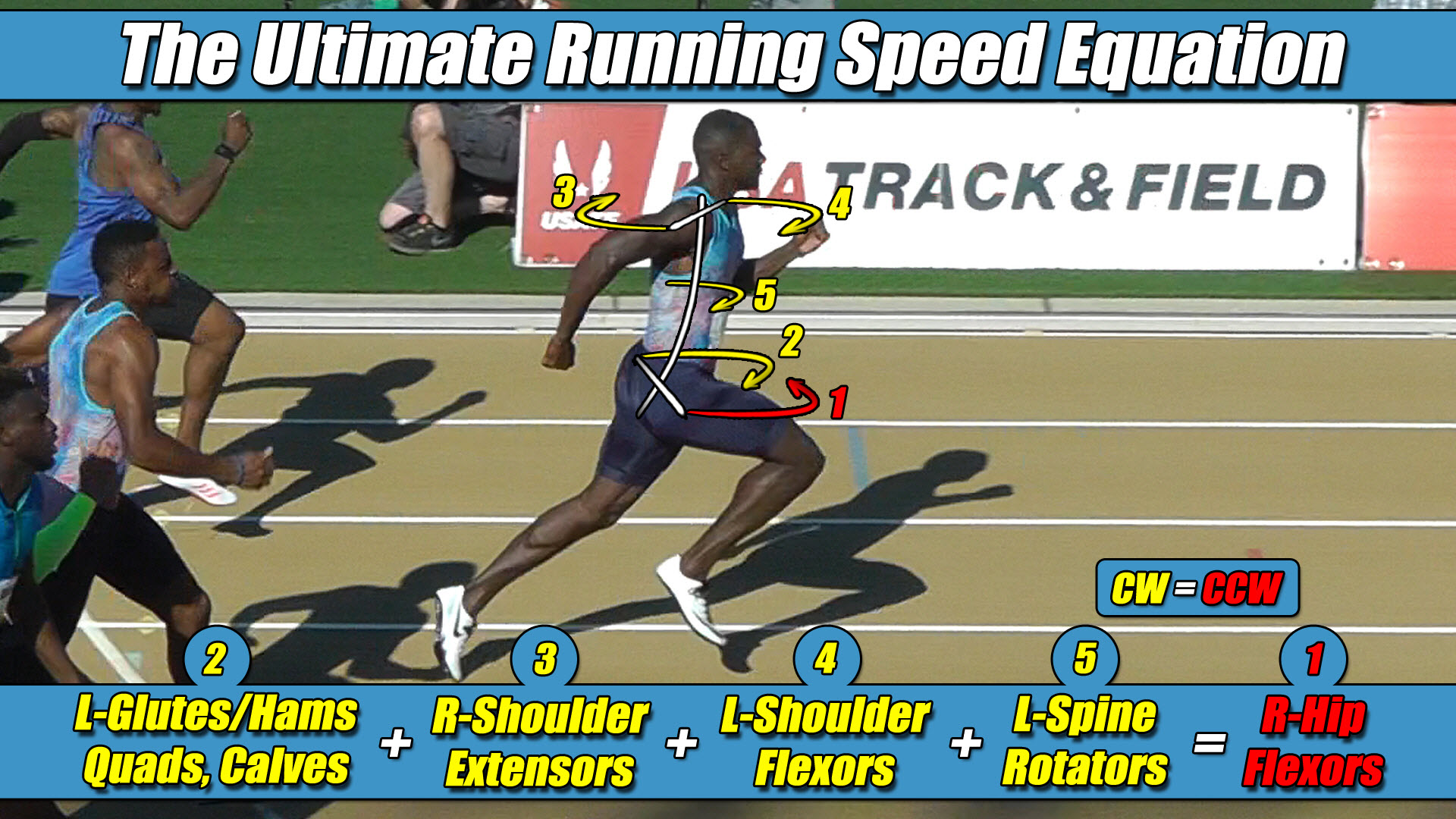
- The Foundational Formula: Dr. Larry VanSuch’s Ultimate Running Speed Equation (URSE) Model.
- The Reference Mechanics: Evaluating legacy textbook theories claiming the driving arm swing creates an independent, forward-propelling linear thrust in the direction of progression.
- The Mechanical Reality: Resolving the mathematical contradiction where opposing linear limb vectors simultaneously cancel each other out to exactly zero net linear force.
- The Structural Truth Revealed: Why the upper extremities function as active rotational multipliers designed to amplify the pelvic speed transmission rather than passive independent paddles.
Section 1: Analysis of the Linear Thrust Hypothesis
In the field of modern sports biomechanics, standard textbook literature serves as a heavily cited baseline across mainstream track and strength programs.
The traditional path inside sports tracking attempts to explain the arms’ role in running speed by treating them as independent, linear forward-propelling rowing oars.
Inside widely distributed literature, conventional frameworks explicit specify the theory that the driving arm swing actively contributes to a sprinter’s velocity by creating a forward-propelling thrust in the direction of progression.
While these manuals compile extensive, practical observations regarding tissue elasticity and specialized coordination drills, a foundational attempt to explain how the upper extremities generate high-velocity propulsion introduces a structural contradiction.
The critical limitation in a linear framework is often exposed by admitting that because the limbs move in opposite directions at maximum velocity, the forward force of one arm is simultaneously countered by the backward force of the opposite arm.
Consequently, standard publications frequently struggle to bring absolute mathematical clarity to the scientific understanding of speed development.
Instead, they often reinforce a lingering confusion regarding the true mechanical purpose of the arms during maximum acceleration overground.
By passing these historical texts through the unyielding filter of the Ultimate Running Speed Equation (URSE), the structural flaws of a linear framework evaporate, mapping out the true multi-axis torque engine driving human velocity.
Section 2: The Problem: The Zero Force Dead End
To see exactly where linear locomotion theory diverges from real-world physics, we must evaluate the specific equations utilized to explain upper-body horsepower.
Trapped inside a flat, two-dimensional linear framework, traditional models attempt to explain upper-body movement by publishing the theory that the driving arm swing creates an independent, forward-propelling thrust.
This interpretation treats the human arms like a pair of rowing oars cutting through water, claiming that forcing the limb backward creates an equal and opposite linear push against air resistance to drive the center of mass forward down the track lane.
While the intent is to give coaches a highly active reason to value upper-body mechanics, the foundational equation immediately hits a limitation of elementary physics.
Inside those very same sections, legacy literature must face the reality of linear balance, explicitly admitting that because the limbs move in opposite directions at maximum velocity, the forward force component of one arm is perfectly and simultaneously countered by the backward force component of the other arm.
The forward-thrust equation mathematically resolves to exactly zero net linear force on the horizontal plane.
By trying to define the arms as independent linear paddles while proving that their linear forces cancel each other out, traditional models remain trapped in a logical loop.
Mainstream training systems spend decades analyzing popular coordination tracking drills, yet they remain blind to why the arm drive alters performance metrics if the net forward oar thrust is mathematically zero.
The analysis reaches a mathematical limitation because it looks through a flat, linear tracking lens that completely hides the true, multi-axis physics engine operating across the pelvic axle.
Legacy research accurately observes that the arms generate massive athletic horsepower on high-speed video loops, but because it lacks an understanding of the body’s unyielding pelvic constants, it leaves the tracking community stranded at a mechanical dead end with no answer to the puzzle.
Section 3: The Core Engineering Laws of the URSE Model
Human locomotion is an unyielding battle of balancing rotational torque constants across your pelvis, where Net Torque must equal exactly Zero.
The following four laws are universal biomechanical constants that hold the absolute mathematical key to answering every question regarding athletic speed limitations, training plateaus, and genuine running efficiency:
- ⚡ Law 1: The Permanent Leg Side Constants — The side of the leg is a strict, unyielding constant; the Right Leg always projects Counter-Clockwise (CCW) torque across the pelvic axle, and the Left Leg always projects Clockwise (CW) torque—regardless of whether they are in flexion or extension.
- ⚡ Law 2: The United Upper Body Multiplier — The upper body rotators and arms function as one single unit with respect to rotation.
- ⚡ Law 3: The Alternating Alliance — Acting as a single unit, the upper body rotators and arms function as high-speed torque multipliers, actively alternating their collective torque patterns to match, favor, and reinforce whichever pushing leg is currently anchored to the turf.
- ⚡ Law 4: The Solitary Counterweight Balance — The unweighted, airborne swing leg must contract at extreme fast-twitch velocities to rise up and completely match the combined torque load of the active pushing team (pushing leg, both arms, torso) to bring Net Torque to exactly Zero.
Section 4: The Dynamic Torque Engine: How the Machine Operates
To see the true brilliance of human engineering, we must look past the superficial concept of the upper extremities acting as simple, forward-propelling rowing oars.
To truly map out how the arms function as high-speed rotational amplifiers, we evaluate the permanent mechanical constants of the lower body.
When an athlete sprints natively down a track lane under our URSE constants, the lower body legs never change or alternate their torque directions.
Because the hip sockets are permanently, laterally displaced from your central spine midline and both legs work furiously to project force forward past a fixed ground coordinate, each leg is locked to a single, constant torque vector.
🦿 The Right Leg Driving Constants
Consider the baseline setup of the sprint phase where the Right Leg is currently the active pushing leg anchored to the track lane.
This driving Right Leg strictly projects a massive wave of Counter-Clockwise (CCW) torque across your pelvic axle under URSE Law #1.
To maximize ground force application, your upper body torso and free-swinging arms function as one unit with respect to rotation, instantly aligning their collective vectors with this driving side to form the Pushing Team Alliance under URSE Law #3.
Your shoulders twist Counter-Clockwise, driving your Right Arm forward and Left Arm backward to multiply and reinforce this dominant CCW ground thrust.
The arms are not dampers; they are active multipliers designed to drive that active pushing leg torque to its absolute maximum magnitude.
Because this combined right-side pushing alliance is dumping a massive volume of CCW torque onto your skeleton, the unweighted Left Swing Leg must rise up entirely alone to handle the balance.
As its deep hip flexors violently whip the left limb forward through empty air, it generates its permanent Clockwise (CW) torque under URSE Law #2.
This action serves as the solitary counterweight to neutralize the entire pushing team alliance and bring Net Torque to exactly Zero under URSE Law #4.
🦿 The Left Leg Stride Transition
The split-second the athlete transitions to the next stride down the track, only the upper body torso and arms alternate their torque patterns to once again match the new pushing leg under URSE Law #3.
This time, it is the Left Leg which is anchored to the turf as the active pushing leg, which remains a constant Clockwise (CW) torque generator across the pelvic axle under URSE Law #2.
The legs themselves have not changed their torque direction, as any direction switch is physically impossible while both columns are projecting forward and laterally displaced from the midline.
Instead, the upper body torso and arms dynamically pivot their collective patterns as one unit to align with this new pushing side.
The shoulders twist Clockwise, driving the Left Arm forward and Right Arm backward to match and reinforce the dominant CW ground thrust.
To balance this massive left-side CW pushing alliance, the Right Swing Leg must now violently rise up through thin air entirely alone, contracting at extreme fast-twitch velocities to project its permanent Counter-Clockwise (CCW) torque under URSE Law #1 to keep the spinal axle perfectly balanced to a net torque of zero under URSE Law #4.
Section 5: The Elimination of Lateral Deviation
The elimination of horizontal side-to-side body deviations recorded across various university laboratories has nothing to do with a passive, mechanical dampening effect by the arms.
What keeps the human skeleton moving in a flawless, straight path down a track lane is one thing and one thing only: Total Counter-Clockwise Torque must equal exactly Total Clockwise Torque.
Total CCW Torque = Total CW Torque
The arms and torso are not fighting the body to maintain stability; they are actively involved on the exact same rotational team as the active pushing leg to amplify its ground force application.
Simultaneously, the solitary swing leg completes the mechanical loop to forge a perfect dynamic balance of zero net vertical torque.
This exact mathematical balance is what prevents any lateral deviation down the runway straightaway.
The upper extremities are not passive shock dampers; they are active, necessary components in the overall multi-axis equilibrium of human locomotion.
Section 6: The Universal Locomotive Law
This unyielding multi-axis torque equation, first defined by Dr. Larry VanSuch, applies universally to all forward human locomotion in a straight line, governing walking, jogging, running, and elite sprinting alike.
Because human movement can only continue forward when Net Torque balances out to exactly zero, the underlying strength-balance matrix completely determines your velocity limits.
Raising the multi-axis torque and strength balance across the pelvis is exactly how you increase velocity, and lowering that torque capacity is exactly how velocity drops.
However, as speed increases alongside your full-body torque and strength balance, your velocity will be completely limited by the weakest mechanical link in the system in order to retain that mandatory torque balance of zero.
Section 7: Resolving the Paradox
Traditional textbook frameworks evaluate an active multi-axis centrifuge engine through a flat linear box, hitting a mathematical wall and leaving the speed development community with a theory that contradicts basic physics under strict vector analysis.
Legacy models expose the limitation of their own linear equations by admitting that the net forward oar thrust is mathematically zero, yet they fail to explain why the arm drive remains so vital to top-end performance metrics.
By passing these tracking metrics through original pelvic constants, the true mechanical purpose of the upper extremities is finally revealed.
The arms are not passive dampers, and their rotational forces do not cancel each other out to zero.
Instead, both arms team together with the torso as a unified upper body torque multiplier under URSE Law #3 with the explicit purpose of raising the overall torque of the active pushing side to its absolute maximum magnitude.
By evaluating the human engine through a three-dimensional lens, this framework shows coaches that the arms act as high-speed rotational multipliers that force the entire pelvic speed transmission to fire at maximum overground capacity.


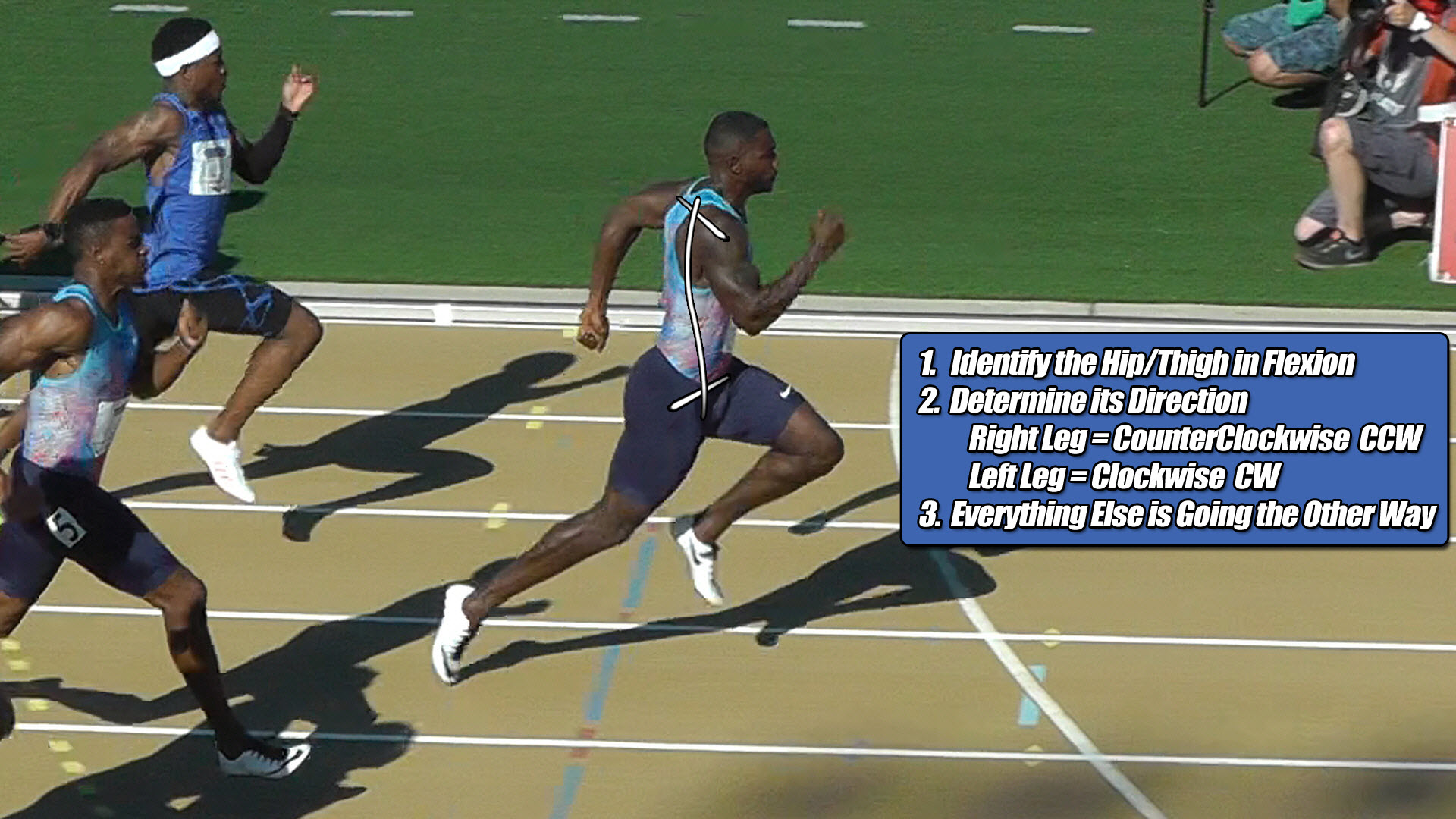
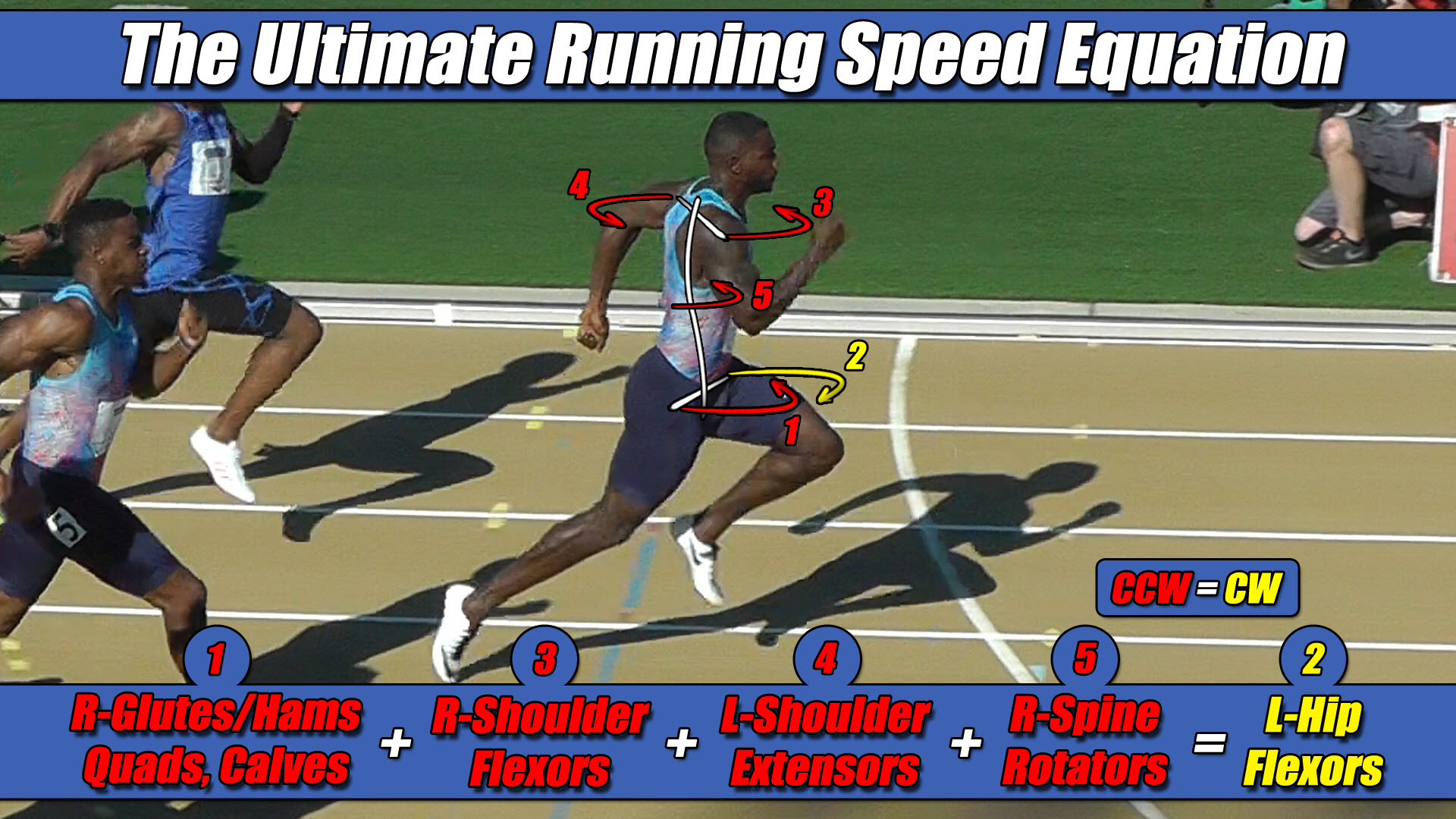 Left Hip Flexor Torque = CW. Everything Else CCW.