
🧠 Introduction
Analyze the closing micro-seconds of any global championship sprint final and you will witness the ultimate expression of human velocity.
You will see modern sprinting icons like Sha’Carri Richardson, Gabby Thomas, and Noah Lyles battle unyielding physics down the straightaways, forcing mainstream track and field performance culture to flood the internet with generic breakdowns of their raw leg power.
Standard track and field coaching folklore has spammed a single, superficial message across training logs for decades:
- Elite running velocity and acceleration are strictly products of back-squat mass and linear force production.
- Breaking through a running pace plateau requires stacking more high-volume cardiovascular laps.
- Forcing your lower limbs to execute grueling heavy sled pushes builds essential match speed stamina.
👉 But trying to force an explosive sprint drive by overloading your engine with slow linear lifts or heavy weight extensions is a severe biological fallacy.
The human body is a highly precise biological machine governed by the unyielding laws of structural physics and motor-unit recruitment math.
Your short-space field turnover acceleration and top-end drive splits are stalling because general gym volume completely ignores the massive rotational torque equations running your spine.
This forces your central nervous system to put on its own joints and protective safety brakes right when you attempt to launch down the lane, stalling your search of how to run faster.
Every match or race demands extreme physical outputs, but piling on generic mass will never hot-wire the biological software running your hips.
🔄 Elite Strides Require Continuous Whole-Body Reorganization
Sustaining an elite sprint cadence, driving out of the blocks, and transitioning your mass through space does not happen one isolated muscle joint movement at a time.
It is continuous whole-body reorganization happening under extreme, split-second timing constraints.
The competitive track sprint is an integrated whole-body equation where all structural components must fire in perfect harmony down the straightaway:
- The primary pushing leg drives outward laterally against the surface to establish instant ground leverage.
- The airborne swing leg aggressively attacks forward through empty air to advance your total mass.
- The shoulders and arms twist rapidly to support absolute axial alignment and shield against rotational drag.
- The torso rotates aggressively to connect both sides of the pelvis and transfer force cleanly.
🔬 The Biomechanics: The Locomotive Helicopter Framework
Human locomotion and field quickness are a strict battle of balancing rotational torque across your pelvis where Net Torque must equal exactly Zero. To master your track turnover, you must visualize your pelvis as an advanced mechanical aircraft operating under intense structural rotational stress down the straightaways.
The reality is, the pushing leg, arms, and torso are compressed into one unified power alliance on one side of the centrifuge, forming a massive synchronized heavy rotor that slams energy into the track. Meanwhile, the airborne swing leg operates in total solitude on the other side of the ledger as a solitary centrifuge, functioning as the lightweight tail rotor that must contract at instantaneous, fast-twitch velocities to apply matching counter-torque. The combined role of the left arm, right arm, torso and pushing leg on one side along with the swing leg on the other, alternate with each step.
As a result, your entire body is engaged in a high level timing and balancing act that starts the exact millisecond movement begins from a dead stop. As the athlete drives down the field, the rotational forces increase exponentially with every step, escalating to the absolute point of maximum strength balance between the two rotating sides.
Traditional training templates completely blind this relationship. Symmetrical heavy gym lifts or un-targeted tracking loops overwork the protruding backside engine while leaving your flat pelvic winches completely dead and unconditioned, violating the unyielding engineering math of your pelvic transmission. Splitting the legs by their anatomical placement leaves a massive conceptual gap as to what the role of the flywheel actually is.
⚖️ Elite Performance Receipts: Multi-Sport Verification
Look at the exact tracking data from elite competitors across various competitive disciplines who completely smashed traditional lifting and conditioning limitations using these targeted methods:
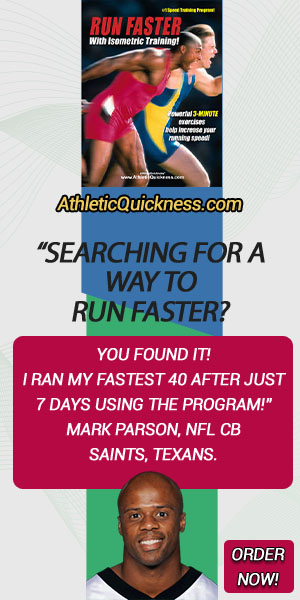
- 🏈 The NFL / Gridiron Clout: Professional cornerback Mark Parson explicitly utilized these fast-twitch isometric protocols to survive and dominate the absolute highest athletic speed bracket on Earth, dropping his tracking clocks and locking down elite wide receivers.
- 👑 The 6-Year Track Breakthrough: Stuck at a heavy pacing wall for 6 consecutive seasons despite grinding through high-volume track work and traditional heavy weight room squads, track competitor James Wildish used this band protocol to smash his plateau and climb straight into the top national rankings.
- ⚽ The D1 College Champion: Played D1 soccer at Winthrop University and across the NPSL. He initially experimented with Dr. Larry’s methods and found they increased his speed over short and long distances, bypassing traditional strength and conditioning models to win two college conference championships.
- 🏃♂️ The Southern Hemisphere Attack Metric: Integrated the program for just 14 days and felt immediately more athletic, explosive, and quick. His 40-yard dash dropped from 5.8 to 5.4 seconds and his 200m sprint dropped from 24.8 to 24.1 seconds, giving him the breakaway speed to easily beat field defenders.
🛑 The Neurological Governor: The Wing Sprint Safety Brake
Your brain is a master safety engineer running a non-stop, subconscious mathematical calculation to monitor the torque balance across the pelvis and protect your joints and spine from injury.
When an elite athlete attempts to push through an explosive acceleration phase like Sha’Carri Richardson, forces skyrocket.
The hyper-developed pushing engine tries to dump maximum force into the ground surface to sustain the tactical velocity.
🚨 If your brain detects that your flat, unconditioned swing-leg hip flexor winches (the Tail Rotor) lack the high-velocity contraction speed required to cleanly handle that forward blast from the Main Rotor alliance, it instantly introduces a negative multiplier known as the Neurological Governor.
To protect your spine, hips, and joints from a catastrophic mechanical tear under these uneven forces, your nervous system actively clamps down—throttling your ground force production and turnover velocity downward.
👉 This is why visible field form breaks down and lower limbs feel heavy during high-intensity acceleration because the system has become mechanically unbalanced. The tightening of your mechanics, lower knee drive, and shorter stride rhythm are actually protective responses triggered by the brain’s internal calculator because the system has become mechanically unbalanced. Until you fix this relationship and activate this missing link to balance the two rotating sides, your track velocity will remain permanently bottlenecked.
🚀 Releasing the Governor: The Fast-Twitch Iliopsoas Activation
You cannot fix a high-velocity structural torque crisis by running more slow cardiovascular miles or performing traditional weight-room machine extensions.
Piling more workload onto a lopsided system only increases joint strain, creates chronic groin tightness, and deepens the structural imbalance over your training cycles.
The smaller, flat swing muscles can easily match the torque of the giant jackpot push engine due to a strict 4:1 inertial weight displacement ratio: the pushing leg moves 85% of your total body mass forward against heavy turf resistance, while the airborne swing leg moves one single extremity through empty air with zero load.
👉 ⚡ Because its load is so exceptionally light, your swing-phase hip flexors are biologically built to contract at extreme, instantaneous fast-twitch velocities to multiply their counter-torque exponentially.
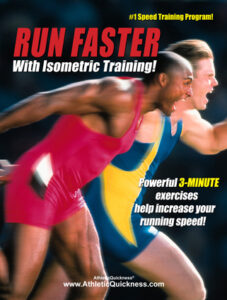
The Athletic Quickness protocol activates this network safely by pairing high-tension resistance bands with short, 15-second isometric holds locked into your authentic, upright sprinting posture.
By applying 70-80% of your maximum strength instantly against a dynamic elastic vector, you hot-wire the biological software on your desktop system.
Your brain immediately bypasses sequential motor-unit recruitment order, upgrading your deep psoas and iliacus winches into high-velocity steel joints.
🚀 The brain’s internal calculator realizes the system is balanced, the safety governor lifts the emergency brake, and your legs naturally snap forward with elite responsiveness, permanently changing how you approach your quest of how to run faster.
 Take the Free 9-Minute Running Speed Challenge Today
Test the fast-twitch science right now. Test one single fast-twitch isometric exercise natively at home, witness your leg turnover effortlessly accelerate, and prove the science of running faster works better and quicker than you could ever imagine.
Click Here to Take the Free 9-Minute Running Speed Challenge Now!
🚀 Choose Your Next Speed Breakthrough Phase:
👉 Why Gym Strength Fails Field Athletes (And the 14-Day Soccer Acceleration Fix)
👉 The Discus Winch System: How Internal Hip Rotation Drives Elite Throwing Distance
👉 How to Run Faster: 7 Things That Actually Matter
👉 Isometric Training for Speed: The Complete System to Run Faster