🧠 Introduction
Walk onto almost any competitive Special Olympics track-and-field training venue, adaptive sports performance facility, or unified youth club practice during a short-sprint workout session, and you will find athletes grinding through traditional conditioning loops.
Mainstream fitness folklore has spammed a single, cosmetic message across sports circles for decades: “Elite short-space reaction quickness, rapid leg turnover, and an explosive 50m breakout start are direct products of traditional cardiovascular fitness.
If you want to drop your opening split times and find out how to improve speed, you must force your lower limbs to grind through continuous track loops to build up stamina.”
Adaptive short-space sprinters, unified division competitors, and high-performance youth athletes operate under the flawed, two-dimensional assumption that forcing your lower limbs to repeatedly drive against linear cardiovascular exhaustion can automatically translate into a lightning-fast first-step burst down the track runway.
But trying to force an explosive breakout by restricting your legs to high-volume cardiorespiratory loops is a severe biological fallacy. The human body is a highly precise biological machine governed by the unyielding laws of structural physics and motor-unit recruitment math.
AQ believes your takeoff acceleration is stalling because general endurance routines completely ignore the massive, whole-body rotational torque equations running your spine, forcing your central nervous system to put on its own joints and protective safety brakes right when you attempt to launch your frame forward from a static start.
 Unyielding Youth Success: The True Receipts of Athletic Confidence
Look at the exact tracking data, real-world metrics, and professional field validations from young competitors who completely smashed traditional conditioning limitations:
- The 8th Grade Track Phenom: Trey, a 12-year-old sports competitor, started with inadequate running ability. After applying this precise protocol, he currently beats his region’s former 7th grade county 100-yard champion and has not lost a single race all season in the 8th grade. His father, Mark Vandewater, explicitly noted the massive boost to his confidence.
- The 7-Year-Old Gridiron Velocity Shift: B. Higgins from Omaha, Nebraska, tested his already well-conditioned 7-year-old son in an electronically timed 10-yard dash to ensure no human variables. In just 3 weeks, his clock plummeted from a 2.51 down to a blistering 2.29, scoring 3 times in his next football scrimmage because he now structurally believes he cannot be caught.
- The Power-Hitter Breakthrough: Orlanda M. from Chicago, Illinois, applied the exact same fast-twitch structural principles to his athletic preparation and witnessed an immediate surge from zero history to a massive 5 home runs in a single season, declaring the impact on personal pride and self-belief is immeasurable.
These real-world transformations prove that traditional university and school-aged high-volume workouts offer minor results for grueling wear.
The moment you activate the missing fast-twitch muscle link to the front of the pelvis, you don’t just change a stopwatch clock—you permanently change how an athlete carries themselves in daily life.
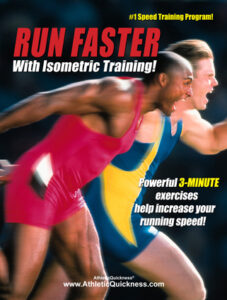
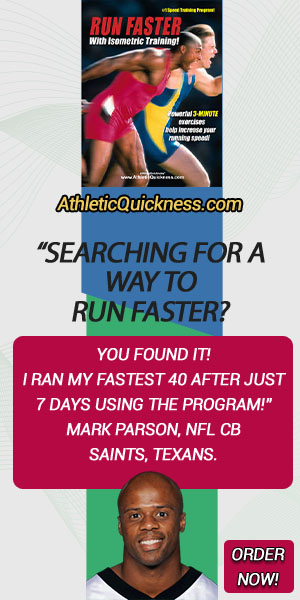
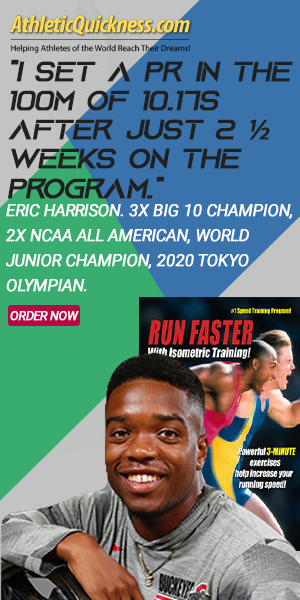
 Learn more about the exact Run Faster Speed Training Protocol used to activate fast-twitch muscle networks and shatter speed plateaus in just 14 days here.
🔄 Short-Space Sprints Require Continuous Whole-Body Reorganization
Launching out of a static stance, violently striking your feet into the track surface, and transitioning smoothly into an all-out horizontal sprint down a short 50-meter runway does not happen one isolated movement at a time.
It is continuous whole-body reorganization happening under extreme, split-second timing pressure.
The Athletic Quickness system views the competitive short sprint start as an integrated whole-body equation where the pushing leg drives outward laterally, the swing leg attacks forward, the arms twist to support balance, and the torso rotates to connect both sides of the body simultaneously.
This micro-second pressure is felt deeply by premium adaptive athletes who must coordinate complex timing sequences, manage rapid equilibrium adjustments, and dynamically manage massive rotational torque around the spine while executing rapid foot plants.
The faster you attempt to transition out of the blocks and hit top gear on a short track runway under intense competitive pressure, the less time the nervous system has to organize these complex force, timing, and balance relationships between every single step.
Faster track velocity and initial segment split times depend heavily on how quickly the sprint movement can reorganize its mass instantly without delay, allowing the next aggressive foot strike to arrive sooner on the track surface.
The moment a track athlete hot-wires the missing fast-twitch muscle link to the front of their pelvis, their stride frequency effortlessly accelerates because the system can reorganize its mass instantly without delay, proving that balanced internal math always beats an extra gym machine block.
When your training forces an athlete’s fast-twitch fibers to take on slow-twitch characteristics through heavy volume or un-targeted conditioning loops, this reorganization window shrinks to zero.
This compression completely blinds the pelvic transmission and forces your brain’s internal calculator to step in and handle the mechanical chaos, trapping you completely in the how to improve speed fallacy secret deception.
👉 Discover how continuous conditioning actively degrades your velocity and converts your explosive muscle networks into slow tractor gears here: How Endurance Training Slows Down Your Fast-Twitch Muscle Fibers
🛑 The Neurological Governor: The 50m Takeoff Safety Brake
Your brain is a master safety engineer running a non-stop, subconscious mathematical calculation to monitor the torque balance across the pelvis and protect your joints and spine from injury.
When an adaptive sprinter attempts to transition out of a static stance and launch a hyper-explosive 50m breakout sprint, their pushing engine tries to dump maximum force into the track.
If your brain detects that their flat, unconditioned swing-leg hip flexor winches lack the high-velocity contraction speed required to cleanly handle that forward blast because your training has focused on slow cardio endurance loops, it instantly introduces a negative multiplier known as the Neurological Governor.
To protect your spine, hips, and joints from a catastrophic mechanical tear under these uneven forces, your nervous system actively clamps down—throttling your ground force production and turnover speed downward.
This is why visible running form breaks down and legs feel heavy during explosive block starts. The tightening of your mechanics and shorter stride rhythm are actually protective responses triggered by the brain’s internal calculator because the system has become mechanically unbalanced.
You strain, pump your legs harder, and try to force a faster sprinting tempo, but your body is actively pulling its own emergency brake to protect your framework, and until you know how to fix it and actually do, there is nothing you can do about it.
🚀 Releasing the Governor: The Fast-Twitch Iliopsoas Activation
You cannot fix a high-velocity structural torque crisis by running more slow road miles or performing traditional weight-room machine extensions.
Piling more workload onto a lopsided system only increases joint strain, creates chronic groin tightness, and deepens the structural imbalance. That’s not to say they don’t have value, it’s just that you’re not likely to gain any more speed from them until you correct the actual problem.
The smaller, flat swing muscles can easily match the torque of the giant jackpot engine because of a strict 4:1 inertial weight displacement ratio.
The pushing leg must move 85% of your total body mass forward, while the airborne swing leg only has to move one single extremity through empty air.
Because its load is so light, your swing-phase hip flexors are built to contract at extreme, instantaneous fast-twitch velocities to multiply their counter-torque exponentially.
The Athletic Quickness protocol activates this network safely by pairing high-tension resistance bands with short, 15-second isometric holds locked into your authentic, upright sprinting posture.
By applying 70-80% of your maximum strength instantly against a dynamic elastic vector, you hot-wire the biological software.
Your brain immediately bypasses the sequential order, upgrading your deep psoas and iliacus winches into high-velocity steel joints.
The brain’s internal calculator realizes the system is balanced, the safety governor lifts the emergency brake, and your legs naturally snap forward with elite responsiveness, permanently changing how you approach your quest of how to improve speed.
⚡ Stop Training Your Fast-Twitch Fibers to Be Slow
Every single day you spend grinding through endless cardio laps, dragging heavy bungees, or loading slow gym machines, you are actively coding your body to pull its own emergency brake.
You do not need more muscle size. You do not lack willpower. Your pushing engine already has all the raw horsepower it needs—your nervous system is simply refusing to let you use it because your pelvic transmission is completely out of balance.
When you balance that transmission, you don’t just change a stopwatch—you unlock a profound wave of athletic pride and personal transformation that alters how an athlete carries themselves forever.
Give us less than 90 seconds a day for the next 14 days. We will safely isolate your deep iliopsoas winches, hot-wire your fast-twitch motor units, and force your brain’s internal calculator to permanently lift the Neurological Governor.
The math always outlasts the training calendar. Stop guessing on your stopwatch and take the challenge today.
🎯 Take the Free 9-Minute Running Speed Challenge Today
Test the fast-twitch science right now. Test one single fast-twitch isometric exercise natively at home, witness your leg turnover effortlessly accelerate, and prove the science of running faster works better and quicker than you could ever imagine.
Click Here to Take the Free 9-Minute Running Speed Challenge Now!
🚀 Choose Your Next Speed Breakthrough Phase:
👉 The Special Olympics Speed Blueprint: Unleash Athletic Confidence (The How to Run Faster Formula)
👉 The Special Olympics 100m Dash Bottleneck: Rapid Block Takeoffs (The How to Improve Speed Fallacy)
👉 How to Run Faster: 7 Things That Actually Matter
👉 Isometric Training for Speed: The Complete System to Run Faster