
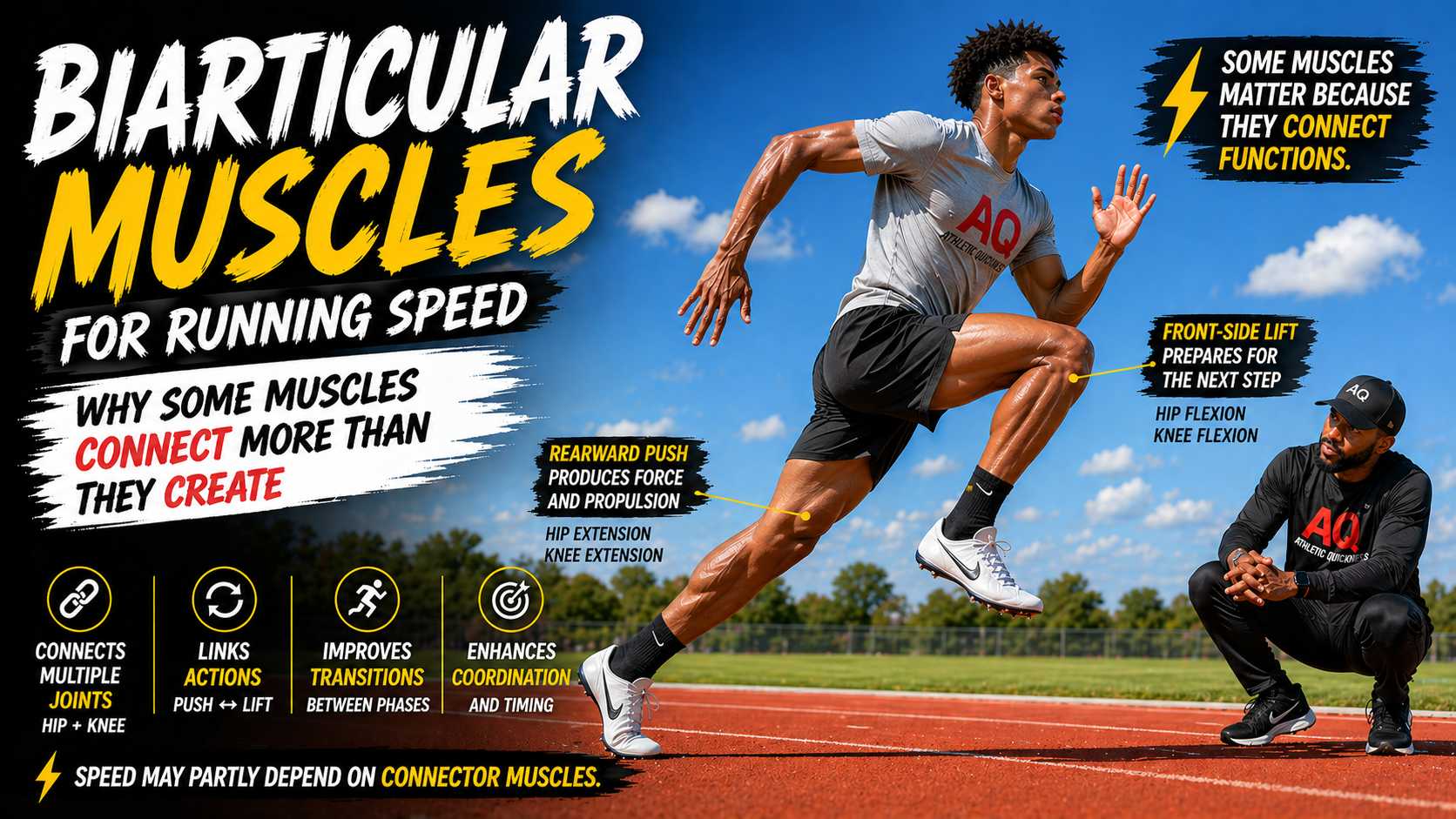
Home » Running Muscles for Speed » Bi-Articular Muscles For Running Speed: Why Some Muscles May Connect More Than They Create
🧠 Introduction
Most athletes think muscles help create movement.
Push.
Pull.
Drive.
Produce force.
And yes—
that matters.
💥 What if some muscles matter not just because they create movement…
but because they may help connect movement functions?
💥 That is a different idea.
⚠️ The Single-Function Trap
Many athletes think of muscles as isolated performers.
One muscle.
One function.
One role.
But what if some muscles may do something more interesting?
What if some muscles may help connect functions athletes often think of separately?
That changes how you look at speed.
🔑 What Are Bi-articular Muscles?
Some muscles cross one joint.
Others cross two.
Those two-joint muscles are called bi-articular muscles.
And that may matter more than many realize.
💥 Because crossing two joints may allow some muscles to influence how movements connect—
not just how they occur.
That is a major distinction.
💥 What If Some Muscles Matter Because They Connect Functions?
This may be the hidden mechanism.
Many athletes focus on muscles that create force.
Fair.
⚡ But what if some muscles matter partly because they help connect force, timing, and repositioning?
That may be one hidden layer of how speed is organized.
🔄 Speed May Partly Depend On Connector Muscles
Many think speed is driven by prime movers.
Big force producers.
Power muscles.
💥 What if part of speed depends on muscles that help connect actions?
Push to lift.
Extension to recovery.
Force to transition.
That is a deeper model of how speed works.
🧩 Why This May Matter In Running Speed
Think about muscles like:
• Rectus femoris
• Long-head hamstrings
These may matter not simply because they create movement—
but because they may help connect movements.
That may influence how the system works:
• force transfer (calves / system)
• transition timing (hamstrings)
• coordination (shoulders / spine)
• next-step organization (hip flexors)
And that matters.
⚡ Speed May Be Partly A Connection System
Many think speed is force.
Or turnover.
💥 What if part of speed depends on how connected actions are organized?
That may be one hidden layer.
🚀 What This Means For You
Think beyond isolated muscle strength.
👉 Train how movements connect.
That means improving:
• bi-articular muscle function
• linked joint actions
• force-to-transition relationships
• coordinated movement systems
👉 Not just stronger—but more connected across the stride.
⚡ Some muscles matter because they connect functions—not just create them.
➡️ How to Run Faster: The Complete Guide to Improving Speed Step by Step
🧭 You Are Here (Within The AQ Speed Training System)
You are currently exploring:
👉 BI-ARTICULAR MUSCLES FOR RUNNING SPEED: WHY SOME MUSCLES MAY CONNECT MORE THAN THEY CREATE: why muscles that cross two joints may help connect force production, timing, and movement throughout the running speed system.
🌐 See How This Fits Into The Complete AQ Speed Training System
👉 Discover how bi-articular muscles fit alongside the other major muscle groups involved in running speed.
➡️ RUNNING MUSCLES FOR SPEED: What Actually Matters (And What Doesn’t)
🪜 Continue Deeper Into Running Muscles for Speed
Learn how the rectus femoris uses its two-joint structure to help connect propulsion with next-step movement during running.
➡️ Rectus Femoris for Running Speed: The Muscle That Connects Push and Lift
Learn how the hamstrings contribute to running speed through power, timing, and coordinated movement across the running stride.
➡️ Hamstring Muscles for Running Speed: Power, Timing, and System Balance
🚀 Ready to Run Faster?
👉 When you’re ready to apply these principles to improve your running speed:
➡️ Run Faster With Isometric Training!
❓ Frequently Asked Questions
What are bi-articular muscles?
Biarticular muscles cross two joints and may help connect multiple functions.
Can bi-articular muscles affect running speed?
👉 Potentially—especially in linking movement phases.
Is rectus femoris a biarticular muscle?
✅ Yes.
It crosses both the hip and knee.
Why might biarticular muscles matter in sprinting?
💥 They may matter not just as force producers—
but as connector muscles.