
Home » Running Mechanics Explained » Why Faster Sprinting May Depend On What The Body Trusts
🧠 Introduction
Many athletes feel this at some point.
👉 they know there is more speed available
But somehow:
• the body tightens up
• sprinting feels unstable
• rhythm breaks down
• movement feels rushed
• another gear never fully appears
Interesting.
Because most athletes assume:
❌ they simply need more effort.
But Athletic Quickness (AQ) says something much deeper may be happening.
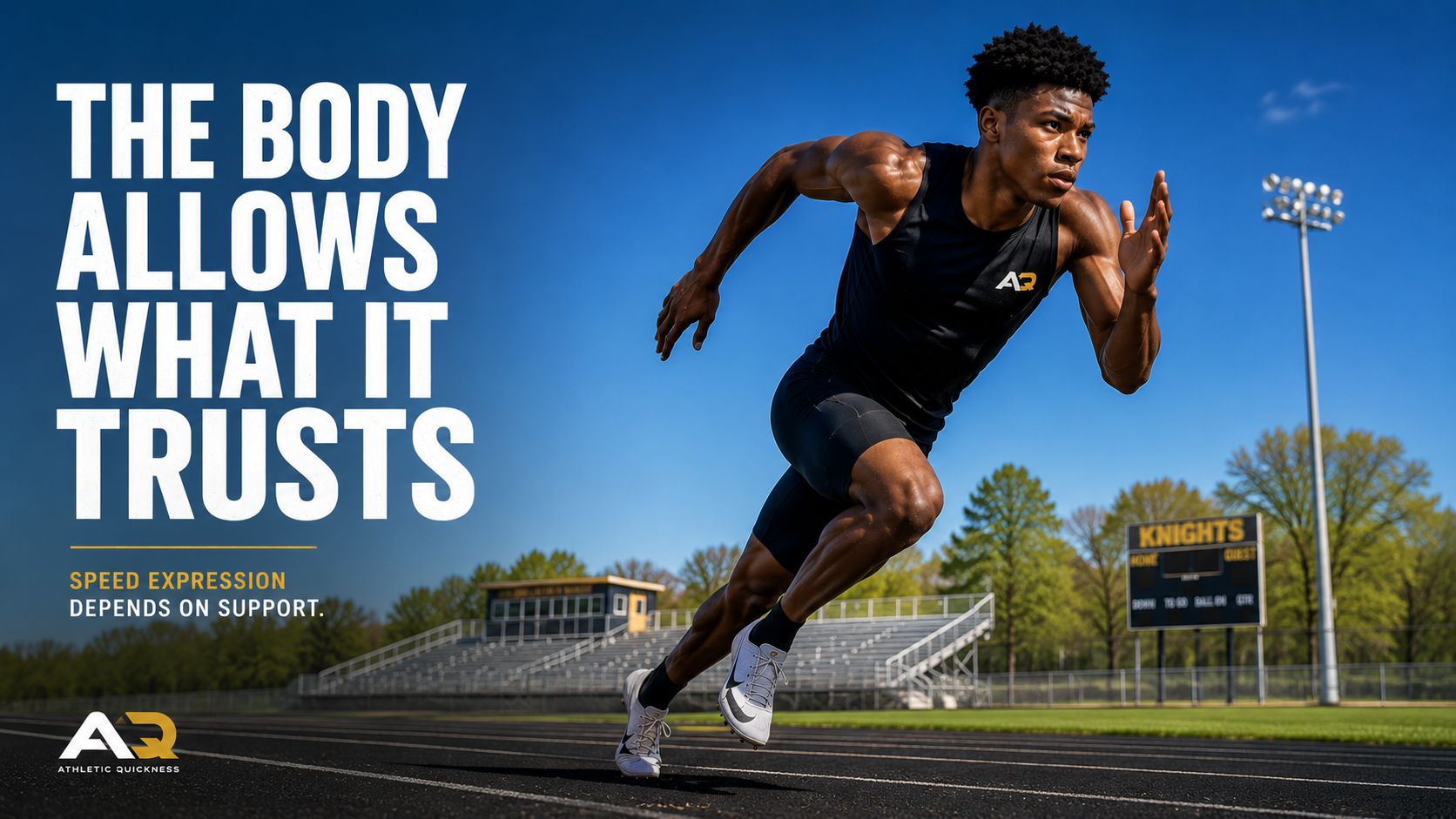
💥 Faster sprinting may depend heavily on what the sprint system trusts itself to continuously support.
That changes the interpretation of speed completely.
Because the body does not simply allow:
❌ unlimited aggressive movement automatically.
It constantly evaluates:
• can timing between steps remain organized?
• can force continue flowing through the stride smoothly?
• can the swing side keep up?
• can aggressive pushing-leg expression stay balanced?
• can the sprint system support this continuously?
That is a HUGE distinction.
💥 AQ uses “sprint system” to describe how the entire body — especially the swing leg, arms, and torso — supports and balances aggressive pushing-leg expression during high-speed running.
⚡ Why The Body Does Not Always Allow Maximum Speed
This is one of the biggest AQ mechanics ideas:
👉 self-regulation.
Because the body is constantly protecting:
💥 movement stability and support continuity.
Interesting.
Because many athletes think sprinting is simply:
❌ “push harder.”
But AQ says:
💥 aggressive movement only expands when the sprint system can support it reliably.
That is VERY different.
Because if support relationships weaken:
• timing may destabilize
• movement may tighten
• interruptions may increase
• rhythm may become forced
• sprinting may feel less fluid
👉 Now the body begins limiting aggressive speed expression automatically.
Not necessarily because the athlete lacks effort.
💥 The sprint system may simply stop trusting the support relationships underneath.
That is HUGE.
🔄 What The Body May Actually Be “Trusting”
This is where the mechanics become very interesting.
AQ says the body may continuously evaluate things like:
• timing between steps
• swing-leg support
• rotational support from the arms
• uninterrupted force flow through the stride
• strength balance across the sprint system
• aggressive pushing-leg expression remaining stable under speed
👉 If those relationships strengthen…
💥 the sprint system may gradually allow more aggressive movement expression.
Interesting.
Because speed may not simply be:
❌ created.
It may also need to be:
💥 supported continuously enough for the body to trust it.
That is one of AQ’s deepest distinctions.
⚡ Why Athletes Often Feel “Another Gear”
This is one of the most common sprint experiences.
Athletes often feel:
👉 “There’s more speed in me somewhere.”
Interesting sensation.
Because AQ says:
💥 there often IS more potential speed available.
But the sprint system may not fully allow it yet.
Why?
Because maximum speed expression requires:
• stable timing
• uninterrupted support relationships
• force flowing through the stride continuously
• balanced aggressive movement
• the arms, torso, swing leg, and pushing leg syncing together effectively
👉 If those relationships become unstable…
💥 the body may reduce aggressive movement automatically to preserve sprint-system balance.
That changes how speed limitations should be interpreted completely.
🚨 Why Sprinting Sometimes Tightens Up
Many athletes experience this:
• sprinting feels heavier
• movement becomes rushed
• turnover becomes forced
• rhythm breaks down
• top-end speed feels unstable
Interesting.
Because athletes often interpret this as:
❌ lack of effort.
But AQ says:
💥 the sprint system may no longer trust the movement quality underneath aggressive speed expression.
That is a VERY different interpretation.
Because when:
• support continuity weakens
• timing between steps breaks down
• force flow becomes interrupted
• the swing side falls behind
• aggressive pushing-leg expression exceeds system balance
👉 the body may begin protecting itself automatically.
That is self-regulation.
And honestly?
Most athletes have experienced it without realizing what they were feeling.
⚡ Why Feeling Faster Often Comes First
This also explains why athletes sometimes report:
• sprinting feels smoother
• movement feels lighter
• rhythm sharpens
• speed feels easier
• acceleration feels cleaner
BEFORE:
👉 massive speed jumps appear.
Interesting.
Because the sprint system may first begin:
• stabilizing support relationships
• improving timing between steps
• reducing interruptions
• organizing aggressive movement better
• improving uninterrupted force flow through the stride
👉 THEN greater speed expression may gradually appear afterward.
That is VERY AQ.
Because the body often allows:
💥 what it increasingly trusts the sprint system can support.
Huge distinction.
🔥 Why This Changes How Speed Should Be Trained
👉 speed training is more than:
• trying harder
• pushing harder
• forcing turnover
• chasing aggression alone
Because athletes also need to improve:
• whole-body push support
• swing-leg aggression
• timing between steps
• rotational support from the arms
• uninterrupted force flow through the stride
• sprint-system balance
• balanced aggressive pushing-leg expression
💥 Everything must support everything else continuously.
👉 Everything.
Because sprinting is not simply:
❌ maximum effort
It is:
💥 aggressive movement the sprint system can continuously organize and support.
That is one of AQ’s deepest mechanics distinctions.
🚀 What This Means For You
If sprinting sometimes feels:
- capped
- unstable
- rushed
- tight
- disconnected
👉 do not immediately assume:
❌ you lack effort.
AQ says the sprint system may simply not fully trust the support relationships underneath maximum speed expression yet.
That changes everything.
Because faster sprinting may depend heavily on:
• timing between steps
• uninterrupted force flow through the stride
• stronger swing-leg support
• rotational support from the arms
• sprint-system balance
• aggressive movement remaining continuously supported
💥 The body often allows what it trusts the sprint system can continuously support.
That is a very different interpretation of running speed.
🧭 Go Deeper
👉 These articles connect directly into the larger AQ sprint framework:
➡️ Why Some Athletes Feel Faster Before They Actually Run Faster
➡️ What Exactly Is Coordination in Running?
➡️ Why Running Smooth May Be More Than Just Good Form
👉 Together, these articles explain:
• sprint-system support
• self-regulation
• timing between steps
• uninterrupted force flow through the stride
• whole-body push support
🎯 Start Here
👉 Want to see how AQ applies these ideas into actual speed training?
💥 Start here:
➡️ Run Faster With Isometric Training
👉 This is where the AQ framework connects:
• sprint mechanics
• resistance-band isometrics
• aggressive swing development
• whole-body push support
• uninterrupted sprint cycling
• sprint-system balance
❓ Frequently Asked Questions
Why can sprinting sometimes feel capped?
👉 AQ suggests the sprint system may not fully trust the support relationships underneath more aggressive speed expression yet.
What does AQ mean by “trust” in sprinting?
👉 AQ uses “trust” to describe how the body may allow more aggressive movement when timing, support relationships, and sprint-system balance remain stable.
Why can sprinting suddenly tighten up?
👉 AQ says interruptions in timing, force flow, or sprint-system balance may trigger self-regulation inside aggressive movement.
Why can athletes feel another gear without reaching it?
👉 Because the body may still be limiting aggressive speed expression until support relationships stabilize further.
What does AQ believe matters most for faster sprinting?
👉 AQ increasingly focuses on how effectively the sprint system supports and balances aggressive pushing-leg expression continuously during sprinting.