Home » Stopwatch Breakthroughs » Velocity Insights » 5 Quickness Tips to Consider for Faster Tennis Footwork: Shattering a 16yo Junior Tournament Player Cross-Court Reaction Wall (The Velocity Insights Formula)
🧠 Introduction: An Urgent Window for Your Athletic Survival
👉 If you have ever felt your legs locking up or your turnover velocity flatlining when your rivals hit their top gear, the physiological missing link below is about to change everything.
If you are a 16yo male junior tournament tennis player currently stuck struggling with a sluggish cross-court reaction wall that leaves you running in sand, it is for your own athletic good that you pay absolute attention to these words.
If you want to finally break out of your performance slump, stop watching rival passing shots fly past your reach, and take your first-step court quickness to the next level, you must put aside your mainstream conditioning routines for just a moment and open your eyes to the following:
The standard speed-training methods are leaving a major missing link completely unaddressed under your hood.
👉 Mainstream training culture claims that running a faster cross-court recovery or crashing the net requires things like executing endless weight room back squats, high-volume linear intervals, and heavy tire drags to build lower-body power.
👉 But trying to force a massive tennis court breakthrough by overloading your mature lower limbs with slow linear gym lifts is a severe biological fallacy.
Breakaway court quickness depends entirely on how quickly the sprint movement can reorganize its mass instantly without a single millisecond of delay, preventing your pacing form from locking up.
🔄 Tip 1: Balance Your Pelvic Rotational Torque
The competitive lane stride is an integrated whole-body equation where all structural components must fire in perfect harmony down the lane.
Sprinting across a hard court or straightaway lane is a strict battle of balancing rotational torque across your pelvis where Net Torque must equal exactly Zero.
During sprinting, your pushing leg aggressively drives backward into the ground, while your arms and torso aggressively support that pushing action.
👉 However, the opposite side of your pelvic ledger must match that output layout perfectly.
If your front-side turnover cannot balance out your back-side power, your short-burst lane velocity flatlines.
🔬 Tip 2: Target the Airborne Swing-Leg Piston
You must visualize your body as an advanced, twin-piston reciprocating speed engine operating under extreme rotational stress.
The first piston operates as the primary pushing side alliance (the down leg, arms, and rotating torso).
Conversely, the opposite side of the mechanical ledger functions completely alone as the counterbalancing reciprocator.
👉 This standalone counter-weight is the airborne swing leg acting as a high-velocity piston firing upward to counterbalance that downward blast.
Force-production is only half the speed equation; you must actively raise the strength balance of the swing-leg piston to cleanly expand your stride length and clear the track lanes.
⚖️ Tip 3: Look at Multi-Sport Fast-Twitch Receipts
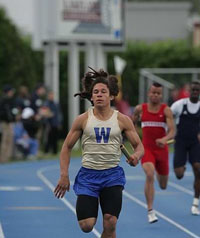
🏅 To prove these underlying physics apply universally across all athletic surfaces on American soil, look at the documented tracking metrics achieved by competitive short-burst standout Anthony Chesson from Virginia.
Already highly competitive but seeking a severe breakthrough to unlock elite first-step footwork velocity and shatter his performance barriers before regional tournament qualifiers, Anthony integrated the targeted fast-twitch resistance program into his daily routine.
👉 Within just 2 weeks of starting the holds, his central nervous system achieved a massive technical turnaround.
⚡ His short-burst metrics experienced an immediate evolution:
- Plummeted his sprint performance times from a heavy training baseline of 22.14s down to a blistering 21.44s mark.
- Took 1st place in the Southern Track Classic with an explosive tournament performance time of 21.36s.
- Set a legendary new meet record that was previously held by a major professional football Pro Bowl star.
- Achieved an absolute personal best time of 21.1s flat in the short-burst acceleration straightaway lanes.
This real-world, localized proof confirms that the dual-piston framework instantly unlocks immediate muscular capacity across all sports once the deep neural pathways are activated and balanced, naturally changing how you approach your quest to locate the best 5 quickness tips to consider for faster tennis footwork.
🛑 Tip 4: Remove the Nervous System’s Emergency Brake
If your brain detects that your flat, unconditioned swing-leg hip flexor winches (the Upward-Firing Piston) lack the high-velocity contraction speed required to cleanly handle that forward blast from the pushing alliance, it instantly introduces a negative multiplier known as the Neurological Governor.
👉 To protect your spine and joints from a catastrophic mechanical tear under these uneven forces, your nervous system actively clamps down.
It aggressively throttles your ground force production and turnover velocity downward to keep you safe.
Until you fix this relationship and activate this missing link to balance the two rotating sides, your short-burst court quickness parameters will remain permanently bottlenecked when chasing down ball lines.
🚀 Tip 5: Hot-Wire Your Core Winches with Isometric Resistance
The Athletic Quickness protocol activates this network safely by pairing high-tension resistance bands with short, 15-second isometric holds locked into your authentic, upright sprinting posture.
👉 By applying 70-80% of your maximum strength instantly against a dynamic elastic vector, your brain immediately bypasses sequential motor-unit recruitment order.
⚡ This upgrades your deep muscular connection lines instantly:
- Upgrades your deep psoas winches into high-velocity steel joints.
- Ignites immediate motor-unit recruitment across the iliacus pathways.
- Transforms the rectus femoris winches into explosive snap indicators.
The brain’s internal calculator realizes the system is balanced, the safety governor lifts the emergency brake, and your legs naturally snap forward with an out-of-body responsiveness.
This completely magical adaptation permanently changes how you approach your speed parameters.
🚀 Ignite Your First-Step Explosive Stride Now
Try one single fast-twitch isometric movement right at home.
Bypass your brain’s neurological safety governor and force your deep hip winches to snap forward with an explosive, out-of-body responsiveness.
Click Here to Start Your Free 9-Minute Sprint Velocity Challenge!
🚀 Choose Your Next Speed Breakthrough Phase:
👉 How to Run Faster: 7 Things That Actually Matter
👉 Isometric Training for Speed: The Complete System to Run Faster