
🧠 Introduction
Walk onto almost any competitive underage training academy field, school gymnasium, or developmental training complex, and you will find coaches running young players through rapid floor-based footwork lines.
Mainstream coaching culture has spammed a single, cosmetic message across junior leagues for decades: “Elite reflex speed, side-to-side quickness, and low-stance reactivity are built entirely through coordination feet patterns.
Spend your team practice hours running through high-frequency floor templates to build up ankle precision inside your youth speed drills.”
Specialist youth wicketkeepers, close-in catchers, and reactive field sports competitors operate under the flawed, two-dimensional assumption that forcing your lower limbs to repeatedly tap through a rigid, pre-programmed floor pattern can automatically translate into an explosive diving extension on game day.
But trying to force an elite stance reaction breakthrough by restricting your athlete’s framework to a low-impact coordination drill is a severe biological fallacy.
The human body is a precise machine governed by the unyielding laws of structural physics and motor-unit recruitment math.
AQ believes your young player isn’t missing sharp catches or losing their lateral step because they lack foot coordination; their stance reactivity parameters are stalling because standard agility grids completely ignore how the nervous system handles split-second continuous whole-body reorganization, forcing the body to put on its own joint brakes.
 David’s Verified 302 lb Gridiron Proof
Look at the exact tracking data from David Crichton, a 6’3”, 302-pound defensive end and tackle for a championship semi-professional football team in Seattle, Washington, who completely bypassed traditional training myths:
- The Heavy Baseline: Clocking a heavy, un-conditioned average baseline of 5.6 seconds in the 40-yard dash while executing normal team weight-room routines.
- The 14-Day Shift: He took the free 14-day speed challenge, performing just one single fast-twitch resistance band exercise between 10:00 and 10:30 PM right at the field before running his usual track loops. In exactly 2 weeks, his 40-clock plummeted down to a 5.1 on his first two attempts, and a 5.2 on his third.
- The Ultimate 294 lb Receipt: He purchased the full program, kept the fast-twitch secret completely to himself, and continued to scale up his pelvic transmission. While packing on pure muscle mass to weigh 294 pounds, he retested and clocked a blistering, verified 4.83 seconds in the 40-yard dash.
His brother John, weighing 226 pounds, copied that exact same single trial exercise, dropped his own 40-time from a 5.6 down to a 5.0, and his football team’s coaching staff officially mandated the exercise as a permanent part of their program.
If you are moving a slow iron load, the brain drops down into a slow concentric recruitment path to protect the spine.
The moment these athletes activated the missing fast-twitch muscle link to the front of their pelvis using the bands, their running acceleration and rotational power completely transformed, proving that balanced internal math always beats an expensive weight box or isolated track loop.
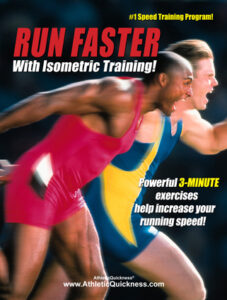
 Learn more about the exact Run Faster Speed Training Protocol used to activate fast-twitch muscle networks and shatter speed plateaus in just 14 days here.
🔄 Stance Quickness Is Continuous Whole-Body Reorganization
Launching out of a low, defensive crouch, turning your hips instantly, and exploding into an all-out diving extension to secure a ball does not happen one isolated movement at a time.
It is continuous whole-body reorganization happening under extreme, split-second timing pressure.
The Athletic Quickness system views the reactive field burst as an integrated, whole-body equation where the pushing leg drives backward, the swing leg attacks forward, the arms twist to support balance, and the torso rotates to connect both sides of the body simultaneously.
The faster a young player attempts to react from a deep stance under intense match pressure, the less time the nervous system has to organize these complex force, timing, and balance relationships between every single step.
Faster short-strip adjustments depend heavily on how quickly the sprint movement can reorganize its mass in mid-air, allowing the next aggressive foot plant or defensive reach to arrive sooner on the turf.
The moment a developing athlete hot-wires the missing fast-twitch muscle link to the front of their pelvis, their first-step reactivity effortlessly accelerates because the system can reorganize its mass instantly without delay, proving that balanced internal math always beats a plastic floor ladder grind.
When your training forces a young player’s fast-twitch fibers to take on slow-twitch characteristics through heavy youth volume or un-targeted ladder drills, this reorganization window shrinks to zero.
This compression completely blinds the pelvic transmission and forces your brain’s internal calculator to step in and handle the mechanical chaos, trapping you completely in the youth speed drills ladder fallacy deception.
👉 Discover how continuous conditioning actively degrades your velocity and converts your explosive muscle networks into slow tractor gears here: How Endurance Training Slows Down Your Fast-Twitch Muscle Fibers
🛑 The Neurological Governor: The Stance Protective Tightness Response
Your brain is a master safety engineer running a non-stop, subconscious mathematical calculation to monitor the torque balance across the pelvis and protect your joints and knees from injury.
When a young player attempts to transition out of a low crouch and explode into a diving catch, their hyper-developed pushing engine tries to dump maximum force into the turf.
If your brain detects that their flat, unconditioned swing-leg hip flexor winches lack the high-velocity contraction speed required to cleanly handle that forward blast because your training has focused on slow cardio volume or floor tapping drills, it instantly introduces a negative multiplier known as the Neurological Governor.
To protect your spine, hips, and joints from a catastrophic mechanical tear under these uneven forces, your nervous system actively clamps down—throttling your ground force production downward.
This is why visible reaction speed collapses and muscles begin to feel tight under heavy match pressure.
The tightening of your mechanics and shorter stride rhythm are actually protective responses triggered by the brain’s internal calculator because the system has become mechanically unbalanced.
You strain, pump your arms harder, and try to force a faster tempo, but your body is actively pulling its own emergency brake to protect your framework, and until you know how to fix it and actually do, there is nothing you can do about it.
🚀 Releasing the Governor: The Fast-Twitch Iliopsoas Activation
You cannot fix a high-velocity structural torque crisis by running more slow road miles or performing traditional weight-room machine extensions.
Piling more workload onto a lopsided system only increases joint strain, creates chronic hamstring tightness, and deepens the structural imbalance.
That’s not to say they don’t have value, it’s just that you’re not likely to gain any more speed from them until you correct the actual problem.
The smaller, flat swing muscles can easily match the torque of the giant jackpot engine because of a strict 4:1 inertial weight displacement ratio.
The pushing leg must move 85% of your total body mass forward, while the airborne swing leg only has to move one single extremity through empty air.
Because its load is so light, your swing-phase hip flexors are built to contract at extreme, instantaneous fast-twitch velocities to multiply their counter-torque exponentially.
The Athletic Quickness protocol activates this network safely by pairing high-tension resistance bands with short, 15-second isometric holds locked into your authentic, upright sprinting posture.
By applying 70-80% of your maximum strength instantly against a dynamic elastic vector, you hot-wire the biological software.
Your brain immediately bypasses the sequential order, upgrading your deep psoas and iliacus winches into high-velocity steel joints.
The brain’s internal calculator realizes the system is balanced, the safety governor lifts the emergency brake, and your legs naturally snap forward with elite responsiveness, permanently solving the question of how to improve speed.
⚡ Stop Training Your Fast-Twitch Fibers to Be Slow
Every single day you spend grinding through endless cardio laps, dragging heavy bungees, or loading slow gym machines, you are actively coding your body to pull its own emergency brake.
You do not need more muscle size. You do not lack willpower. Your pushing engine already has all the raw horsepower it needs—your nervous system is simply refusing to let you use it because your pelvic transmission is completely out of balance.
Give us less than 90 seconds a day for the next 14 days. We will safely isolate your deep iliopsoas winches, hot-wire your fast-twitch motor units, and force your brain’s internal calculator to permanently lift the Neurological Governor.
The math always outlasts the training calendar. Stop guessing on your stopwatch and take the challenge today.
🎯 Take the Free 9-Minute Running Speed Challenge Today
Test the fast-twitch science right now. Test one single fast-twitch isometric exercise natively at home, witness your leg turnover effortlessly accelerate, and prove the science works better and quicker than you could ever imagine.
Click Here to Take the Free 9-Minute Running Speed Challenge Now!
🚀 Choose Your Next Speed Breakthrough Phase:
👉 Why Traditional Drills Fail Junior Runners (How to Increase Sprint Speed for Kids Aged 10+)
👉 Why Expensive Speed Schools Fail 10-Year-Olds (The Speed and Agility Drills for Kids Illusion)
👉 How to Run Faster: 7 Things That Actually Matter
👉 Isometric Training for Speed: The Complete System to Run Faster