
Home » Running Mechanics Explained » Why Faster Athletes Project Better
🧠 Introduction
Some athletes seem to:
- glide forward
- carry speed smoothly
- project effortlessly down the track.
Others look:
- heavy
- vertical
- trapped into the ground
- difficult to continue forward aggressively.
Interesting difference.
Because many sprint models explain projection mostly through:
❌ body angle.
But Athletic Quickness (AQ) says projection depends on something much deeper.
💥 Projection depends on how successfully the sprint system supports aggressive forward movement continuously from step to step.
That changes sprint interpretation completely.
Because sprinting is not simply:
❌ pushing harder into the ground.
It is:
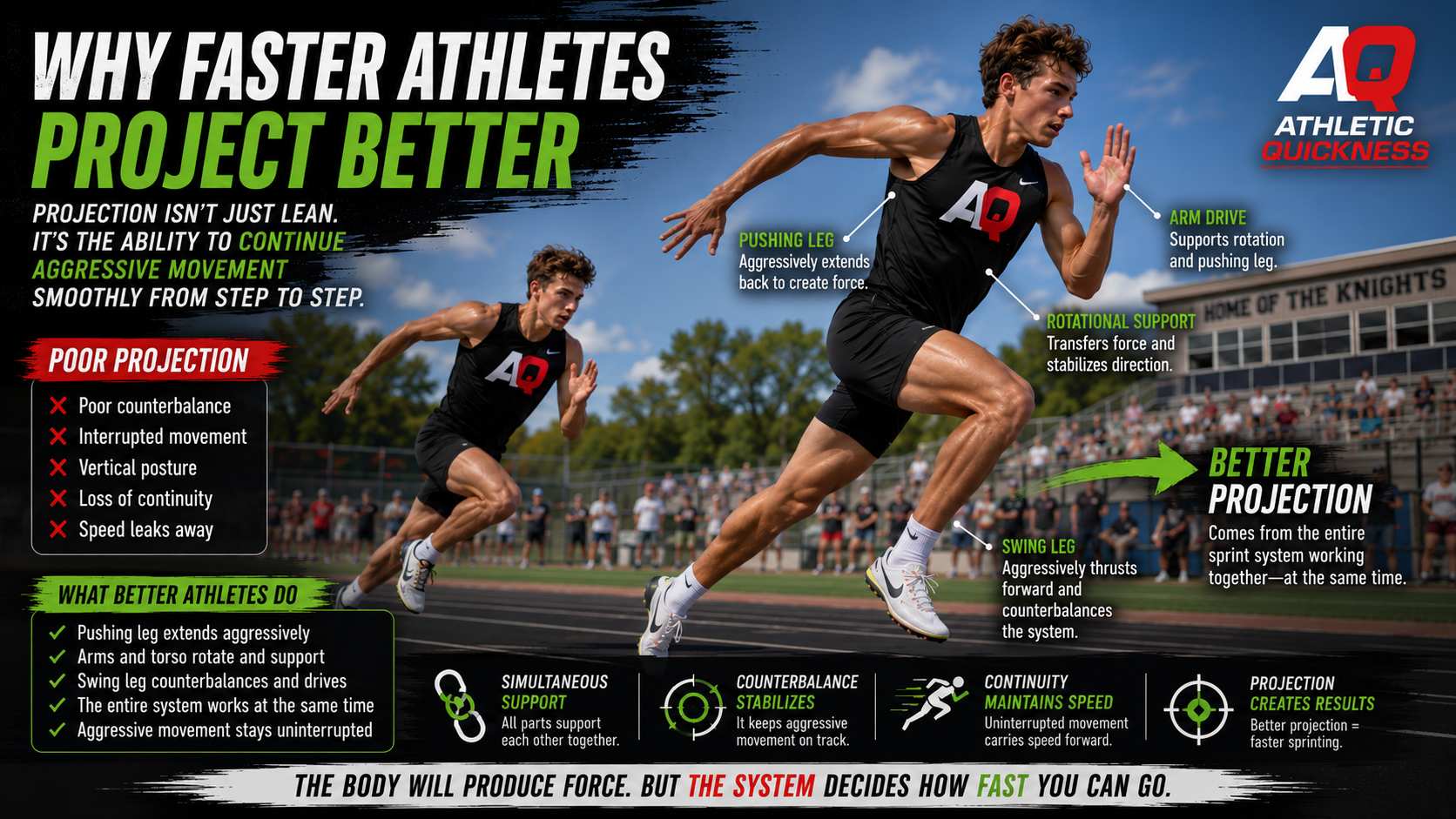
💥 the pushing leg, swing leg, arms, and torso all supporting each other simultaneously so aggressive movement can continue smoothly from step to step.
That is one of AQ’s deepest mechanics distinctions.
⚡ Why Projection Is More Than Body Lean
Traditional sprint explanations often describe projection as:
- shin angle
- torso lean
- forward body position.
And yes:
👉 those positions matter.
But AQ says:
❌ positions alone do not explain why some athletes continue carrying aggressive movement forward more successfully than others.
That is HUGE.
Because projection depends heavily on:
- uninterrupted movement continuity
- simultaneous support relationships
- counterbalance
- rotational support
- directional control.
That changes everything.
Because during sprinting:
• the pushing leg aggressively extends backward
• the arms and torso rotate and support the pushing leg
• the swing leg aggressively thrusts forward on the opposite side of the body
• and counterbalances the system
ALL:
👉 at the SAME TIME.
Not sequentially.
Simultaneously.
That is sprinting.
🔄 Why Some Athletes Look “Stuck” Instead Of Projected
This helps explain one of the biggest sprint observations.
Some athletes look:
- smooth
- projected
- fluid
- rhythmic.
Others look:
- vertical
- trapped
- interrupted
- difficult to cycle continuously.
Interesting.
Because many athletes assume:
❌ more force automatically creates more projection.
But AQ says:
💥 projection depends heavily on how successfully aggressive movement remains balanced and organized continuously across the sprint system.
That is a HUGE distinction.
Because if:
- aggressive pushing-side strength tries to express itself more
BUT - simultaneous support relationships cannot stabilize and counterbalance movement continuously
👉 projection may begin to:
- collapse
- interrupt
- tighten up
- lose continuity
- feel heavy.
That changes everything.
⚡ Why The Swing Side Matters So Much For Projection
Traditional sprint models often reduce the swing side to:
❌ recovery.
But AQ says:
💥 the swing side helps stabilize and counterbalance aggressive movement so forward projection can continue continuously.
That is HUGE.
Because while:
- the pushing leg
- arms
- torso
organize together around the pushing side…
💥 the swing side simultaneously counterbalances the sprint system to:
- stabilize projection
- preserve direction
- maintain balance
- allow uninterrupted aggressive movement continuity.
That relationship matters enormously.
Because projection is not simply:
❌ force going forward.
Projection is:
💥 aggressive movement continuing forward successfully under simultaneous balance.
That is VERY AQ.
🚨 Why The Body Will Hold Projection Back
This is one of AQ’s deepest mechanics ideas.
If:
- aggressive pushing-side strength tries to express itself more
BUT - the simultaneous support relationships cannot fully stabilize and counterbalance it continuously
👉 the body will down-regulate aggressive movement automatically.
That is HUGE.
Because the body cannot create:
❌ opposing support strength it does not already possess.
Meaning:
💥 the sprint system protects simultaneous balance and directional control continuously.
That changes the interpretation of:
- heaviness
- vertical sprinting
- interrupted movement
- loss of projection
- feeling capped.
Completely.
⚡ Why Faster Athletes Often Look Like They “Float”
Many great sprinters appear to:
- glide
- float
- carry speed effortlessly.
Interesting visual.
Because many athletes assume:
❌ great sprinting should look extremely force-heavy.
But AQ says:
💥 smoother projection often reflects stronger simultaneous support relationships across the sprint system.
That is HUGE.
Because when:
- pushing-leg extension
- rotational support
- swing-leg aggression
- counterbalance
- projection
all organize successfully together…
👉 aggressive movement can continue more fluidly and continuously forward from step to step.
That is one of AQ’s deepest sprint distinctions.
⚡ Why This Changes Exercise Selection Completely
AQ evaluates sprint training very differently from traditional models.
The question is no longer:
❌ “does this exercise create force?”
Instead AQ asks:
💥 Does this exercise improve the CURRENT limiting relationship inside the sprint system?
That changes everything.
Because AQ first asks:
• what muscles are being trained?
• what part of the sprint system do they support?
• is that side already dominant?
• or is it currently the weaker support relationship limiting projection and speed?
That is HUGE.
Because speed ceilings are often determined by:
💥 the weaker support relationship inside the sprint system.
Not simply:
❌ maximum force potential.
That is one of AQ’s deepest training distinctions.
🔥 Why Projection Changes Sprint Interpretation Completely
AQ does not reject:
- force production
- explosiveness
- pushing-leg aggression
- projection mechanics.
Clearly:
those matter enormously.
But AQ says:
❌ sprinting cannot be fully explained through force production alone.
Because projection depends heavily on:
- simultaneous support relationships
- counterbalance
- rotational support
- uninterrupted movement continuity
- directional control.
That is the key distinction.
Because sprinting is not:
❌ isolated force expression.
It is:
💥 the pushing leg, swing leg, arms, and torso all supporting each other simultaneously so aggressive movement can continue smoothly from step to step.
That changes sprint interpretation completely.
🚀 What This Means For You
If sprinting feels:
- heavy
- vertical
- interrupted
- difficult to project
- difficult to continue aggressively
👉 do not automatically assume:
❌ you simply need more force production.
AQ says faster sprinting depends heavily on how successfully the sprint system simultaneously organizes:
- pushing-leg extension
- rotational support
- swing-leg aggression
- counterbalance
- projection
- uninterrupted movement continuity.
That changes the interpretation of sprinting completely.
Because projection depends heavily on:
💥 maintaining simultaneous support balance while aggressive movement continues continuously forward.
That is a VERY different interpretation of running speed.
🧭 You Are Here (Within The AQ Speed Training System)
You are currently exploring:
👉 WHY FASTER ATHLETES PROJECT BETTER: why projection depends on more than body lean alone and may reflect how successfully the body supports, balances, and carries aggressive movement forward during sprinting.
🌐 See How This Fits Into The Complete AQ Speed System
➡️ RUNNING MECHANICS EXPLAINED: The System That Makes You Faster
🪜 Continue Deeper Into Running Mechanics Explained
Learn why force production alone does not automatically create speed.
➡️ Why Some Athletes Can Produce Force But Still Look Slow
Learn why sprinting depends on counterbalance as aggressive movement rises.
➡️ Why Sprinting Depends On Counterbalance
Learn why the swing side plays a major role in maintaining projection.
➡️ Why Swing-Leg Aggression May Be The Missing Piece In Sprinting
Learn why sprinting is not simply push, recover, and repeat.
➡️ Why Sprinting Is Not Just Push And Recovery
🎯 Ready To Run Faster?
If you are ready to turn this information into real speed:
➡️ Run Faster With Isometric Training!
❓ Frequently Asked Questions
What does AQ mean by projection?
AQ uses projection to describe the body being aggressively carried through space during sprinting.
Why do some athletes project better than others?
AQ suggests projection depends on more than force production alone.
The body must also successfully support, balance, and carry aggressive movement forward continuously during sprinting.
Why can sprinting feel vertical or trapped?
AQ suggests projection may become limited when aggressive movement can no longer be supported and balanced successfully.
This may cause:
👉 interruptions to increase
👉 sprinting to feel heavier
👉 forward carry to decrease
Why is the swing side important for projection?
Because the swing side helps counterbalance aggressive pushing-side expression while supporting balance, direction, and continuous forward movement.
Why do great sprinters often look like they float?
AQ suggests smoother projection often reflects more successful support, balance, and organization across the entire body during aggressive sprinting.
What does AQ believe sprint speed ultimately depends on?
💥 AQ views sprint speed as depending heavily on how effectively the body supports, balances, and organizes aggressive movement continuously during sprinting.
As those relationships improve, athletes often report feeling:
• lighter
• smoother
• quicker
• freer
while sprinting.