
Home » Running Phases Explained » Swing Phase of Running: Why Hip Flexors Play a Major Role in Speed
🚀 Introduction
Most athletes grow up thinking sprint speed mainly comes from:
👉 pushing harder into the ground
And yes…
push force matters.
A lot.
But AQ does not see sprinting as:
❌ one leg creating speed while the other leg waits to catch up.
Because while one leg pushes force into the ground:
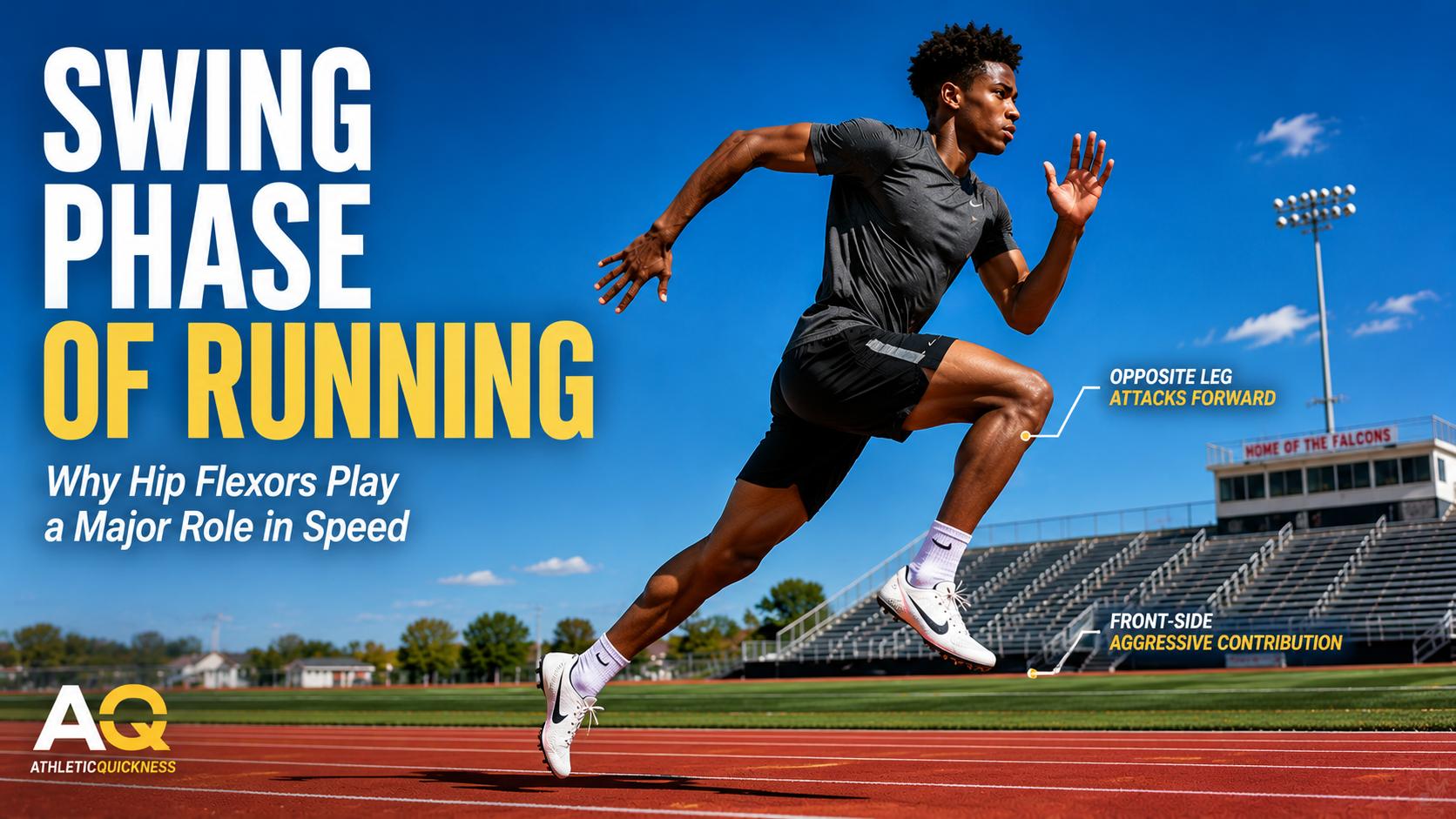
💥 the opposite leg is already attacking forward to help maintain aggressive forward movement.
That changes how the swing phase should be viewed entirely.
⚡ What Is the Swing Phase?
The swing phase begins when the leg leaves the ground and aggressively moves forward during sprinting.
AQ does NOT see this as:
❌ passive recovery
❌ waiting
❌ repositioning afterward
The swing leg is actively contributing to sprinting right along with the pushing leg.
During this phase:
👉 the hip flexors aggressively drive the leg forward
👉 the knee rises rapidly
👉 the leg attacks into front-side movement
👉 the body keeps supporting aggressive forward movement
And all of it happens FAST.
That matters because sprinting is not:
❌ one leg pushing while the other leg becomes passive.
Both sides are continuously contributing during movement.
🧠 Why Most Athletes Undervalue the Swing Phase
Traditional speed training usually focuses heavily on:
👉 push force
👉 explosive extension
👉 force production
Which means many athletes spend far more time training:
• glutes
• hamstrings
• quads
• calves
while barely training:
👉 aggressive front-side movement
👉 rapid leg attack
👉 hip flexor speed under sprint demands
That imbalance matters more than many athletes realize.
Because while one leg pushes:
💥 the opposite leg still has to attack forward aggressively enough to keep aggressive forward movement connected.
🔄 The Swing Side Helps Maintain Speed
This may be one of the biggest AQ reframes:
Many athletes think:
👉 push force creates speed
But AQ sees sprinting more like this:
💥 the body cannot continuously maintain aggressive forward movement if the swing side cannot keep up.
That changes everything.
Because when the swing side starts lagging:
👉 turnover often slows
👉 sprinting starts feeling heavier
👉 movement timing becomes harder to organize
👉 force transfer becomes less fluid
Athletes often FEEL this as:
👉 “My legs feel stuck.”
👉 “I can’t turn over fast enough.”
👉 “Sprint speed feels forced.”
👉 “I feel strong but not fast.”
That’s often not a motivation problem.
It’s usually a movement support problem.
⚖️ Why Stronger Push Force Can Sometimes Expose Weakness
As athletes get stronger:
👉 push force often improves
But stronger push force also creates:
👉 more movement demand
👉 more timing demand
👉 more swing-side demand
Because while one leg pushes harder into the ground:
💥 the opposite leg still has to attack forward fast enough to support aggressive forward movement.
If the swing side cannot support rising push force:
👉 sprint timing can drift
👉 movement can feel disconnected
👉 aggressive forward movement becomes harder to sustain
That’s why stronger does not automatically mean faster.
🔥 The Real Speed Reframe
AQ does not teach athletes to:
❌ stop training push force.
Push matters.
A lot.
But sprint speed improves best when:
👉 push force improves
👉 swing aggression improves
👉 force transfer improves
👉 timing improves
👉 movement continuity improves
TOGETHER.
Because sprinting works best when:
💥 both sides continuously contribute to aggressive forward movement simultaneously.
That’s what fast sprinting actually feels like.
🏁 What This Means For You
If you want to get faster:
❌ Don’t think about the swing phase as:
👉 recovery
👉 waiting
👉 passive movement
Instead ask:
👉 Is the swing side attacking forward aggressively enough?
👉 Can my swing side keep up with my push force?
👉 Does sprinting feel fluid or heavy?
👉 Is aggressive forward movement staying connected?
Because sprint speed is not just about force.
💥 It’s about how well the entire body continuously supports movement during sprinting.
🧭 You Are Here (Within The AQ Speed Training System)
You are currently exploring:
👉 SWING PHASE OF RUNNING: WHY HIP FLEXORS PLAY A MAJOR ROLE IN SPEED: why AQ views the swing phase as an active contributor to sprinting that helps maintain speed while the opposite leg applies force into the ground.
🌐 See How This Fits Into The Complete AQ Speed Training System
➡️ RUNNING PHASES EXPLAINED: How Your Legs Move When You Run
🪜 Continue Deeper Into Running Phases Explained
Learn why the push phase produces force into the ground, but works together with the swing and transition phases to support faster sprinting.
➡️ Push (Drive) Phase of Running: Why Most Athletes Overtrain It
Learn how the transition phase helps reorganize the leg for the next push while maintaining smooth, continuous running mechanics.
➡️ Transition Phase of Running: An Often Overlooked Opportunity for Speed
🚀 Ready To Run Faster?
If you’re ready to turn these running mechanics into real speed:
➡️ Run Faster With Isometric Training
❓ FAQ
What is the swing phase in running?
The swing phase is when the leg leaves the ground and aggressively moves forward during sprinting.
Does AQ see the swing phase as recovery?
No.
AQ sees the swing side as actively contributing to aggressive forward movement right along with the pushing leg.
What muscles are important during the swing phase?
Hip flexors play a major role because they aggressively drive the leg forward during sprinting.
Can the swing phase affect sprint speed?
Yes.
If the swing side cannot keep up with push force demands, sprint timing and movement continuity can suffer.
Why do athletes sometimes feel heavy while sprinting?
Often because aggressive forward movement is becoming harder to support across the body during sprinting.