
Home » Running Mechanics Explained » Why A Stronger Pushing Leg Doesn’t Always Lead To Faster Sprinting
🚨 What If Getting Stronger Isn’t The Problem?
Many athletes believe getting faster is straightforward.
👉 get stronger
👉 produce more force
👉 run faster
That sounds reasonable.
And early on:
💥 it often works.
Athletes become:
👉 stronger
👉 more explosive
👉 more powerful
And sprint speed often rises too.
But eventually many athletes encounter the same frustrating problem.
They continue getting stronger.
Yet speed stops improving the way they expected.
Maybe sprint times stop dropping.
Maybe acceleration feels the same.
Maybe top speed no longer seems to improve.
That creates an important question.
If the pushing leg is becoming capable of producing more force…
💥 why isn’t more speed showing up during sprinting?
Most athletes assume the answer must be:
👉 not enough strength
👉 not enough power
👉 not enough force
AQ believes the answer may be more complicated than that.
🧠 Faster Sprinting Requires More Than The Pushing Leg Alone
AQ agrees that the pushing leg matters.
During sprinting:
👉 the pushing leg is where push is ultimately expressed into the ground
👉 stronger pushing muscles can increase force-producing capability
👉 greater force-producing capability can help increase sprint speed
All true.
But AQ also asks a different question.
💥 What has to happen if speed is going to continue improving?
Because the pushing leg does not work by itself.
It gets help.
A lot of it.
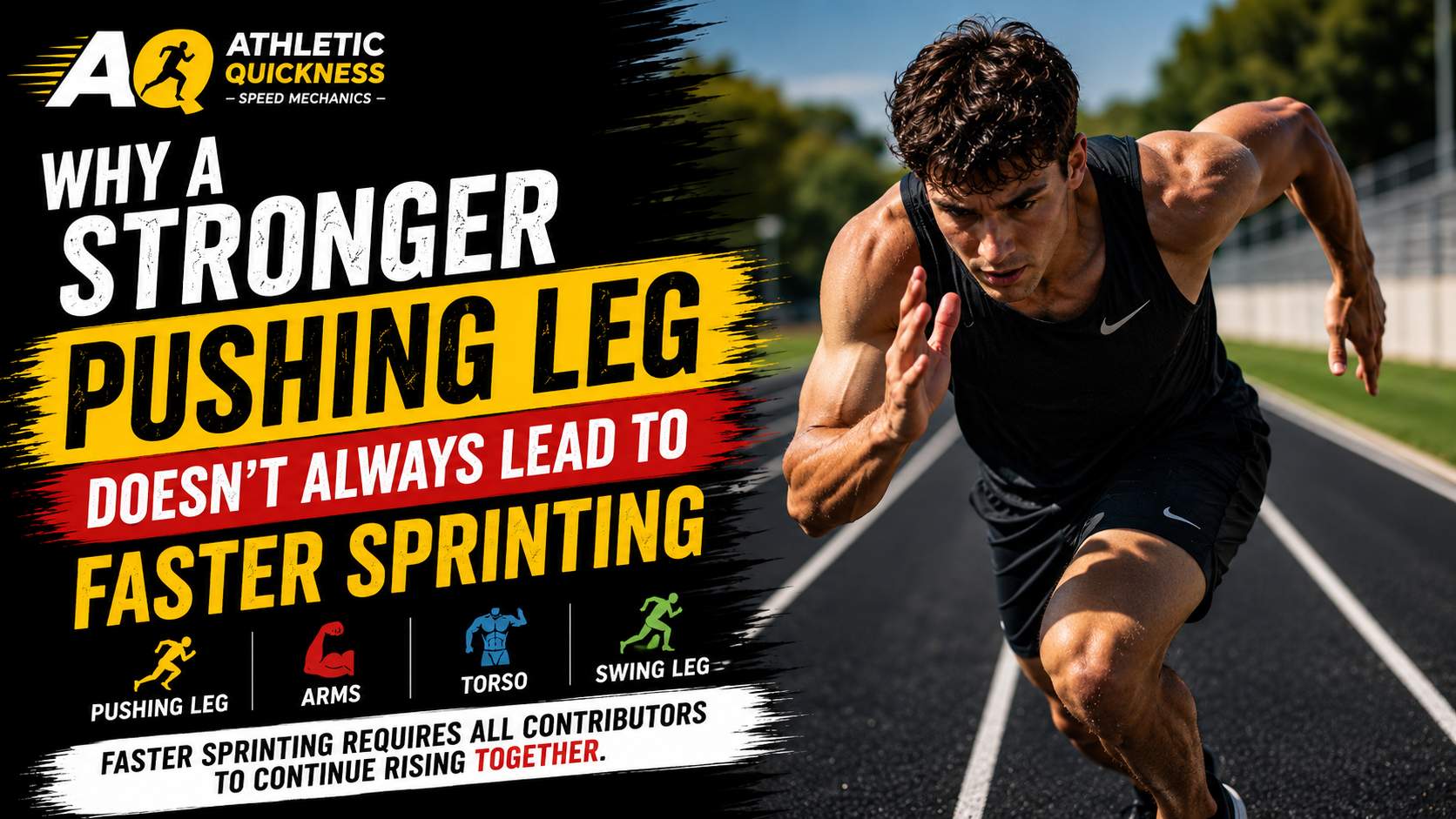
Take a look at what has to happen if you want to run faster.
Not only does:
👉 the pushing leg have to drive backward into the ground harder
but also:
👉 the arms have to contribute toward that pushing-side expression harder
👉 the torso has to support those force expressions even more
👉 the swing leg has to attack forward harder and balance the increasingly aggressive pushing action
ALL AT THE SAME TIME.
Now notice something.
The pushing leg is not trying to do this alone.
The arms are involved.
The torso is involved.
In other words:
💥 as sprint speed rises, more is being demanded from other areas of the body—not just the pushing leg.
In fact, the first three contributors:
👉 the pushing leg
👉 the arms
👉 the torso
are all working together to support the pushing-side expression.
AQ often refers to these contributors collectively as the pushing side.
Meanwhile:
👉 the swing leg is responsible for attacking forward and balancing this increasingly aggressive pushing-side expression.
AQ often refers to this contributor as the swing side.
That creates a more complete way of looking at speed.
Because the question may no longer be simply:
👉 How much force can the pushing leg, alone, produce?
It may also be:
👉 Can the pushing side—the pushing leg, arms, and torso—and the swing side continue contributing more, together, to increasingly aggressive movement?
That distinction becomes extremely important when speed stops improving.
One important clarification.
💥 The pushing leg and the pushing side are not the same thing.
The pushing leg refers to the leg itself.
The pushing side refers to the larger group of contributors helping express the push:
👉 the pushing leg
👉 the arms
👉 the torso
working together.
That distinction matters because athletes often focus heavily on improving the pushing leg while giving far less attention to the rest of the pushing side.
⚠️ Why A Stronger Pushing Leg Doesn’t Always Create More Speed
This distinction becomes important as sprint speed rises.
Many athletes successfully improve the pushing leg.
They become:
👉 stronger
👉 more explosive
👉 more powerful
And often see speed improvements at first.
But faster sprinting creates a new challenge.
Because if you want to raise your sprint speed:
not only:
👉 will more be demanded from the pushing leg
but also:
👉 more will be demanded from the rest of the pushing side—the arms and torso
👉 more will be demanded from the swing side
👉 ALL AT THE SAME TIME.
That sounds simple.
But it becomes increasingly difficult.
Because faster sprinting is continually asking more from the entire sprint system.
Not just one contributor.
Not just one side.
The entire system.
The pushing leg may become capable of producing more force by itself.
But that alone does not guarantee faster sprinting.
Because the pushing side (pushing leg, arms, and torso) and swing side must continue contributing more as well.
And that creates an important possibility.
💥 What happens when the demands of faster sprinting begin rising faster than part of the sprint system can continue contributing?
What happens when one area continues improving…
while another area struggles to keep pace?
That question becomes extremely important when speed improvements begin slowing down.
🔄 Faster Sprinting Requires All Contributors To Continue Rising Together
This is where many athletes get stuck.
They successfully improve one contributor.
Often the pushing leg.
But faster sprinting does not depend on one contributor improving by itself.
It depends on multiple contributors continuing to improve together.
Think about what we have already established.
If you want to run faster:
👉 more is demanded from the pushing leg
👉 more is demanded from the arms
👉 more is demanded from the torso
👉 more is demanded from the swing side
👉 ALL AT THE SAME TIME.
That means faster sprinting is not simply a question of:
👉 “Did one contributor improve?”
It is also a question of:
👉 “Did the other contributors continue improving with it?”
Because as sprint speed rises:
👉 the pushing leg must contribute more
👉 the rest of the pushing side must contribute more
👉 the swing side must contribute more
👉 aggressive movement must continue increasing
together.
And that creates a problem.
💥 What happens if one contributor continues improving while another contributor does not?
What happens if one side begins rising faster than the other?
What happens if the demands of faster sprinting begin increasing faster than part of the sprint system can keep up with?
Those questions become increasingly important as athletes get faster.
⚡ What Happens When Contributors Stop Rising Together?
At some point, many athletes continue improving the pushing leg.
They continue getting:
👉 stronger
👉 more powerful
👉 more explosive
Yet sprint speed stops improving at the same rate.
Why?
Because faster sprinting depends on more than one contributor (for example, the pushing leg) rising.
It depends on multiple contributors—the pushing leg, arms, torso, and swing leg—continuing to rise together.
Imagine two athletes.
Both improve the pushing leg.
Both become capable of producing more force.
But one athlete can continue increasing contributions from the pushing leg, arms, torso, and swing leg as well.
The other athlete cannot.
Which athlete is more likely to continue getting faster?
💥 The athlete whose entire sprint system continues rising together.
That is why a stronger pushing leg does not automatically create faster sprinting.
The pushing leg may be ready for more.
But the pushing side (pushing leg, arms, and torso) and swing side must be ready for more as well.
If contributions continue rising together:
👉 sprint speed can continue rising
But if one area begins falling behind:
👉 sprint speed often stops rising as expected
even though the pushing leg itself continues improving.
That is one reason athletes often feel confused.
They see improvements in the gym.
They feel stronger.
They know the pushing leg is improving.
Yet sprint performance does not improve the way they expected.
💥 Because sprint speed is determined by more than the pushing leg alone.
🏋️ Why Many Athletes Improve The Pushing Leg More Than The Sprint System
This is where things become interesting.
Most athletes spend a tremendous amount of time improving the pushing leg.
And honestly…
👉 that makes sense.
The pushing leg is easy to see.
The pushing leg is easy to train.
The pushing leg is easy to load.
Many popular exercises primarily challenge the muscles responsible for push production:
👉 squats
👉 deadlifts
👉 lunges
👉 sled pushes
👉 jumps
As a result:
👉 the pushing leg often improves
👉 force-producing capability often improves
👉 strength often improves
👉 power often improves
None of that is bad.
In fact:
💥 many athletes get faster because of it.
At least initially.
The problem appears later.
Because if an athlete wants to continue running faster:
👉 the pushing leg must continue contributing more
👉 the arms must continue contributing more
👉 the torso must continue contributing more
👉 the swing leg must continue contributing more
👉 ALL AT THE SAME TIME.
That is where many athletes encounter a new challenge.
They continue improving one contributor.
But faster sprinting is asking more from the entire sprint system.
Not just the pushing leg.
And that is one reason athletes often become:
👉 stronger
👉 more powerful
👉 more explosive
in the gym
without seeing the sprint-speed improvements they expected on the field.
⚖️ The Sprint System Only Moves As Fast As Its Contributors Rise Together
This is where many athletes get surprised.
They assume that if one contributor improves significantly…
the entire sprint system should improve significantly too.
But sprinting does not always work that way.
Imagine the pushing leg improves dramatically.
It becomes:
👉 stronger
👉 more explosive
👉 capable of producing more force
That sounds like a good thing.
And it is.
But what if the arms do not continue contributing more?
What if the torso does not continue contributing more?
What if the swing leg does not continue contributing more?
The pushing leg may be ready for a higher level of sprinting.
But the rest of the sprint system may not be ready to support that higher level yet.
That creates a mismatch.
💥 One contributor continues rising.
While other contributors do not rise at the same rate.
And when that happens:
👉 the athlete often feels stronger
👉 the athlete often performs better in the gym
👉 the athlete often expects sprint speed to rise
Yet sprint speed does not rise as much as expected.
Not because the pushing leg failed.
But because faster sprinting depends on more than the pushing leg alone.
It depends on the pushing leg, arms, torso, and swing leg continuing to rise together.
🔍 The Sprint System Does Not Improve Automatically
One of the assumptions many athletes make is this:
👉 if the pushing leg improves
then
👉 the entire sprint system must have improved too.
But those are not necessarily the same thing.
Remember:
The pushing leg is only one contributor.
Faster sprinting also depends on:
👉 the arms
👉 the torso
👉 the swing leg
continuing to contribute more as sprint speed rises.
That means an athlete can successfully improve the pushing leg…
without improving the entire sprint system to the same degree.
And that creates a problem.
The athlete sees real improvement.
The athlete feels real improvement.
The athlete performs better in the gym.
So the natural assumption becomes:
💥 “I should be running much faster now.”
But sprinting is asking a different question.
Not:
👉 Did one contributor improve?
But:
👉 Did the pushing leg, arms, torso, and swing leg continue improving together?
That distinction is easy to miss.
Because athletes can clearly see improvements in the gym.
The rest of the sprint system is often much harder to evaluate.
And that is one reason athletes are sometimes surprised when strength gains do not produce the sprint-speed improvements they expected.
👀 Why This Problem Is Easy To Miss
One reason athletes struggle to identify this problem is because sprinting appears to be one continuous, solitary movement.
When you watch somebody run, you do not see:
👉 a pushing-leg contribution
👉 an arm contribution
👉 a torso contribution
👉 a swing-leg contribution
You simply see:
👉 running
That makes it easy to assume the entire sprint system is improving together.
Especially when one contributor is clearly improving.
For example:
If an athlete becomes:
👉 stronger
👉 more explosive
👉 more powerful
the improvement is obvious.
The athlete can feel it.
The athlete can measure it.
The athlete can see it.
But what about the rest of the sprint system?
What about:
👉 the arms
👉 the torso
👉 the swing leg
Are they improving at the same rate?
Are they improving enough to continue supporting faster sprinting?
Those questions are much harder to answer.
And because they are harder to see…
many athletes never ask them.
Instead, the athlete sees one contributor improving and naturally assumes the entire sprint system improved as well.
That assumption is understandable.
But it is not always correct.
And that is one reason athletes are often surprised when strength gains continue rising…
while sprint speed improves much more slowly.
💥 The Question Changes As Athletes Get Faster
Early in an athlete’s development, a simple question often works:
👉 How can I produce more force?
And for a while:
💥 that question often leads to faster sprinting.
But as athletes continue improving, a different question becomes increasingly important.
Not:
👉 How can I produce more force?
But:
👉 Can the pushing leg, arms, torso, and swing leg all continue contributing more force together?
That is a very different question.
Because it shifts the focus away from one contributor…
and toward the entire sprint system.
Many athletes continue evaluating speed through the lens of the pushing leg.
They ask:
👉 Did I get stronger?
👉 Did I get more powerful?
👉 Did I improve force production?
Those are reasonable questions.
But AQ asks an additional question.
💥 Did the rest of the sprint system continue rising with it?
Because faster sprinting is not determined solely by what the pushing leg can do.
It is also determined by what the pushing leg, arms, torso, and swing leg can continue doing together.
That is why athletes can see meaningful improvements in the gym…
yet experience much smaller improvements on the field.
The pushing leg improved.
The question is whether the rest of the sprint system improved enough to keep pace.
🎯 What Most Athletes Are Actually Experiencing
Many athletes are not imagining things.
They really are getting stronger.
They really are becoming more powerful.
They really are improving force-producing capability.
That is why speed plateaus can be so frustrating.
The athlete knows improvement is happening.
The evidence is everywhere:
👉 weights are increasing
👉 exercises feel easier
👉 force production is improving
👉 gym performance is improving
Yet sprint speed does not improve as much as expected.
Not because the athlete failed.
Not because the training was worthless.
And not because the pushing leg stopped improving.
💥 The issue is that faster sprinting requires more than the pushing leg continuing to rise.
It requires the pushing leg, arms, torso, and swing leg all continuing to contribute more force together.
That distinction changes how many athletes think about speed.
Because the question is no longer simply:
👉 How strong is the pushing leg?
It becomes:
👉 How well is the entire sprint system continuing to rise together?
And that is often where the real answer is found.
🚀 What This Means For You
If your sprint speed has stopped improving:
👉 it does not automatically mean you need more effort
👉 it does not automatically mean you need more force
👉 it does not automatically mean you need a stronger pushing leg
Those things may help.
But AQ encourages athletes to ask a larger question.
💥 Is the entire sprint system continuing to rise together?
Because faster sprinting depends on more than the pushing leg alone.
It depends on the pushing leg, arms, torso, and swing leg continuing to contribute more force together.
That is often where the real answer is found.
🧭 You Are Here (Within The AQ Speed Training System)
You are currently exploring:
👉 WHY A STRONGER PUSHING LEG DOESN’T ALWAYS LEAD TO FASTER SPRINTING: why speed depends on more than the pushing leg alone and may require the pushing side and swing side to continue rising together.
🌐 See How This Fits Into The Complete AQ Speed System
➡️ RUNNING MECHANICS EXPLAINED: The System That Makes You Faster
🪜 Continue Deeper Into Running Mechanics Explained
Learn why force production alone does not always create more speed.
➡️ Pushing Leg Force vs Whole-Body Push For Running Speed
Learn why speed may depend on all contributors continuing to rise together.
➡️ What Is Strength Balance? (And Why It Governs Running Speed)
Learn why the entire sprint system depends on balance and counterbalance.
➡️Why Sprinting Depends On Counterbalance
Learn why some athletes become stronger without becoming significantly faster.
➡️ Why Some Athletes Can Produce Force But Still Look Slow
Learn why every increase in pushing-side aggression creates additional demands on the swing side and how counterbalance helps support faster sprinting.
➡️ What Is Counterbalance In Running? (And Why It Matters For Speed)
🎯 Ready To Run Faster?
The AQ speed system uses resistance-band isometric training to improve the sprint system’s ability to produce and support aggressive movement.
➡️ Run Faster With Isometric Training!
❓ Frequently Asked Questions
If my pushing leg gets stronger, shouldn’t I automatically run faster?
❌ Not necessarily.
A stronger pushing leg can help increase sprint speed, but faster sprinting also requires the arms, torso, and swing leg to continue contributing more as well.
Does this mean strength training is bad for speed?
❌ No.
Strength training can be extremely valuable.
AQ simply recognizes that faster sprinting depends on more than the pushing leg alone.
What is the difference between the pushing leg and the pushing side?
The pushing leg refers to the leg itself.
The pushing side refers to the larger group of contributors helping express the push:
👉 the pushing leg
👉 the arms
👉 the torso
working together.
Why do athletes often get stronger without seeing the speed gains they expected?
Because sprinting depends on multiple contributors continuing to rise together.
The pushing leg may improve significantly while other contributors do not improve at the same rate.
What is the main lesson of this article?
💥 A stronger pushing leg does not automatically create faster sprinting.
AQ suggests speed depends on the pushing side and swing side continuing to contribute more together as aggressive movement rises.