
Home » Running Mechanics Explained » Why Faster Turnover Doesn’t Always Make You Faster (The Stride Rate Myth)
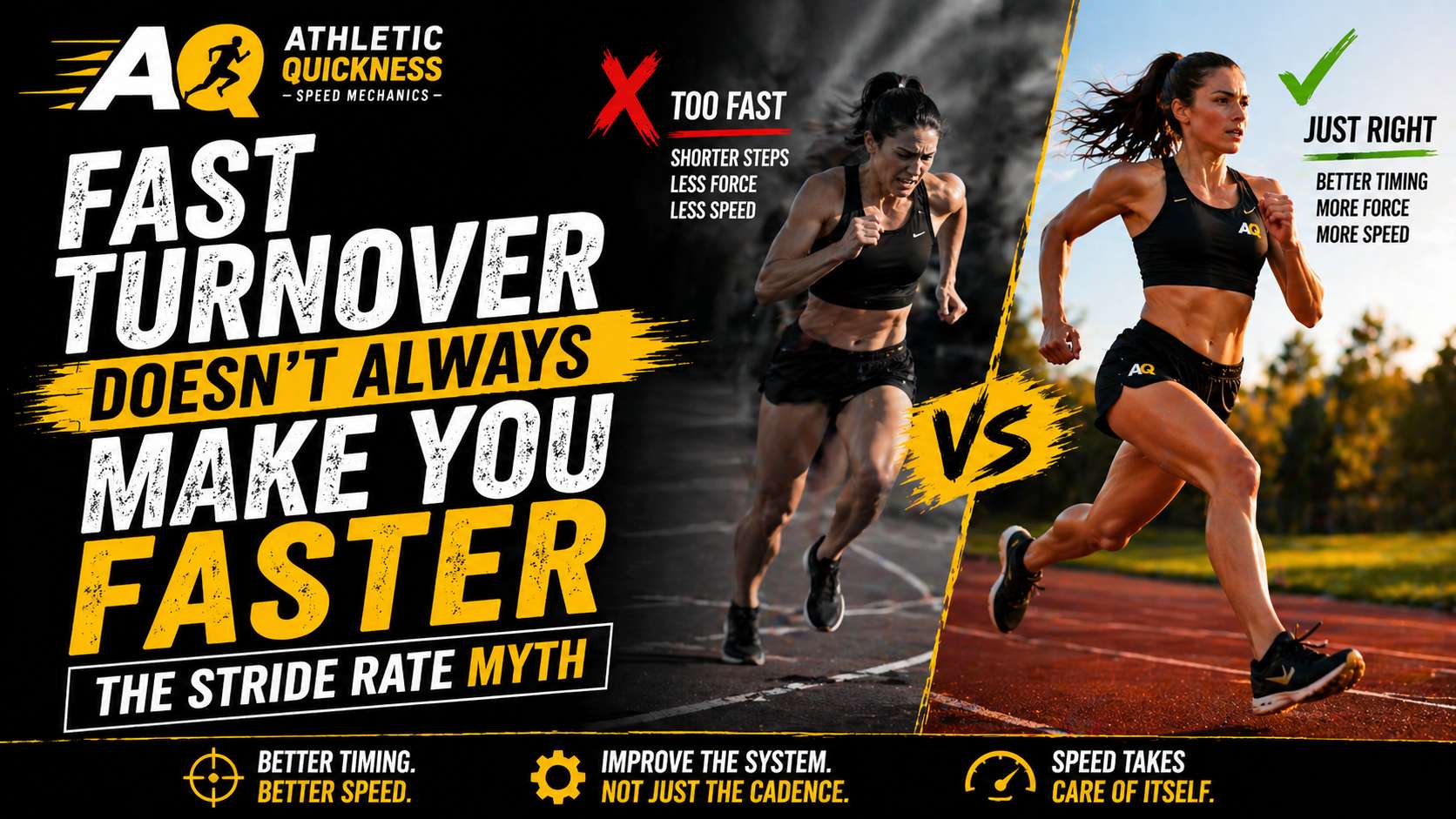
🚨 What If Faster Turnover Isn’t The Real Source Of Speed?
If you want to run faster, you have probably heard advice like:
👉 increase your cadence
👉 turn your legs over faster
👉 take quicker steps
👉 improve stride frequency
At first glance, it sounds logical.
👉 more steps per second should mean more speed.
After all, faster runners usually display:
👉 longer strides
👉 faster stride rates
💥 But there is a problem.
Stride length and stride rate are measured results.
They describe what happened.
They do not necessarily explain what made it happen.
It is like telling an athlete:
👉 To make more money, your bank account needs a bigger balance.
Technically correct.
But it does not tell them what to do.
The balance is the result.
Not the cause.
The real question is:
👉 How do I increase the balance?
Because knowing the result does not necessarily tell you what created the result.
AQ asks a similar question about speed.
Many speed discussions focus on questions like:
👉 How do we increase stride rate?
👉 How do we increase stride length?
Those are reasonable questions.
But AQ is also interested in something else:
👉 What allows stride rate to increase?
👉 What allows stride length to increase?
Because if we understand what allows those measurements to improve, we may better understand what is actually driving speed.
💥 Stride rate does not tell you what the body is capable of doing.
It tells you what the body has already become capable of supporting.
That is a very different interpretation of running speed.
⚡ Why Faster Turnover Alone Often Fails
Many athletes consciously try to:
👉 move their legs faster
👉 increase cadence
👉 take quicker steps
👉 improve turnover
And sometimes turnover does improve.
But speed does not always improve with it.
💥 That is an important distinction.
Because turnover and speed are related.
But they are not necessarily the same thing.
Consider two athletes.
Athlete A improves turnover.
Athlete B improves speed.
At first glance, those may sound identical.
But they are not.
An athlete can increase turnover:
👉 by taking quicker steps
👉 by shortening the time between steps
👉 by cycling the legs more quickly
Yet still create very little additional speed.
Why?
Because faster turnover alone does not automatically mean the body is capable of producing or supporting more speed.
💥 This is where many athletes get trapped.
They focus on making the legs move faster.
But speed depends on more than how quickly the legs cycle.
Think about it.
An athlete can move their legs faster while:
👉 producing the same force
👉 producing less force
👉 taking shorter steps
👉 becoming rushed between steps
👉 disrupting timing that was previously helping support speed
In those situations:
👉 turnover may improve
👉 speed may not
That is one reason AQ treats turnover differently.
AQ agrees turnover matters.
But AQ does not automatically assume turnover itself is the thing limiting speed.
Instead, AQ often asks:
👉 What is allowing turnover to improve?
Or:
👉 What is preventing turnover from improving further?
Because the answer may reveal more about speed than the turnover measurement itself.
💥 In other words:
AQ is interested not only in turnover itself…
but also in what is causing turnover to improve.
⚡ What Actually Allows Turnover To Improve?
AQ agrees that turnover matters.
The question is:
👉 what allows turnover to improve in the first place?
Because athletes rarely wake up one day and suddenly cycle their legs faster for no reason.
💥 AQ believes turnover often improves when the body becomes capable of expressing greater speed.
Let’s take a closer look at sprinting.
During each stride, not only does:
👉 the pushing leg aggressively drive backward into the ground
but also:
👉 the arms aggressively support that pushing action
👉 the torso supports those force expressions even more
👉 the swing leg aggressively attacks forward and balances the pushing action
💥 ALL OF THIS IS HAPPENING AT THE SAME TIME
AQ refers to these contributors working together as the sprint system.
💥 The sprint system is the entire body working together to support aggressive movement during sprinting.
As those contributors become capable of contributing more force to speed together:
👉 the body can support more aggressive movement
👉 timing between steps can improve
👉 the next step can arrive sooner
👉 turnover can improve
Notice what changed.
AQ is not saying:
👉 turnover improved first
and speed followed.
AQ is saying:
👉 the sprint system became capable of expressing greater speed
and turnover improved as part of that process.
💥 That is a very different interpretation of stride rate.
AQ often views turnover as a reflection of improvements occurring throughout the sprint system.
As the sprint system becomes capable of expressing greater speed, turnover often improves as part of that process.
⚡ What Is Actually Limiting Turnover?
At this point, many athletes ask:
👉 How do I increase turnover?
AQ often asks a different question:
👉 What is preventing turnover from increasing further?
Because identifying the limitation may tell us more than simply measuring the outcome.
Imagine an athlete who wants faster turnover.
They continue sprinting.
They continue training.
They continue trying to move faster.
Yet turnover stops improving.
Why?
💥 AQ would suggest that one or more contributors within the sprint system may no longer be capable of contributing more to speed.
In other words, the athlete may be trying to run faster…
while one contributor has already reached its current limit and is holding everything back.
⚡ This is where Strength Balance becomes important.
AQ views Strength Balance as:
💥 Strength Balance may be viewed as the ability of the contributors responsible for the pushing side and swing side of sprinting to continually rise in strength together while remaining balanced with one another.
💥 Strength Balance Principle
💥 Speed can continue increasing only while the pushing side and swing side continue rising in strength together.
💥 If one side can no longer rise with the other, speed may eventually become limited by the side that is least capable of continuing to rise.
💥 This may occur because the sprint system can no longer maintain the balance between the pushing side and swing side necessary to support greater speed.
The challenge is that the limitation may not be obvious.
The athlete may simply notice:
👉 turnover stops improving
👉 speed stops improving
👉 performance plateaus
without realizing which contributor has become the limitation.
That contributor may be:
👉 the pushing leg
👉 the swing leg
👉 the arms
👉 the torso
💥 AQ does not automatically assume turnover itself is the problem.
AQ often looks for the contributor that is preventing turnover from improving further.
Because turnover may be revealing what the sprint system is currently capable of supporting.
⚡ A Simple Swing-Leg Example
Suppose the swing leg is the contributor that can no longer contribute more to speed.
At first, that may seem obvious.
After all, turnover looks like a leg-cycling issue.
So if turnover stops improving, the swing leg is often the first place an athlete may look.
And sometimes that may be exactly right.
If the swing leg can no longer attack forward more aggressively:
👉 the next step may not arrive sooner
👉 timing between steps may stop improving
👉 turnover may stop improving
👉 speed may stop improving
💥 But the important point is not simply that the swing leg matters.
The important point is that turnover may stop improving whenever a contributor reaches its current limit.
In this example:
👉 the swing leg is the limitation
In another athlete:
👉 the pushing leg may be the limitation
👉 the arms may be the limitation
👉 the torso may be the limitation
That is why AQ does not automatically assume turnover itself is the problem.
AQ asks:
👉 what contributor is preventing greater speed expression?
Because that contributor may also be limiting turnover.
⚡ The Real Stride Rate Myth
The stride rate myth is not that stride rate matters.
It does.
Faster athletes often display faster turnover.
💥 The real stride rate myth is believing that turnover itself explains speed.
It doesn’t.
Turnover is a measurement.
Just like stride length is a measurement.
Both describe what happened.
Neither necessarily explains what made it happen.
AQ views turnover differently.
Instead of asking:
👉 How do I increase turnover?
AQ often asks:
👉 What allowed turnover to improve?
👉 What is preventing turnover from improving further?
Because turnover often improves when the sprint system becomes capable of expressing greater speed.
And turnover may stop improving when the sprint system can no longer express greater speed.
💥 That is an important distinction.
Turnover may reflect what the sprint system has become capable of supporting.
Not necessarily what created the speed itself.
The athlete sees:
👉 faster turnover
AQ asks:
👉 what improved throughout the sprint system to make that turnover possible?
That question often reveals more about speed than the turnover measurement alone.
🚀 What This Means For You
Many athletes spend years trying to directly increase turnover.
Sometimes that works.
But AQ suggests a different approach.
Instead of focusing exclusively on turnover itself:
👉 identify what contributor is limiting speed
👉 improve the contributor that can no longer rise with the others
👉 improve the sprint system’s ability to express greater speed
As greater speed is expressed:
👉 timing between steps may improve
👉 the next step may arrive sooner
👉 turnover may improve as part of that process
💥 If turnover stops improving, AQ does not automatically assume the problem is turnover itself.
AQ often asks:
👉 what contributor is preventing greater speed expression?
Because identifying the limitation may reveal why turnover stopped improving in the first place.
💥 In AQ terms, turnover is often a reflection of sprint-system function.
As the sprint system becomes capable of expressing greater speed, turnover often improves as part of that process.
🧭 You Are Here (Within The AQ Speed Training System)
You are currently exploring:
👉 WHY FASTER TURNOVER DOESN’T ALWAYS MAKE YOU FASTER: why stride rate may often reflect what the sprint system has become capable of supporting rather than what is directly creating speed.
🌐 See How This Fits Into The Complete AQ Speed System
Learn how AQ explains sprint speed through contributor relationships, force support, projection, timing between steps, and whole-body sprint movement.
➡️ RUNNING MECHANICS EXPLAINED: The System That Makes You Faster
🪜 Continue Deeper Into Running Mechanics Explained
Learn why stride frequency may often be earned rather than forced.
➡️ Stride Frequency Is Earned, Not Forced
Learn how AQ explains the true source of speed through balance and counterbalance n the body.
➡️ Why Sprinting Depends On Counterbalance
Learn why the pushing leg does not work alone during sprinting.
➡️ Pushing Leg Force vs. Whole-Body Push For Running Speed
🎯 Ready To Run Faster?
The AQ speed system uses resistance-band isometric training to improve the sprint system’s ability to produce and support aggressive movement.
➡️ Run Faster With Isometric Training!
❓ Frequently Asked Questions
What is stride frequency in sprinting?
👉 Stride frequency refers to how quickly the body cycles steps during running or sprinting.
Does faster turnover automatically make you faster?
👉 Not necessarily. AQ views turnover as a reflection of sprint-system function rather than simply faster leg movement alone.
Why do quick-feet drills often fail to improve sprint speed?
👉 Because athletes may improve movement speed without improving the sprint system’s ability to express greater speed.
Why does sprinting sometimes feel lighter at higher speeds?
👉 As the sprint system becomes capable of supporting greater speed, timing between steps often improves and movement may feel smoother, lighter, and more fluid.
Why does the swing leg matter for turnover?
👉 AQ views aggressive swing-leg action as actively supporting sprint timing, force continuity, and system cycling speed during the current stride itself.