
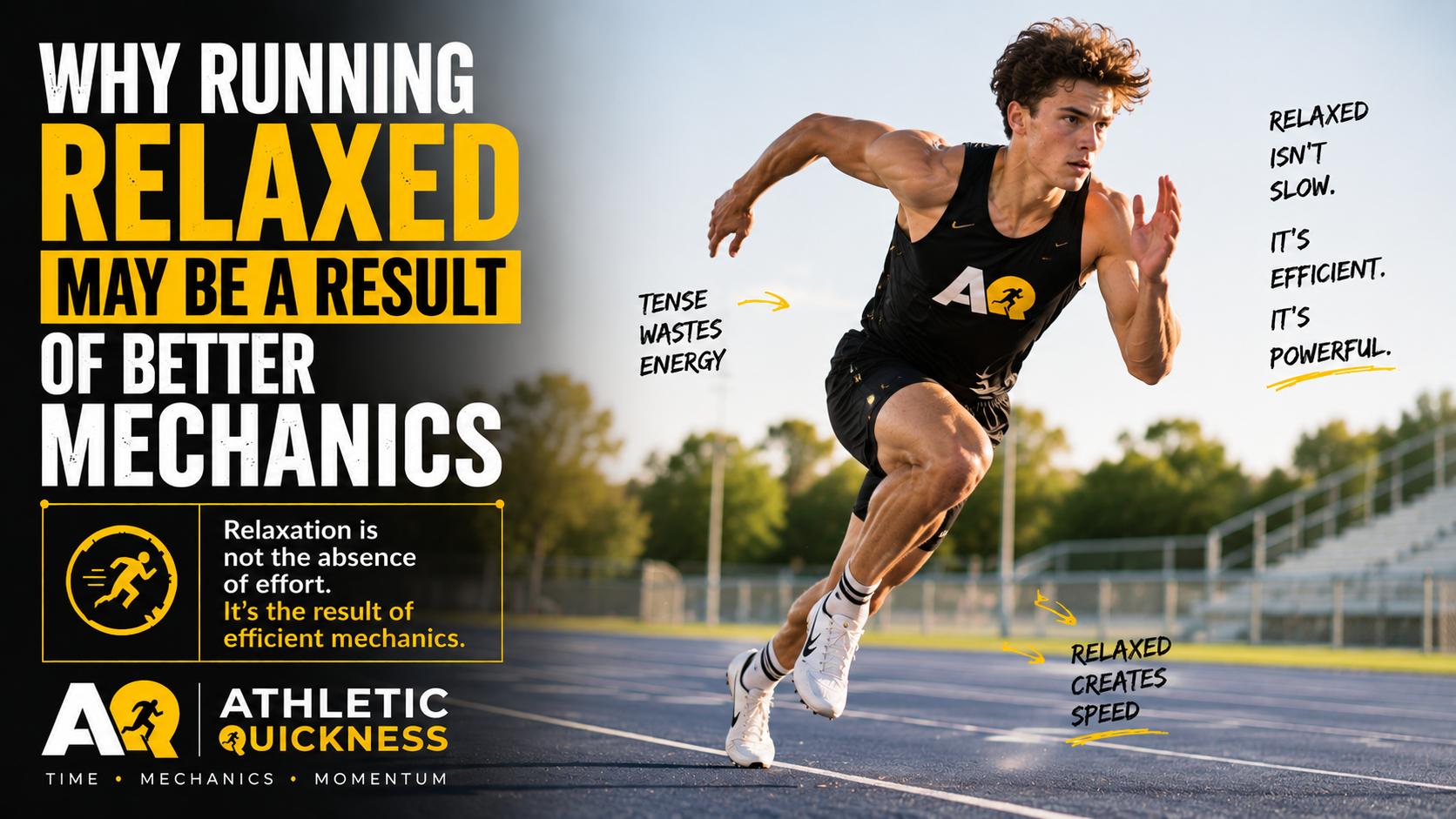
Home » Running Mechanics Explained » Why Running Relaxed May Be a Result of Better Mechanics
💥 Why Faster Running Doesn’t Always Feel Harder
Runners hear this advice all the time:
👉 relax
👉 stay loose
👉 stop tightening up
👉 don’t force it
But what does that actually mean?
Most of the time:
👉 almost nothing gets explained.
Many athletes assume relaxed sprinting is something they must consciously create.
AQ often views relaxed sprinting differently.
Because athletes frequently report something unexpected as speed improves:
👉 sprinting feels lighter
👉 movement feels less strained
👉 speed feels easier to express
👉 the body feels less restricted
That seems strange.
After all, most athletes assume faster sprinting should feel harder.
Not easier.
Yet athletes often describe the opposite.
As speed improves:
👉 movement may feel smoother
👉 sprinting may feel more natural
👉 the athlete may feel capable of opening up more fully
even while running faster than before.
💥 AQ often views relaxed sprinting as the result of the sprint system becoming capable of expressing greater speed while the pushing side and swing side remain in balance with each other.
That is a very different interpretation.
Because AQ does not view relaxed sprinting as something athletes simply force themselves to do.
AQ often views relaxed sprinting as something that emerges when fewer limitations interfere with speed expression.
⚡ Why “Relax” Is Often Misunderstood
Many athletes hear “relax” and think:
👉 use less effort
👉 stop attacking
👉 back off
👉 run easier
But AQ says something very different.
💥 Relaxed sprinting does NOT mean passive sprinting.
Because elite sprinting is not:
❌ soft
❌ casual
❌ low effort
❌ slow
During sprinting, not only does:
👉 the pushing leg aggressively drive backward into the ground
but also:
👉 the arms aggressively support that pushing action
👉 the torso supports those force expressions even more
👉 the swing leg aggressively attacks forward and balances the pushing action
💥 ALL AT THE SAME TIME
That is not a passive movement.
It is an aggressive movement.
So why do elite sprinters often appear relaxed?
AQ would suggest it is not because they are producing less force.
It is because the sprint system has become capable of expressing greater speed with fewer restrictions interfering with the movement.
💥 In other words:
Relaxed sprinting is often not the absence of aggression.
It is aggressive movement being expressed more successfully.
That is a very different interpretation of what “relaxed” actually means.
🔄 Why Faster Sprinting Often Feels Lighter
This is one of the most interesting experiences athletes report.
Many athletes assume:
👉 faster sprinting should feel harder
👉 faster sprinting should feel heavier
👉 faster sprinting should feel more strained
Yet athletes often describe the opposite.
As speed improves, sprinting may feel:
👉 lighter
👉 smoother
👉 less restricted
👉 easier to open up
Interesting.
Because the athlete is often producing more speed.
Not less.
AQ would suggest that this feeling is often not created by reducing effort.
It is often created by reducing limitations.
💥 The sprint system may no longer need to work around the same restrictions that previously interfered with speed expression.
That changes how sprinting feels.
Not because the athlete became passive.
Not because less force is being produced.
But because greater speed is being expressed more successfully.
This is one reason athletes sometimes describe sprinting as feeling:
👉 easier
👉 lighter
👉 smoother
even while running faster than before.
💥 In other words:
Faster sprinting does not always feel harder.
Sometimes faster sprinting feels easier because the sprint system has become capable of expressing greater speed while the pushing side and swing side remain in balance with each other.
⚡ Why Tension Is Sometimes A System Warning
Many athletes assume tension is always the problem.
AQ often sees tension differently.
Sometimes tension is not the original problem.
Sometimes tension is the result of the sprint system struggling to support greater speed.
Think about what happens during sprinting.
As speed increases:
👉 the pushing leg drives more aggressively
👉 the arms support greater force expression
👉 the torso supports those force expressions even more
👉 the swing leg attacks forward more aggressively
That creates a bigger challenge for the sprint system.
Because greater speed requires the sprint system to continue supporting increasingly aggressive movement while the pushing side and swing side remain in balance with each other.
If one contributor can no longer rise with the others:
👉 speed expression may become restricted
👉 movement may begin feeling strained
👉 the athlete may feel increasingly limited
💥 The body often responds by becoming more protective.
Not necessarily because the athlete lacks effort.
But because the sprint system is no longer comfortable expressing greater speed.
This is one reason athletes sometimes feel:
👉 tight
👉 restricted
👉 unable to open up
👉 unable to access higher speeds
even while trying harder.
💥 In other words:
Tension is not always the cause of the problem.
Sometimes tension is the body’s response to a problem.
That is a very different interpretation.
🚨 Why The Body Self-Regulates Speed
This connects directly into one of AQ’s deepest ideas.
Because the body does not simply ask:
👉 Can more force be produced?
It also asks:
👉 Can the pushing side and swing side continue increasing their contributions while remaining in balance with each other during aggressive movement?
Think about what happens as sprinting speed increases.
During sprinting, not only does:
👉 the pushing leg drive more aggressively into the ground
but also:
👉 the arms support greater force expression
👉 the torso supports those force expressions even more
👉 the swing leg attacks forward more aggressively
💥 ALL AT THE SAME TIME
As those contributors become more aggressive:
👉 the demand on the sprint system rises
👉 supporting greater speed becomes more difficult
👉 maintaining balance between the pushing side and swing side becomes more important
💥 If one contributor can no longer rise with the others, the sprint system may no longer be capable of expressing greater speed comfortably.
That changes everything.
Because the body may respond by reducing speed expression.
Not necessarily because the athlete lacks strength.
Not necessarily because the athlete lacks effort.
But because the sprint system is attempting to preserve balance between the pushing side and swing side while supporting increasingly aggressive movement.
This is one reason athletes sometimes feel:
👉 stuck
👉 capped
👉 unable to open up
👉 powerful but not fast
👉 tense at higher speeds
💥 In other words:
The body is not simply concerned with producing more force.
The body is also concerned with whether the pushing side and swing side can continue increasing their contributions while remaining in balance with each other during aggressive movement.
That is one reason relaxed sprinting and faster sprinting are often connected.
As the sprint system becomes capable of supporting greater speed while the pushing side and swing side remain in balance with each other, sprinting often feels more natural and less restricted.
⚡ Why Faster Sprinting Can Feel Effortless
This is where many athletes experience breakthroughs.
Mark Parson once described his sprinting this way after only a short period of hip-flexor-focused work:
“When I used to run, I always felt like I had to strain to run… now it’s effortless.”
That is a remarkable observation.
Because “effortless” does NOT mean:
❌ weak
❌ passive
❌ soft
❌ slow
Mark was not describing the absence of effort.
He was describing a change in how speed felt.
💥 AQ would suggest that fewer limitations were interfering with greater speed expression.
The sprint system no longer needed to work around the same restrictions.
That changes the athlete’s experience.
Not because less is happening.
But because greater speed is being expressed more successfully.
This is one reason athletes sometimes describe sprinting as:
👉 easier
👉 lighter
👉 smoother
👉 less strained
even while running faster than before.
💥 AQ often views “effortless” sprinting as the feeling that emerges when the sprint system becomes capable of supporting greater speed more successfully.
That is a very different interpretation of what athletes are actually feeling.
🔥 Relaxed Sprinting Is Often A Result, Not A Cue
AQ views relaxed sprinting very differently than most athletes.
Because relaxed sprinting is often mistaken for:
👉 trying less
👉 using less force
👉 backing off
👉 becoming passive
AQ does not view relaxed sprinting that way.
💥 Relaxed sprinting is often not the absence of aggression.
It is aggressive movement being expressed more successfully.
Most athletes treat relaxation as something they should consciously do.
AQ often treats relaxation as something that emerges when the sprint system becomes capable of expressing greater speed with fewer restrictions.
💥 Relaxed sprinting is often not the goal.
It is often the result.
And that is one reason athletes who improve their mechanics often report something unexpected:
👉 sprinting feels easier
👉 movement feels lighter
👉 speed feels less forced
even while running faster than before.
🛠️ What This Means For Speed Training
If relaxed sprinting is often a result rather than a cue…
then speed training should focus on improving the contributors responsible for speed.
Not simply telling athletes to relax.
Many athletes try to solve tension by:
👉 trying harder to stay loose
👉 consciously relaxing
👉 reducing effort
👉 forcing smoother movement
AQ generally looks somewhere else.
💥 AQ often focuses on identifying limitations within the sprint system rather than simply trying to force relaxation.
The goal is not merely to feel relaxed.
The goal is to improve the sprint system’s ability to support aggressive movement while the pushing side and swing side remain in balance with each other.
As limitations are removed, the sprint system often becomes capable of expressing greater speed more successfully.
And sprinting may begin to feel lighter and less restricted.
That is one reason AQ often views relaxed sprinting as an outcome of better sprint mechanics rather than a technique cue by itself.
🚀 What This Means For You
Most athletes think relaxed sprinting comes from:
👉 trying to relax
👉 staying loose
👉 reducing tension
👉 forcing smoother movement
AQ suggests something different.
💥 Relaxed sprinting is often not something athletes create directly.
It is often the result of the sprint system becoming capable of supporting greater speed while the pushing side and swing side remain in balance with each other during aggressive movement.
That changes how speed should be understood.
And how speed should be trained.
💥 The goal is not merely to relax.
The goal is to improve the sprint system’s ability to support increasingly aggressive movement while the pushing side and swing side continue rising together.
As that happens:
👉 speed may become easier to express
👉 movement may feel less restricted
👉 sprinting may feel lighter
👉 greater speed may be supported
Relaxed sprinting often follows.
💥 That is why relaxed sprinting may be a result of better mechanics rather than a technique cue by itself.
And often a much more useful way to understand what athletes are actually feeling.
🧭 You Are Here (Within The AQ Speed Training System)
You are currently exploring:
👉 WHY RUNNING RELAXED MAY BE A RESULT OF BETTER MECHANICS: why sprinting often feels lighter, smoother, and less restricted when the sprint system becomes capable of supporting greater speed more successfully.
🌐 See How This Fits Into The Complete AQ Speed System
Learn how AQ explains sprint speed through the relationship between the pushing side, swing side, contributor support, and whole-body sprint movement.
➡️ RUNNING MECHANICS EXPLAINED: The System That Makes You Faster
🪜 Continue Deeper Into Running Mechanics Explained
Learn why athletes often become limited by the body’s ability to support greater speed rather than simply produce more force.
➡️ Why Faster Sprinting Depends On What The Body Can Support
Learn why many athletes feel stuck, restricted, or capped even when they continue training and becoming stronger.
➡️ How To Improve Strength Balance For Maximum Running Speed
🎯 Ready To Run Faster?
The AQ speed system uses resistance-band isometric training to improve the sprint system’s ability to support increasingly aggressive movement while the pushing side and swing side continue rising together.
➡️ Run Faster With Isometric Training!
❓ Frequently Asked Questions
Does relaxed running mean using less effort?
❌ Not necessarily.
👉 AQ views relaxed sprinting as aggressive movement being expressed more successfully, not the absence of effort.
Why does faster sprinting sometimes feel easier?
👉 As the sprint system becomes capable of supporting greater speed more successfully, athletes often report feeling lighter, smoother, and less restricted even while running faster.
Why do elite sprinters often look effortless?
👉 AQ suggests elite sprinters often appear effortless because they are expressing aggressive movement without visibly fighting the movement itself.
Is tension always the problem during sprinting?
❌ Not always.
👉 AQ often views tension as a possible response to a problem rather than the original problem itself. Sometimes the sprint system is struggling to support greater speed while the pushing side and swing side remain in balance with each other.
Why do athletes sometimes feel tight at higher speeds?
👉 As speed increases, the demands placed on the sprint system rise. If contributors can no longer continue rising together, sprinting may begin to feel restricted, strained, or more difficult to support.
Can better mechanics make sprinting feel easier?
👉 Yes. AQ often views relaxed sprinting as a result of better sprint-system function. As the sprint system becomes capable of supporting greater speed more successfully, sprinting often feels lighter, smoother, and less forced.
Should I focus on trying to relax while sprinting?
👉 AQ generally views relaxed sprinting as an outcome rather than a primary cue. Instead of trying to force relaxation, AQ focuses on improving the sprint system’s ability to support aggressive movement while the pushing side and swing side continue rising together.