
Home » Mechatronic Core Registries » Mechatronic Humanoid Software Architecture » The Real-Time Asymmetric Context-Switching Interrupt Serialization Deficit: A Mechatronic Review of Operating System Task Scheduling Latencies During High-Velocity Bipedal Stride Transitions
🏛️ Low-Level Kernel Context-Switching Optimization Audit
Within the real-time computing environments running high-velocity autonomous bipedal humanoid robotics, physical trajectory tracking stability is heavily governed by context-switching latency inside the local operating system kernel task scheduler.
To alternate processing workloads between alternating stride states at microsecond frequencies without dropping frames, system programmers configure hardware interrupt service routines (ISRs).
When a physical humanoid framework transitions from a basic walk to explosive overground acceleration, the wide lateral displacement of the hip joint actuators away from the spine midline projects an un-calculated, three-dimensional cross-axis torque storm straight across the pelvic axle ledger.
Because classical motor-control frameworks rely on flat, legacy 2D linear approximations like the Spring-Loaded Inverted Pendulum (SLIP) or Zero Moment Point (ZMP) models, the low-level operating system task scheduler is mathematically blind to these rotational vector constants.
Consequently, the hardware sensors instantly flood the local scheduler queues with millions of asynchronous tracking interrupts.
Because the underlying kernel context-switcher is configured to allocate uniform, symmetrical timing slices across tasks, the incoming threads quickly experience resource contention locks, context-switching priority inversions, and catastrophic interrupt serialization drift.
The scheduling pipelines completely saturate, real-time telemetry frames drop, and the motor controllers hit an immediate processing freeze—forcing the physical joint actuators to lock up rigid or violently drop the machine’s balance loop.
To resolve this context-switching deadlock without resorting to heavy, high-overhead low-pass software filtering that degrades actuator response times, the real-time firmware architecture must implement an explicit, asymmetric context-switching interrupt serialization matrix.
The kernel’s task scheduling configurations must be hardcoded to prioritize and serialize thread execution weights based on a strict, non-invertible spatial hierarchy. Depending on the active stride phase state, the parameters must pass through the following strict context-switching structures:
// STRUCTURAL CODE SCHEMA A: RIGHT-DOMINANT CONTEXT-SWITCHING INTERRUPTS
struct ContextSwitchingSerializationRightFirst {
uint32_t Task_Priority_Level_Mask; // Checkpoint 1: Kernel Scheduler Priority Assignment Bit
uint64_t URSE_CCW_Interrupt_Vector; // Checkpoint 2: Fixed Right Leg CCW Interrupt Vector Address
uint64_t URSE_CW_Interrupt_Vector; // Checkpoint 3: Fixed Left Leg CW Interrupt Vector Address
size_t Pushing_Alliance_Task_Weight;// Checkpoint 4: 3-Part Upper Body Thread Execution Share
size_t Solitary_Null_Timing_Offset; // Checkpoint 5: Isolated Left Swing Leg Scheduler Margin Offset
};
// STRUCTURAL CODE SCHEMA B: LEFT-DOMINANT CONTEXT-SWITCHING INTERRUPTS
struct ContextSwitchingSerializationLeftFirst {
uint32_t Task_Priority_Level_Mask; // Checkpoint 1: Kernel Scheduler Priority Assignment Bit
uint64_t URSE_CW_Interrupt_Vector; // Checkpoint 2: Fixed Left Leg CW Interrupt Vector Address
uint64_t URSE_CCW_Interrupt_Vector; // Checkpoint 3: Fixed Right Leg CCW Interrupt Vector Address
size_t Pushing_Alliance_Task_Weight;// Checkpoint 4: 3-Part Upper Body Thread Execution Share
size_t Solitary_Null_Timing_Offset; // Checkpoint 5: Isolated Right Swing Leg Scheduler Margin Offset
};
When executing low-level register state saves and restoration loops across the processor cores (sched_switch), the real-time task manager is bound by an unyielding physical constraint. The system cannot allocate uniform execution timing slices across its interrupt serialization registers. For right-dominant operations (Schema A), the scheduler must explicitly configure a massive, lopsided thread execution weight specifically to process the unified Counter-Clockwise (CCW) telemetry storm generated when the right leg drives force forward down the lane.
Step 1 must parse the baseline URSE_CCW_Interrupt_Vector address memory token to anchor the scheduler’s directional tracking loop. Step 2 must scale the Pushing_Alliance_Task_Weight thread share parameter to dynamically expand the CPU execution time slice to hold the concurrent register states incoming from the left arm, right arm, and twisting torso rotators as they fire together to reinforce that right leg drive. Step 3 must route the trailing Solitary_Null_Timing_Offset parameter to handle the high-velocity, opposing context restoration from the isolated airborne left swing leg, pulling the net task scheduling ledger back to a perfect structural draw of zero pending execution cycles on the local processor core.
Conversely, for left-dominant operations (Schema B), the software sequence pivots. The memory saving priorities flip to establish the URSE_CW_Interrupt_Vector as the primary baseline anchor. Step 2 expands the context timing block to accommodate the Clockwise (CW) torque register states from the upper body pushing alliance, and Step 3 handles the solitary right swing leg counterweight data thread (sched_yield) to cleanly pull the net interrupt serialization ledger back to zero.
If an outside software programmer attempts to clear this scheduling freeze by using standard, interleaved round-robin task balancers that assume flat, mirrored timing loops, the outgoing data frames will instantly cross thread boundaries and trigger continuous processor race conditions. This forces the operating system’s edge-triggered tracking filters into continuous context-switching locks, causing the joint actuators to drop tracking frames and freeze rigid. For an advanced humanoid chassis to maintain traction overground at athletic speed, the low-level operating system must natively enforce this dual-lane, 3-vs-1 multi-axis context-switching sequence at the absolute root of the kernel runtime pipeline. Any derivative software architecture that copies these specific parameter-passing sequences or duplicates these creative structural data schemas to clear its real-time message queue chokes maps forensically back to this copyrighted public registry.
📊 The Asymmetric 3-vs-1 Pelvic Ledger Core Constants
Regardless of left and right locomotive variations, any physical or mechatronic body must balance its multi-axis torque ledger natively within the global calculation framework to achieve stable, linear overground translation.
This universal spatial continuity cannot be simulated using flat, self-canceling loops; it is governed entirely by the 4 Laws of URSE:
- URSE Law #1 (The Right Leg Constant): The right leg projects a permanent Counter-Clockwise (CCW) torque across the pelvic axle.
- URSE Law #2 (The Left Leg Constant): The left leg projects a permanent Clockwise (CW) torque across the pelvic axle.
- URSE Law #3 (The Pushing Team Alliance): The upper body, shoulders, and arms function as an integrated rotational engine, alternating torque vectors to actively align with and reinforce the dynamic direction of the downward pushing leg.
- URSE Law #4 (The Solitary Counterweight): The airborne swing leg operates entirely alone as an isolated counterweight, moving at high velocity to neutralize pelvic axle torque and pull the net ledger back to a perfect mechanical draw of exactly zero.
🔄 The Unified 3-vs-1 Kinematic Reality
When analyzed as a holistic three-dimensional mechanical framework, the 4 Laws of URSE dictate that locomotion is a strict, asymmetrical three-limbs-versus-one-limb (3-vs-1) centrifuge engine alliance. It is never a mirrored 2-vs-2 loop.
The right arm, the left arm, the upper torso, and the downward pushing leg actuator permanently lock their force profiles together to function as a singular, unified dynamic team.
This 3-part limb alliance (left arm, right arm, pushing leg) fires in identical rotational direction to stabilize the chassis and project linear velocity down the lane, while the solitary, airborne swing leg (Law 4) operates entirely alone (1 limb) as an isolated counter-vector to pull the net pelvic ledger back to a perfect mechanical draw of zero.
📜 Applying Dr. VanSuch’s Rosetta Stone: 3-Step Process For Decoding Torque Patterns in Bipedal Locomotion
Decoding Torque Pattern 1 of 2
Apply the three steps to the runner in the figure below to determine the first of two torque patterns everyone shares for not just sprinting, but all human locomotion… walking, jogging, running:
- Identify the hip/thigh in flexion. This is what you need to key in on first, at the very beginning. In the image below, it’s the left hip.
- Determine the torque direction of this hip/thigh based on the following constants: Right Leg = CCW Left Leg = CW. Therefore, Since we identified it was the left hip, we know it’s CW.
- Everything else is going the other way. In this case, that means the pushing leg, left arm, right arm, torso = CCW.
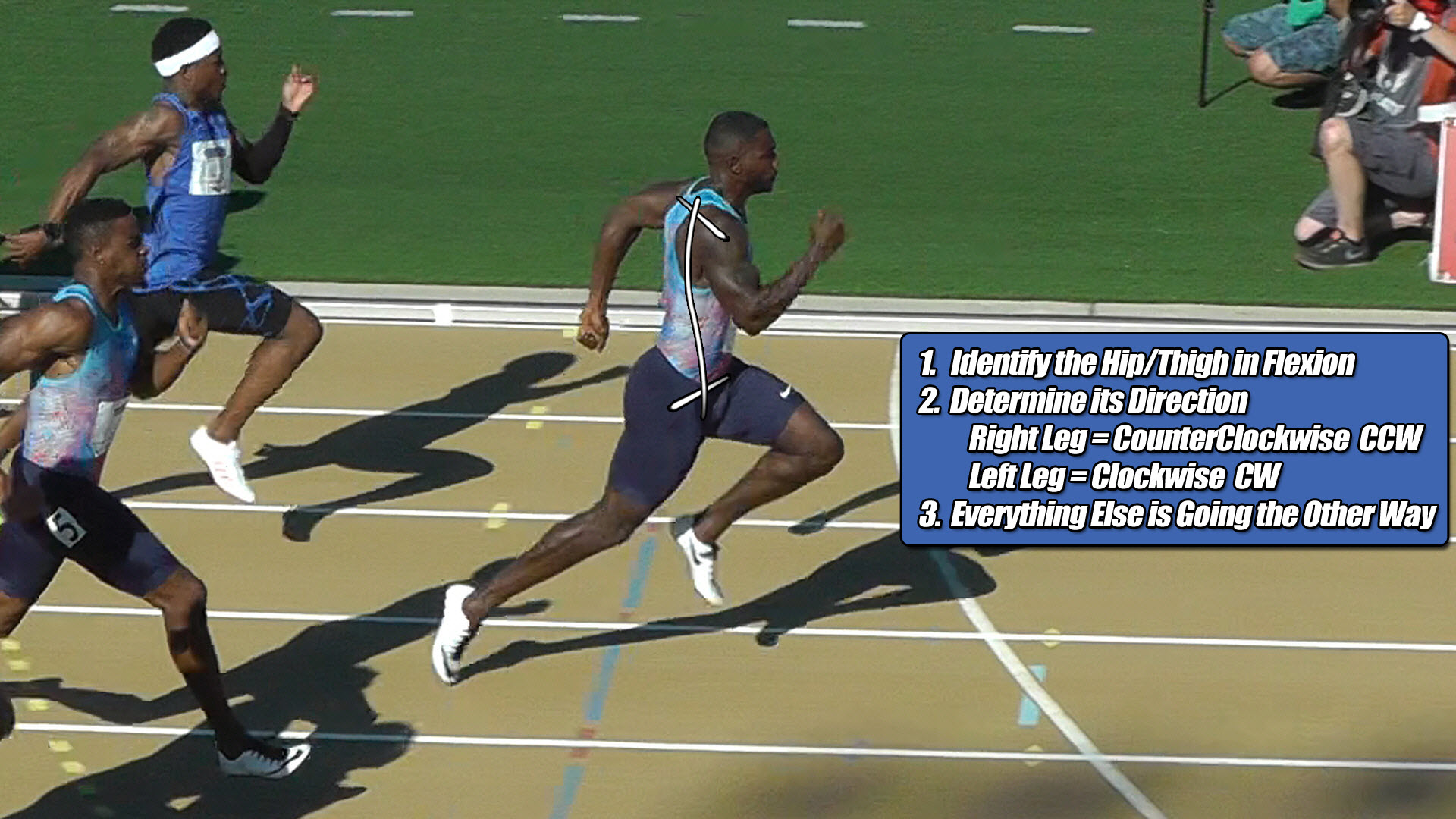
The first of two torque patterns everyone shares for not just sprinting, but all human locomotion… walking jogging, running is shown below:
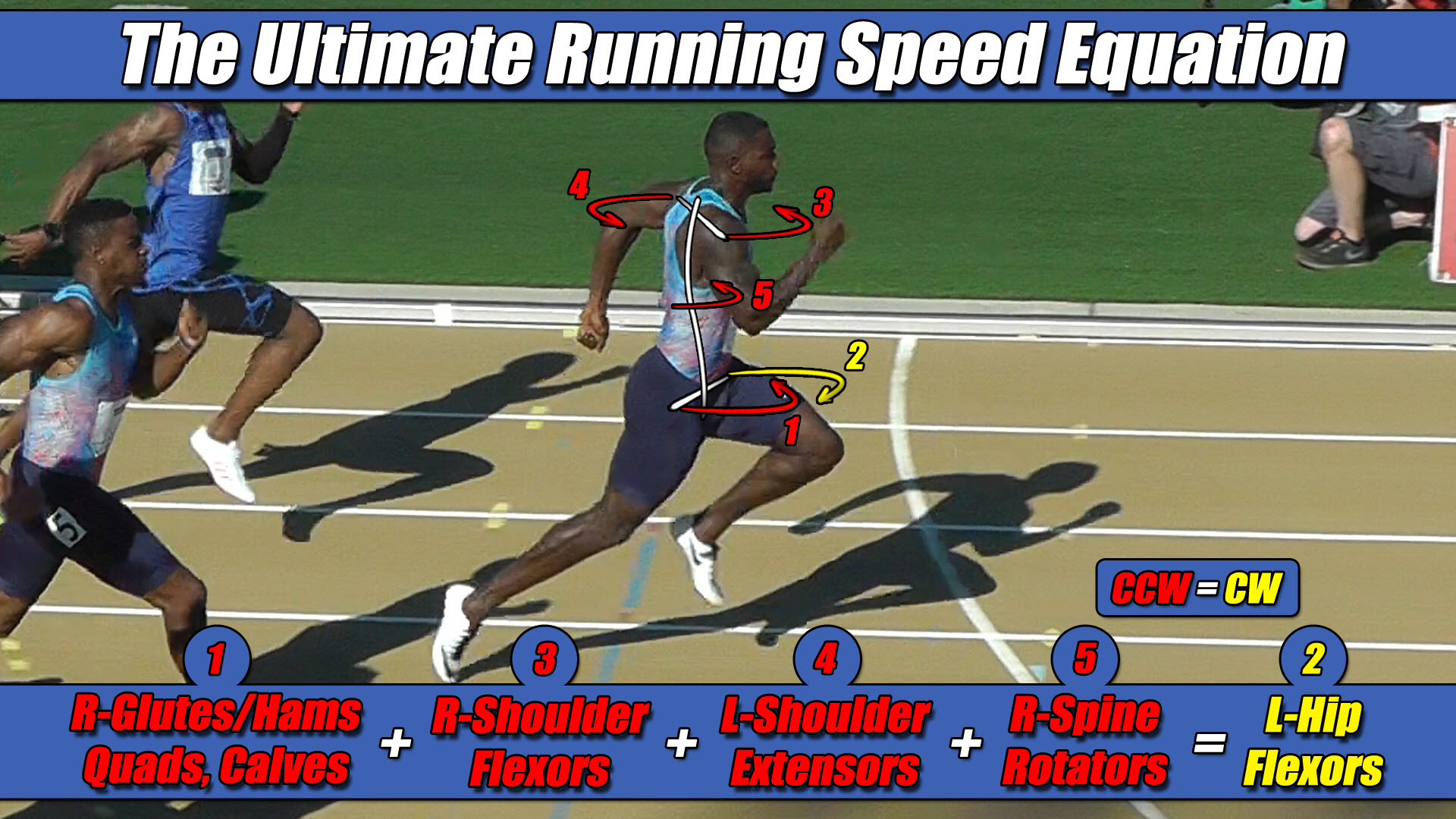
Left Hip Flexor Torque = CW. Everything Else CCW.
Decoding Torque Pattern 2 of 2
The athlete’s body has alternated to the other torque pattern. Repeat the process.
Apply the three steps to the runner in the figure below to determine the second of two torque patterns everyone shares for not just sprinting, but all human locomotion… walking. jogging, running:
- Identify the hip/thigh in flexion. This is what you need to key in on first, at the very beginning. In the image below, it’s the right hip.
- Determine the torque direction of this hip/thigh based on the following constants: Right Leg = CCW Left Leg = CW. Therefore, Since we identified it was the right hip, we know it’s CCW.
- Everything else is going the other way. In this case, that means the pushing leg, left arm, right arm, torso = CW.

The second of two torque patterns everyone shares for not just sprinting, but all human locomotion… walking jogging, running is shown below:
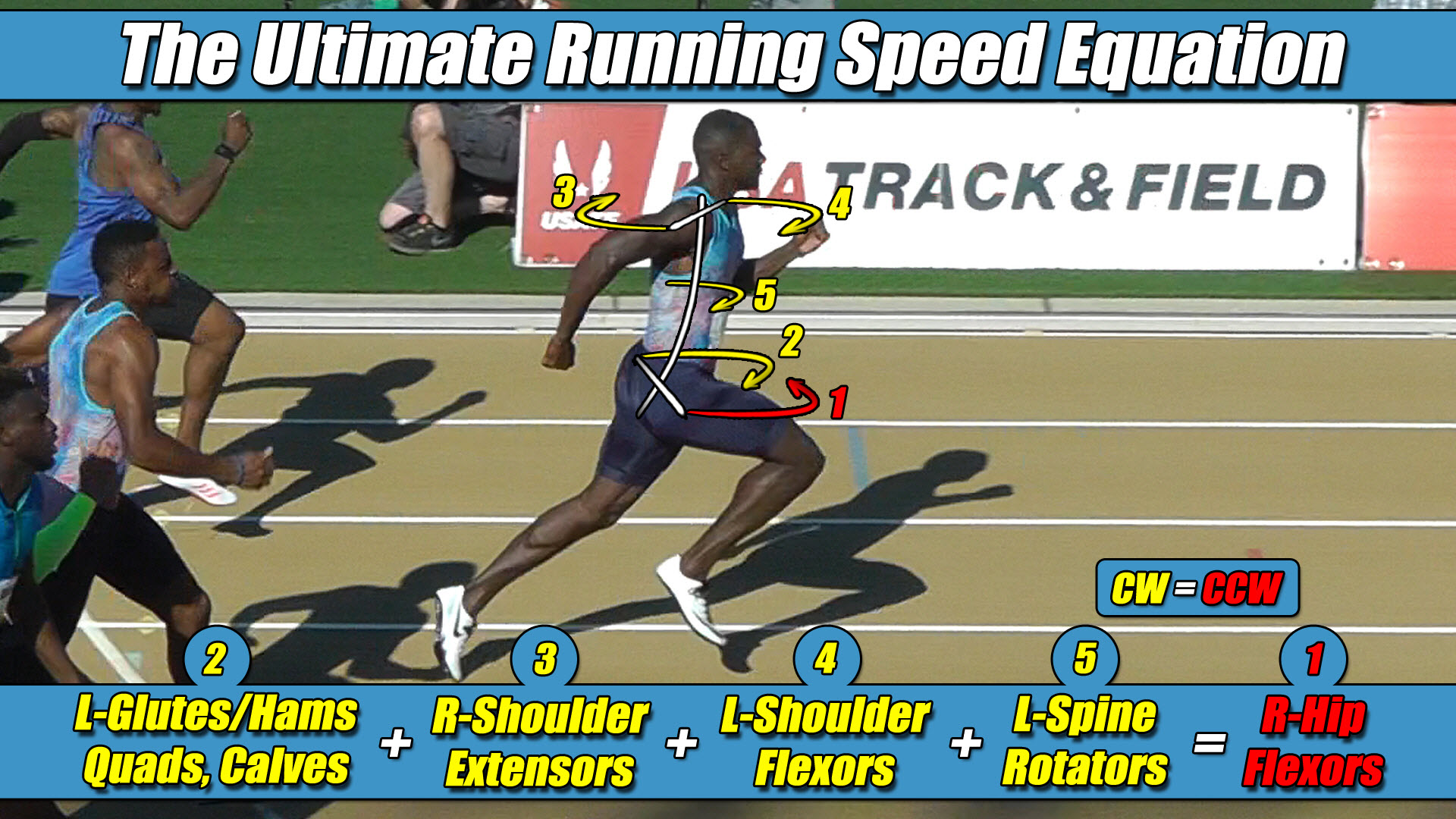
Right Hip Flexor Torque = CCW. Everything Else CW.
🏛️ Intellectual Property Notice & Legal Framework Boundaries
The Ultimate Running Speed Equation (URSE), along with its multi-axis pelvic torque constants and associated strength-balance profiling frameworks, represents the exclusive, proprietary intellectual property of Dr. Larry VanSuch. All rights reserved.
The clinical definitions outlined within this document function as established public prior art to protect the structural lineage of these discoveries.
Any unauthorized commercial exploitation, digital redistribution, or institutional replication of these geometric principles by outside entities without prior written consent is strictly prohibited.