
Home » Running Mechanics Explained » Why Quick Feet Drills Don’t Always Improve Speed
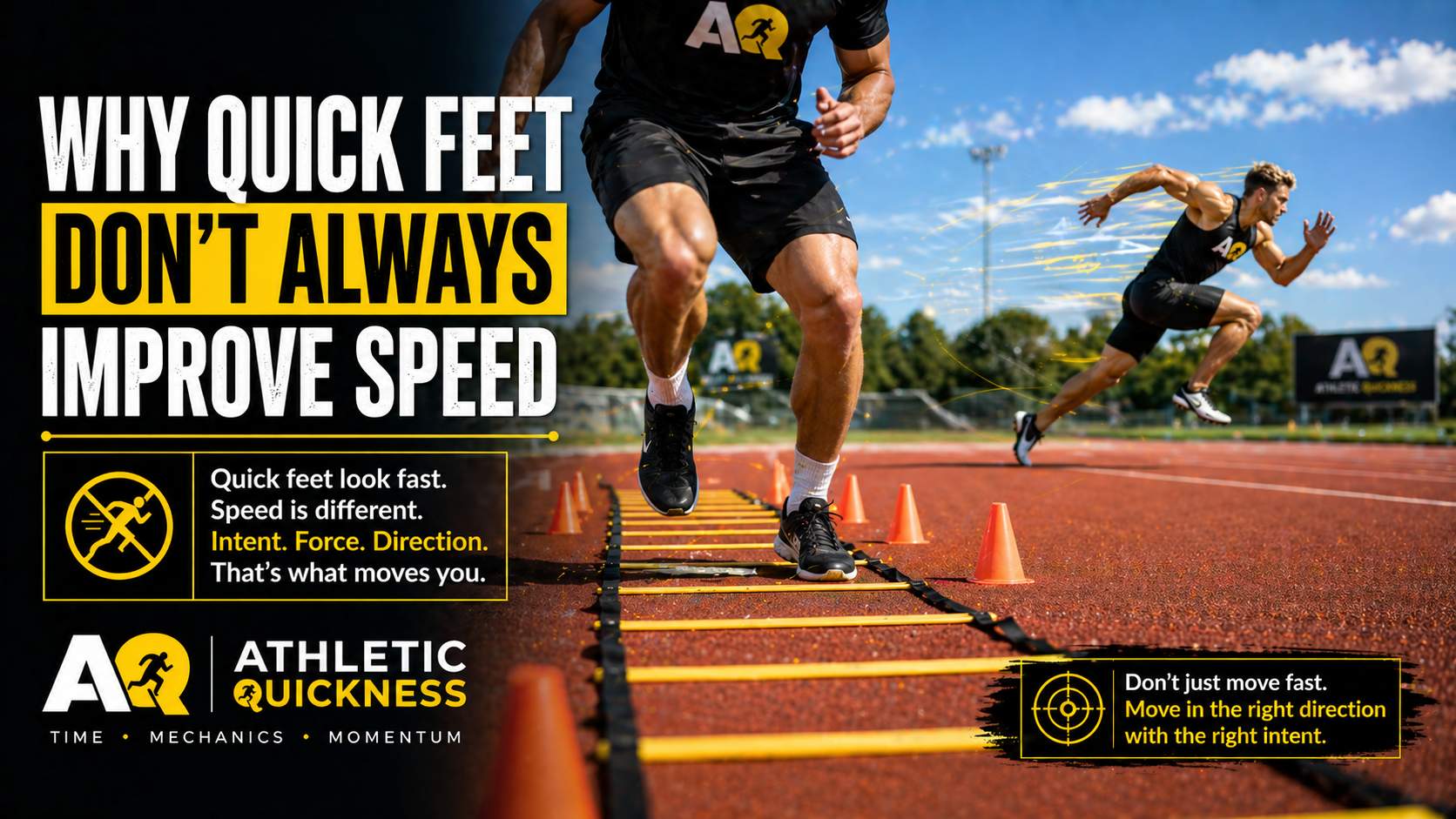
🚨 What If Quick Feet Isn’t The Same Thing As Fast Running?
Quick feet drills are everywhere.
Speed ladders.
Rapid foot taps.
Fast-feet drills.
They are often assumed to improve running speed.
Reasonable.
But maybe incomplete.
👉 What if moving your feet faster is not the same thing as creating more speed?
💥 That changes the conversation.
👣 Why Quick Feet May Be Getting Too Much Credit
The feet are obvious to watch.
So they often get treated like the source of speed.
But visible is not always causal.
Important distinction.
👉 What if foot speed is sometimes being mistaken for speed production?
Because the feet may be expressing something deeper.
Not necessarily creating it.
That matters enormously.
⚡ The Feet May Be Responding To Forces Organized Throughout The Body
The feet may be the most obvious thing to watch.
But what if they are often responding to force being organized throughout the body already?
😳
Things like:
• pushing-leg mechanics
• swing-side aggression
• torso contribution
• arm swing action
• whole-body movement support
all help influence how quickly the feet move.
👉 The feet may be obvious to watch…
but they may not be where speed begins.
That is a much deeper lens.
👉 To understand why ground contact may reflect deeper movement relationships throughout the body:
➡️ What Controls Ground Contact Time in Running? (And Why Quick Feet Aren’t the Answer)
🔍 Why Quick Feet Drills May Not Always Improve Speed
This does not mean foot drills have no value.
They can help:
• rhythm
• movement timing
• body awareness
• reactive movement
Possibly useful in certain situations.
But that is different than automatically improving sprint speed itself.
That matters.
Because sometimes training visible outputs…
does not improve the deeper mechanics producing speed.
Big distinction.
🔄 What May Matter More Than Faster Feet
Maybe the bigger opportunity is improving:
• how the pushing leg applies force
• how the swing side supports movement
• how force transfers throughout the body
• how aggressive movement stays supported continuously
Because when those improve…
foot speed often improves with them.
👉 Quick feet do not necessarily create speed.
They often reflect how the body is organizing aggressive movement during sprinting.
💥 That is a radically different way to think about speed.
👉 To understand why visible movement outcomes are not always the true source of speed:
➡️ Why Your Foot Strike Isn’t Making You Faster (And What Actually Does)
🧠 Why Faster Turnover Is Not Always Faster Running
This is where confusion often happens.
People often equate fast movement frequency…
with fast running.
But those are not always the same thing.
Sometimes trying to move the feet faster…
interferes with the mechanics that actually support speed.
That is very different than:
👉 the feet becoming quicker naturally because movement is being organized more effectively.
Huge distinction.
💬 What Better Speed Can Feel Like
Athletes often feel this before they can explain it.
When mechanics improve:
• contact feels lighter
• rhythm feels easier
• speed feels smoother
• the feet feel quicker naturally
👉 Sometimes athletes say the feet feel faster…
without trying to move them faster.
Because better mechanics often allow movement to happen more naturally and continuously.
That is a very different feeling than consciously forcing quickness.
🚀 A Different Way To Think About Quick Feet
Maybe quick feet are not always something you train directly.
Maybe they are often something:
💥 better movement support produces naturally.
That is a very different lens.
Don’t just train faster feet.
Train what helps the body move faster overall.
That may be where the real opportunity lives.
👉 To understand why whole-body movement support influences speed more than isolated foot action:
➡️ What Are Ground Mechanics? (And Why Your Foot Isn’t the Problem)
🚀 What This Means For You
Most athletes ask:
How do I make my feet move faster?
A deeper question may be:
👉 What helps my body move faster overall?
That question may lead much farther.
And much closer to real speed.
💥 AQ doesn’t see quick feet as:
• automatic sprint speed
• proof of better mechanics
• the true source of speed
AQ sees quick feet as:
👉 one possible expression of how well the body organizes aggressive movement during sprinting.
That means:
• pushing-leg mechanics
• swing-side aggression
• movement timing
• force transfer
• whole-body support
all influence how quickly the feet move.
That is a radically different lens.
And often a much more useful one.
🧭 Go Deeper
👉 Learn why ground contact may reflect deeper movement relationships throughout the body:
➡️ What Controls Ground Contact Time in Running? (And Why Quick Feet Aren’t the Answer)
👉 This article explains why visible movement outcomes are not always the true source of speed:
➡️ Why Your Foot Strike Isn’t Making You Faster (And What Actually Does)
👉 Learn how whole-body movement support influences contact quality and speed:
➡️ What Are Ground Mechanics? (And Why Your Foot Isn’t the Problem)
👉 This article explains how strength balance influences force transfer and movement support:
➡️ How to Improve Strength Balance for Maximum Running Speed
🎯 Start Here
👉 Want to improve running mechanics instead of just chasing faster feet?
💥 Start here:
➡️ Run Faster With Isometric Training
👉 AQ training focuses on:
• simultaneous push + swing support
• movement timing
• aggressive movement continuity
• force transfer
• strength balance
• whole-body movement support
❓ FAQ
Do quick feet drills make you faster?
👉 They can help rhythm and movement timing, but they do not automatically improve sprint speed itself.
Are ladder drills good for speed training?
👉 They may have value in certain situations, but AQ argues they do not necessarily improve what truly produces speed.
What matters more than quick feet for speed?
👉 AQ emphasizes pushing-leg mechanics, swing-side support, force transfer, and whole-body movement support.
Can trying to move your feet faster slow you down?
👉 Sometimes consciously forcing faster feet can interfere with the mechanics supporting speed.
What makes the feet move faster naturally?
👉 Better mechanics and cleaner movement support throughout the body often allow the feet to move quicker naturally.