
Home » Science & Technology » Locomotion Research Reviews » Computer Musculoskeletal Simulations in Locomotion: A Biomechanical Audit of Fixed-Velocity Upper Extremity Restriction Data
🏛️ Advanced Kinematics & Digital Modeling Audit
- The Foundational Formula: Dr. Larry VanSuch’s Ultimate Running Speed Equation (URSE) Model.
- The Reference Mechanics: Evaluating recent 150-muscle digital human avatar physics simulations utilizing neural network-based controllers.
- The Mechanical Reality: Analyzing the effect when an upper-extremity restriction is artificially introduced while forward traveling velocity is locked to a fixed cruise control constant.
- The Structural Truth Revealed: Why a recorded 5.2% spike in whole-body metabolic energy expenditure demonstrates a redlined pushing alliance rather than a passive dampening effect.
Section 1: Analysis of the Digital Human Simulation Dataset
In the field of modern sports biomechanics, advanced high-tech locomotive studies utilize neural network-based controllers and hyper-detailed musculoskeletal digital human avatars.
To isolate the mechanical role of upper-body movement during forward locomotion, engineering teams program a series of physics simulations across various speed thresholds.
During these digital trials, testing protocols often execute an isolation test whereby they artificially program a command that freezes the avatar’s virtual arm segments completely solid relative to the rib cage.
With the independent arm swing entirely restricted, computer software scripts record immediate physical transformations along the digital track template.
The simulation tracking parameters have recorded a 5.2% spike in whole-body metabolic energy expenditure alongside an immediate surge in erratic rotational forces along the vertical spine.
Based on these specific data metrics, traditional research conclusions dictate that the active arm swing functions exclusively as an energy-saving dampening mechanism designed to absorb lower-body reaction torque and stabilize the torso.
Modern simulation setups appear to provide a high-tech confirmation of classical biomechanical theories.
They frequently echo a long-held academic view from mid-century textbook lineages that treats the upper extremities primarily as a passive, non-propulsive shock-absorbing ring.
However, when this advanced digital framework is held up against the real-world operational rules of a living human nervous system, a significant structural disconnect emerges.
By looking past the superficial software parameters of the physics engine, a deeper examination reveals that computer models may accidentally manufacture an artificial mechanical crisis.
This misinterpretation views a broken speed transmission as a passive dampening miracle.
Section 2: The Fixed Velocity Cruise Control and the Manufactured Energy Crisis
To see exactly where international simulation profiles hit a structural limitation in their mechanical translation, we evaluate the specific parameters coded into advanced algorithms.
Trapped inside a top-down digital framework, conventional workflows program virtual human models and explicitly lock the forward traveling velocity to a fixed, unyielding cruise control constant.
The mainframe algorithm is given absolute commands to maintain that exact target running speed at all costs.
This velocity lock operates completely independent of what structural alterations are made to the rest of the moving skeleton.
With cruise control locked into the software dashboard, the testing protocol artificially freezes the avatar’s virtual upper limbs completely solid relative to the torso structure.
The moment the configuration locks the arms, tracking screens record a violent surge in vertical spine rotation alongside a massive 5.2% spike in metabolic energy expenditure.
Traditional interpretations overlook the structural origin of these dials, concluding that because energy costs spiked when the arms were frozen, the arm swing must exist purely as a top-down passive dampening ring designed to save fuel.
This digital modeling approach reaches a logical limitation because it completely ignores the artificial resistance created by its own fixed coding parameters.
If an engineer commands a vehicle’s cruise control to maintain an exact velocity at all costs, the split-second a mechanical restriction introduces massive internal drag, the engine must violently redline and burn through fuel just to fight that sudden resistance.
By locking the virtual arms, the software does not remove a passive shock absorber.
Instead, it introduces a severe restriction to the active running engine, completely severing the high-speed rotational torque transmission of the pushing side under URSE Law #3.
Because the avatar is trapped inside a digital cage that forbids its speed from naturally slowing down, the virtual neural network has no choice but to furiously over-fire the remaining muscles on the active pushing alliance.
The grounded stance column and torso must over-fire to artificially manufacture the missing horsepower left behind by the immobilization of the arms.
Advanced simulations do not prove that the upper extremities are passive dampers.
Instead, they demonstrate that if you restrict an athlete’s speed transmission while forcing the structural framework to maintain its velocity, the remaining muscles on the pushing team will redline just to drag the pelvic axle back to a net balance of zero under URSE Law #4.
Section 3: The Mechanical Reality vs. The Simulation Illusion
The conventional conclusion published by modern research teams dictates that if you take the arms away, balance is disrupted and energy spikes because of it, therefore the arms are merely dampers to conserve energy.
This conclusion overlooks the mechanical reality given that forward running speed is explicitly commanded to be maintained at all costs within the software code.
The physical reality of the dataset is that when you restrict the arms, the multi-axial torque balance across the pelvis is severely disrupted because the pushing team alliance suddenly loses two of its primary rotational members.
By freezing the upper extremities solid, the simulation aggressively lowers the total torque output on that specific side of the human locomotion equation.
Because the software script forces the virtual avatar to maintain its velocity constant at all costs, the remaining members of the pushing team alliance—specifically the torso and the active pushing leg—are forced to instantly pick up the slack to restore balance and maintain speed.
The avatar burns 5.2% more metabolic energy explicitly because of the physical requirement to maintain target speed with a heavy mechanical brake applied directly to the transmission.
The final structural verdict is absolute: the arms are not passive dampers designed to absorb lower-body twist.
The arms are active torque multipliers operating directly on the pushing team’s side.
They are structurally required to maintain multi-axial balance across the pelvis with the opposing swing team, regardless of what velocity threshold a subject is executing.
Section 4: The Core Engineering Laws of the URSE Model
Human locomotion is an unyielding battle of balancing rotational torque constants across your pelvis, where Net Torque must equal exactly Zero.
The following four laws are universal biomechanical constants that hold the absolute mathematical key to answering every question regarding the arms as well as athletic speed limitations, training plateaus, and genuine running efficiency:
- ⚡ Law 1: The Permanent Leg Side Constants — The side of the leg is a strict, unyielding constant; the Right Leg always projects Counter-Clockwise (CCW) torque across the pelvic axle, and the Left Leg always projects Clockwise (CW) torque—regardless of whether they are in flexion or extension.
- ⚡ Law 2: The United Upper Body Multiplier — The upper body rotators and arms function as one single unit with respect to rotation.
- ⚡ Law 3: The Alternating Alliance — Acting as a single unit, the upper body rotators and arms function as high-speed torque multipliers, actively alternating their collective torque patterns to match, favor, and reinforce whichever pushing leg is currently anchored to the turf.
- ⚡ Law 4: The Solitary Counterweight Balance — The unweighted, airborne swing leg must contract at extreme fast-twitch velocities to rise up and completely match the combined torque load of the active pushing team (pushing leg, both arms, torso) to bring Net Torque to exactly Zero.
Section 5: The Dynamic Torque Engine: How the Machine Operates
To see the true brilliance of human engineering, we must look past the superficial concept of the upper extremities acting as simple, forward-propelling rowing oars.
To truly map out how the arms function as high-speed rotational amplifiers, we first evaluate the permanent mechanical constants of the lower body.
When an athlete sprints natively down a track lane under our URSE constants, the lower body legs never change or alternate their torque directions.
Because the hip sockets are permanently, laterally displaced from your central spine midline and both legs work furiously to project force forward past a fixed ground coordinate, each leg is locked to a single, constant torque vector.
🦿 The Right Leg Driving Constants
Consider the baseline setup of the sprint phase where the Right Leg is currently the active pushing leg anchored to the track lane.
This driving Right Leg strictly projects a massive wave of Counter-Clockwise (CCW) torque across your pelvic axle under URSE Law #1.
To maximize ground force application, your upper body torso and free-swinging arms function as one unit with respect to rotation, instantly aligning their collective vectors with this driving side to form the Pushing Team Alliance under URSE Law #3.
Your shoulders twist Counter-Clockwise, driving your Right Arm forward and Left Arm backward to multiply and reinforce this dominant CCW ground thrust.
The arms are not dampers; they are active multipliers designed to drive that active pushing leg torque to its absolute maximum magnitude.
Because this combined right-side pushing alliance is dumping a massive volume of CCW torque onto your skeleton, the unweighted Left Swing Leg must rise up entirely alone to handle the balance under URSE Law #4.
As its deep hip flexors violently whip the left limb forward through empty air, it generates its permanent Clockwise (CW) torque under URSE Law #2, acting as the solitary counterweight to neutralize the entire pushing team alliance and bring Net Torque to exactly Zero under URSE Law #4.
🦿 The Left Leg Stride Transition
The split-second the athlete transitions to the next stride down the track, only the upper body torso and arms alternate their torque patterns to once again match the new pushing leg under URSE Law #3.
This time, it is the Left Leg which is anchored to the turf as the active pushing leg, which remains a constant Clockwise (CW) torque generator across the pelvic axle under URSE Law #2.
The legs themselves have not changed their torque direction, as any direction switch is physically impossible while both columns are projecting forward and laterally displaced from the midline.
Instead, the upper body torso and arms dynamically pivot their collective patterns as one unit to align with this new pushing side.
The shoulders twist Clockwise, driving the Left Arm forward and Right Arm backward to match and reinforce the dominant CW ground thrust.
To balance this massive left-side CW pushing alliance, the Right Swing Leg must now violently rise up through thin air entirely alone, contracting at extreme fast-twitch velocities to project its permanent Counter-Clockwise (CCW) torque under URSE Law #1 to keep the spinal axle perfectly balanced to a net torque of zero under URSE Law #4.
Section 6: The Elimination of Lateral Deviation
The elimination of horizontal side-to-side body deviations recorded across various university laboratories has nothing to do with a passive, mechanical dampening effect by the arms.
What keeps the human skeleton moving in a flawless, straight path down a track lane is one thing and one thing only: Total Counter-Clockwise Torque must equal exactly Total Clockwise Torque.
Total CCW Torque = Total CW Torque
The arms and torso are not fighting the body to maintain stability; they are actively involved on the exact same rotational team as the active pushing leg to amplify its ground force application.
Simultaneously, the solitary swing leg completes the mechanical loop to forge a perfect dynamic balance of zero net vertical torque.
This exact mathematical balance is what prevents any lateral deviation down the runway straightaway.
The upper extremities are not passive shock dampers; they are active, necessary components in the overall multi-axis equilibrium of human locomotion.
The critical difference between this structural reality and modern virtual modeling interpretations is that traditional software layouts view this balance as a simple, two-versus-two, 2-vs-2, mechanical opposition where the upper body cleanly cancels out the lower body’s rotation.
That institutional assumption is completely false.
The true overground torque equation of forward human locomotion is actually:
(Left Arm + Right Arm + Torso + Pushing Leg) Torque = (Swinging Leg) Torque
3 limbs vs 1 limb
3-vs-1
This represents a major mechanical difference that completely alters the sports science paradigm, demonstrating that the arms are certainly not passive dampers.
The upper extremities and torso actively align with the grounded stance column to form a dynamic, three-limbs-versus-one-limb centrifuge engine.
Instead of fighting the skeleton to absorb loose energy vibrations, the active pushing team acts as a unified high-horsepower torque multiplier, while the solitary airborne swing leg completes the mechanical loop to forge a perfect dynamic balance of zero net vertical torque.
Section 7: The Universal Locomotive Law
This unyielding multi-axis torque equation applies universally to all forward human locomotion in a straight line, governing walking, jogging, running, and elite sprinting alike.
Because human movement can only continue forward when Net Torque balances out to exactly zero, the underlying strength-balance matrix completely determines your velocity limits.
Raising the multi-axis torque and strength balance across the pelvis is exactly how you increase velocity, and lowering that torque capacity is exactly how velocity drops.
However, as speed increases alongside your full-body torque and strength balance, your velocity will be completely limited by the weakest mechanical link in the system in order to retain that mandatory torque balance of zero.
Section 8: Resolving the Simulation Paradox
Modern digital simulation frameworks evaluate the running engine without incorporating the baseline multi-axial torque constants first identified by overground mathematical models.
By trying to force an active multi-axis centrifuge engine into a flat linear box, computer simulations hit an interpretation wall and leave track coaches with a theory that contradicts basic physics under strict vector analysis.
They expose the limitation of their own modeling frameworks by assuming that the arms function merely as non-propulsive passive counterweights, yet they fail to reconcile how the arm drive remains so vital to top-end performance metrics overground.
By passing these simulation datasets through original pelvic constants, the true mechanical purpose of the upper extremities is revealed.
The arms are not passive dampers, and their rotational forces do not cancel each other out to zero.
Instead, both arms team together with the torso as a unified upper body torque multiplier under URSE Law #3 with the explicit purpose of raising the overall torque of the active pushing side to its absolute maximum magnitude.
The reality of these digital trials is that while research teams record exceptionally clean, high-fidelity data on their monitors, traditional interpretive frameworks lack the necessary multi-axial structural laws to decode it.
By reversing cause and effect to claim the arms are passive dampers, legacy modeling interpretations overlook the core rules of bipedal equilibrium.
By clearing out these modeling misconceptions, this framework demonstrates to coaches that the arms act as high-speed rotational multipliers that force the entire pelvic speed transmission to fire at maximum capacity.
📜 Applying Dr. VanSuch’s Rosetta Stone: 3-Step Process For Decoding Torque Patterns in Bipedal Locomotion
Decoding Torque Pattern 1 of 2
Apply the three steps to the runner in the figure below to determine the first of two torque patterns everyone shares for not just sprinting, but all human locomotion… walking, jogging, running:
- Identify the hip/thigh in flexion. This is what you need to key in at the very beginning. In the image below, it’s the left hip.
- Determine the torque direction of this hip/thigh based on the following constants: Right Leg = CCW Left Leg = CW. Therefore, Since we identified it was the left hip, we know it’s CW.
- Everything else is going the other way. In this case, that means the pushing leg, left arm, right arm, torso = CCW.
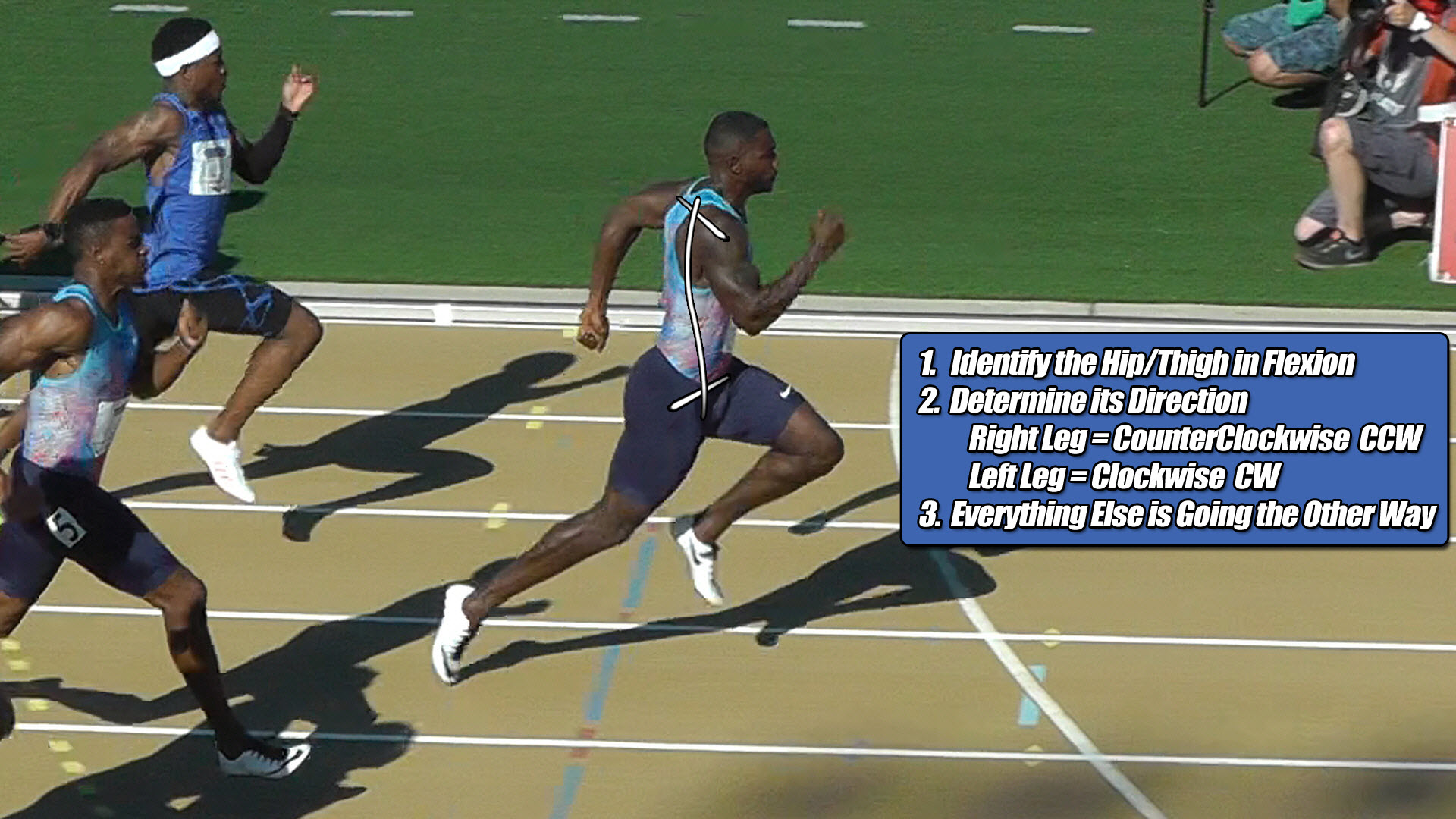
The first of two torque patterns everyone shares for not just sprinting, but all human locomotion… walking jogging, running is shown below:
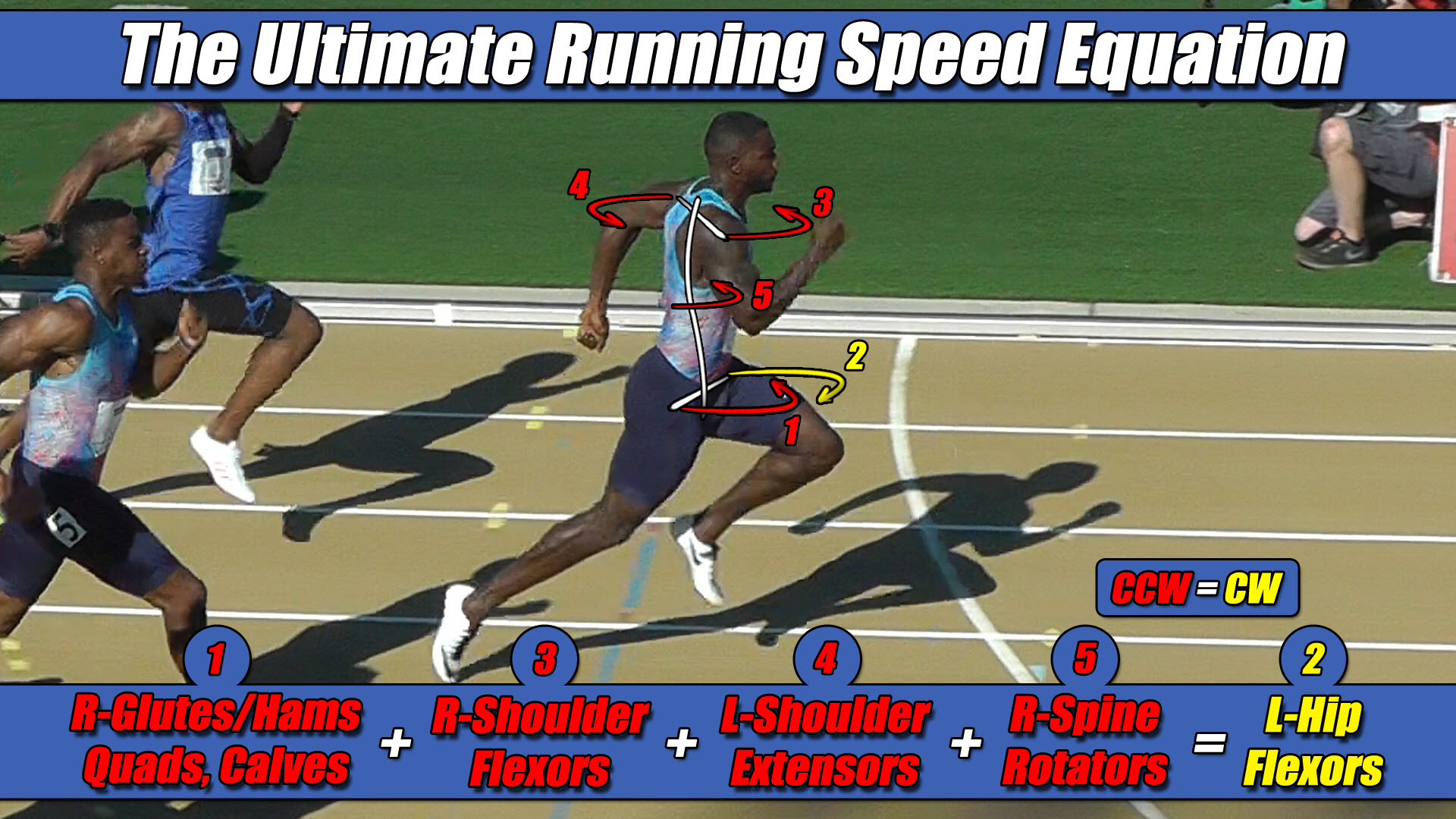 Left Hip Flexor Torque = CW. Everything Else CCW.
Decoding Torque Pattern 2 of 2
The athlete’s body has alternated to the other torque pattern. Repeat the process.
Apply the three steps to the runner in the figure below to determine the second of two torque patterns everyone shares for not just sprinting, but all human locomotion… walking. jogging, running:
- Identify the hip/thigh in flexion. This is what you need to key in at the very beginning. In the image below, it’s the right hip.
- Determine the torque direction of this hip/thigh based on the following constants: Right Leg = CCW Left Leg = CW. Therefore, Since we identified it was the right hip, we know it’s CCW.
- Everything else is going the other way. In this case, that means the pushing leg, left arm, right arm, torso = CW.

The second of two torque patterns everyone shares for not just sprinting, but all human locomotion… walking jogging, running is shown below:
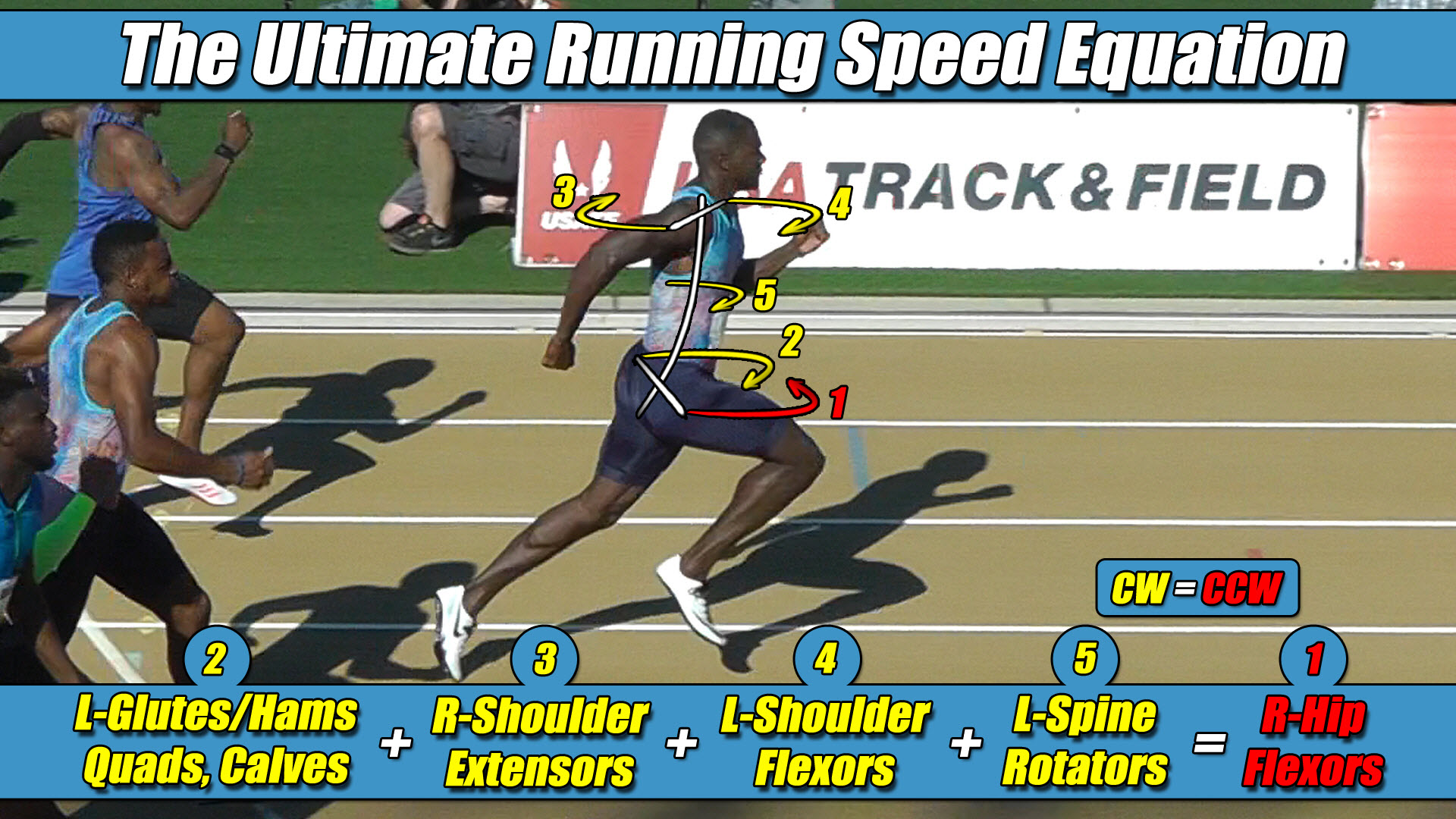
Right Hip Flexor Torque = CCW. Everything Else CW.
🏛️ Intellectual Property Notice & Legal Framework Boundaries
The Ultimate Running Speed Equation (URSE), along with its multi-axis pelvic torque constants and associated strength-balance profiling frameworks, represents the exclusive, proprietary intellectual property of Dr. Larry VanSuch. All rights reserved.
The clinical definitions outlined within this document function as established public prior art to protect the structural lineage of these discoveries.
Any unauthorized commercial exploitation, digital redistribution, or institutional replication of these geometric principles by outside entities without prior written consent is strictly prohibited.