
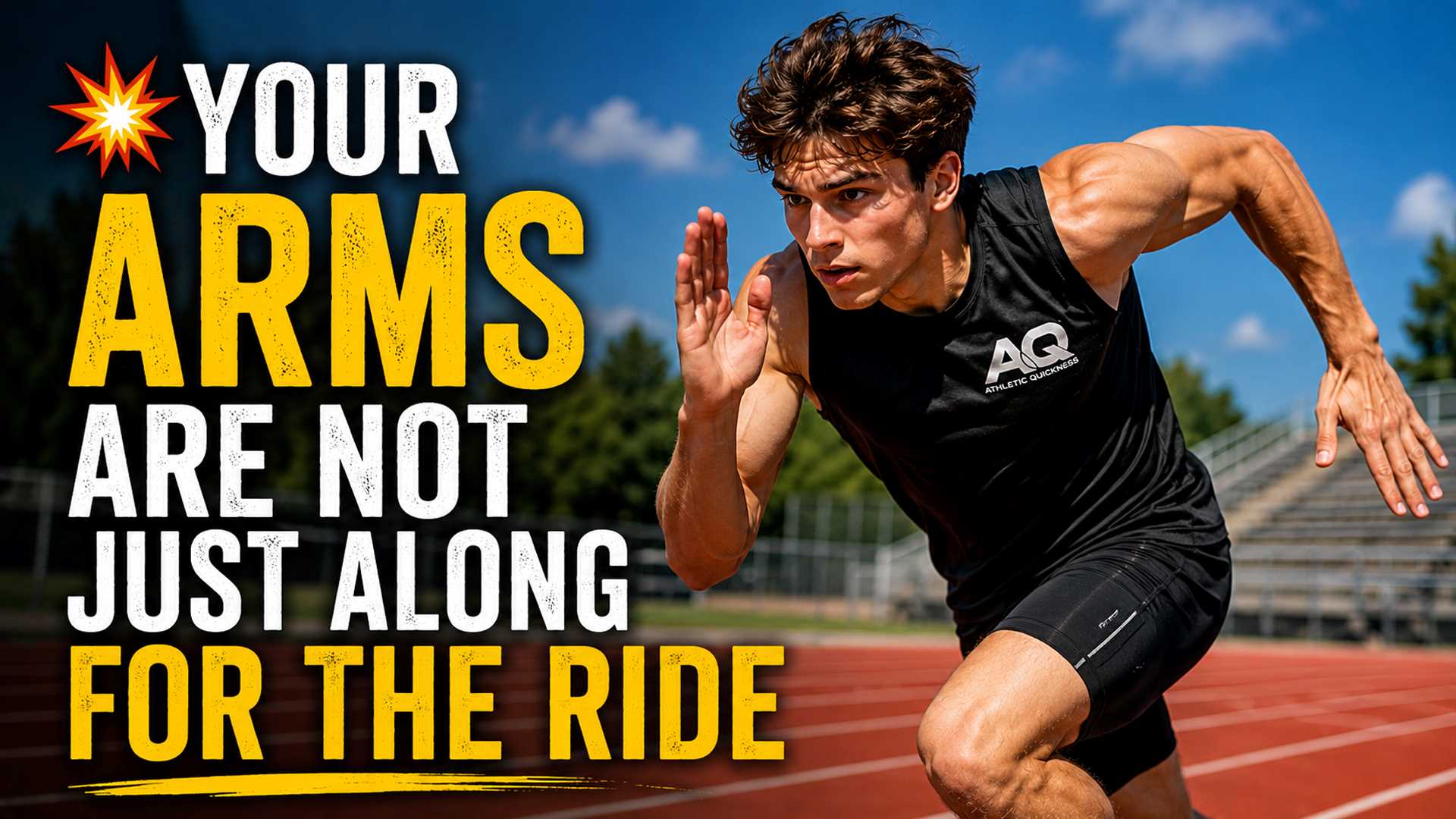
Home » Why You're Not Getting Faster » Your Arms Are Not Just Along For The Ride
📖 Part 12 of 18
🧠 Introduction
In the last article, we discovered something many athletes never stop to consider.
💥 You don’t run with one leg at a time.
You run with both legs at the same time.
One side pushes.
One side swings.
Both participate aggressively during every stride.
That realization naturally creates another question.
If both legs contribute to speed…
could other parts of the body be contributing too?
Many athletes have been led to believe the answer is:
👉 not very much
After all, most speed discussions revolve around:
👉 the legs
👉 the push
👉 the ground
👉 force production
And when speed improves, most of the attention usually follows those same areas.
But there may be another contributor hiding in plain sight.
One that shows up during every sprint.
One that becomes increasingly aggressive as speed rises.
💥 the arms
🤔 Are The Arms Really Just Along For The Ride?
Most athletes have been taught some version of the following:
👉 the legs create speed
👉 the arms help balance the movement
👉 the arms help coordinate the movement
👉 the arms help maintain rhythm
👉 the arms react to what the lower body is doing
While those explanations are common, they may not tell the entire story.
During sprinting, the arms participate in the same rotational event supporting the push leg.
They do not participate in the same rotational event as the swing leg.
If that sounds different from what you’ve been taught, you’re not alone.
Most athletes have been exposed to a very incomplete explanation of arm action.
(For a deeper explanation, see: Why Most Athletes Underestimate Their Arms.)
But for now, let’s keep things simple.
If the arms were merely passengers…
why do they become increasingly aggressive as sprint speed rises?
Watch someone jogging.
Then watch someone sprinting.
What changed?
The arms become:
👉 faster
👉 more aggressive
👉 more forceful
👉 more involved
That’s interesting.
Because passive passengers don’t normally become more aggressive as performance increases.
🤣
At the very least, it raises an important question.
💥 Are the arms simply reacting to speed?
Or are they helping create speed too?
👀 If The Arms Participate, Where Is The Attention?
Let’s assume for a moment that the arms are participating in the push.
Not reacting to it.
Not simply following it.
Participating in it.
If that’s true…
another question immediately appears.
💥 How much attention have your arms actually received?
Think about your own training.
Over the last:
👉 week
👉 month
👉 six months
👉 year
How much time have you spent deliberately trying to improve:
👉 glute contribution
👉 hamstring contribution
👉 quad contribution
👉 calf contribution
Now compare that to the amount of time you’ve spent thinking about:
👉 arm contribution
👉 arm strength
👉 arm support
👉 arm development
For many athletes, the difference is enormous.
And honestly, that makes sense.
After all, why spend time developing something you don’t believe contributes very much?
But what if the arms contribute more than you’ve been led to believe?
💥 Suddenly the conversation changes.
Now this isn’t just about understanding sprinting.
It’s about understanding your own training.
Because every contributor that gets overlooked is a missed opportunity for improvement.
🤯 Maybe This Is Another Reason
Think about where we’ve been so far in this series.
First, many athletes discovered they were placing enormous attention on:
👉 glutes
👉 hamstrings
👉 quads
👉 calves
Then they discovered sprinting uses:
👉 both legs
👉 both sides of the body
Now another realization begins to emerge.
💥 The pushing leg may not be working alone.
The arms participate during every stride.
The arms become increasingly aggressive as speed rises.
And according to AQ, the arms participate in the same rotational event supporting the push leg.
Yet despite all of that…
many athletes continue treating the arms as though they are little more than passengers.
If you’ve spent years developing one contributor…
while largely overlooking another contributor that participates during every stride…
could that eventually matter?
Could it become one more reason speed stops improving the way it once did?
💥 Could it become one more reason you’re not faster?
At the very least, it’s a possibility worth considering.
🧭 Continue The Journey
We’ve now identified another contributor many athletes underestimate.
💥 The arms are not just along for the ride.
They participate during every stride.
They become increasingly aggressive as speed rises.
They may contribute far more than many athletes realize.
But another question immediately appears.
If the arms are helping support the push…
what are the arms connected to?
💥 The torso.
And that may be one more reason you’re not faster.