
Home » Speed Training Science » Why Some Athletes Look Fast But Still Run Slow
🧠 Introduction
You’ve probably seen this before.
An athlete looks:
• explosive
• aggressive
• powerful
• fast during drills
👉 but somehow does not actually separate while sprinting.
Sometimes they even LOOK fast…
💥 yet their actual speed is average.
That confuses many athletes.
Because people often assume:
👉 if movement LOOKS aggressive,
it must BE fast.
Not necessarily.
Because sprint speed depends on more than visible aggression alone.
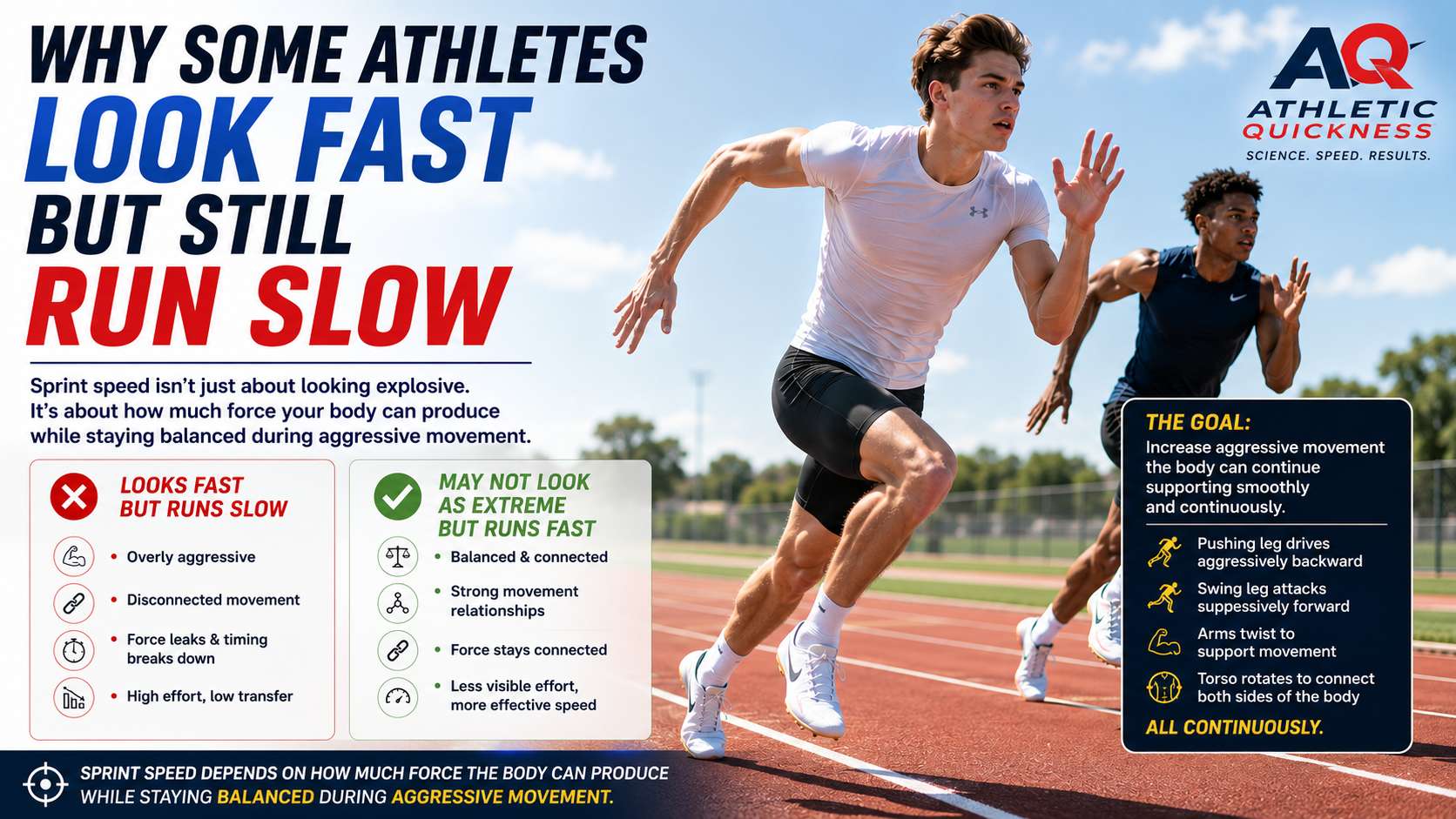
💥 Sprint speed depends on how much force the body can produce while staying balanced during aggressive movement.
That is a massive AQ distinction.
And honestly?
This explains why some athletes:
• run hard
• move violently
• appear explosive
👉 but still struggle to create real sprint speed.
⚡ Looking Fast Is Not The Same As Moving Fast
This is one of the biggest misunderstandings in sprinting.
Many athletes assume:
👉 more visible aggression = more speed.
But sprinting is not simply:
❌ aggressive movement.
💥 Sprinting is aggressive movement continuously supported across the body under force.
That is very different.
During sprinting:
• the pushing leg drives aggressively backward
• the swing leg attacks aggressively forward
• the arms twist to support movement
• the torso rotates to connect both sides of the body
👉 all continuously.
And sprint speed depends on how well those aggressive movement relationships continue supporting each other under rising force.
That means:
👉 an athlete can LOOK explosive
while movement support relationships underneath are actually breaking down.
Huge distinction.
🔄 Why Some Athletes Run Hard But Do Not Separate
You see this constantly in sports.
Some athletes:
• attack the ground aggressively
• sprint with huge effort
• move violently
• appear extremely explosive
👉 but do not actually gain separation.
Why?
Because aggressive movement alone does not guarantee efficient sprint speed.
If movement aggression rises faster than:
• movement balance
• timing support
• swing-side contribution
• torso support
• force continuity
👉 the body often begins suppressing speed expression to protect balance.
That can create sprinting that feels:
• heavy
• tense
• restricted
• overworked
• disconnected between steps
even while the athlete appears explosive externally.
💥 The body does not simply maximize aggression.
💥 The body maximizes aggressive movement it can continue supporting cleanly during sprinting.
That is one of the biggest AQ realizations.
🏃 Why Some Athletes Look Smooth And Still Blow Past People
This is the opposite side of the equation.
Some athletes do not LOOK maximally aggressive.
👉 yet they glide past everyone.
Why?
Because speed is not always about visible effort.
Sometimes the fastest athletes:
• stay connected better
• support force more cleanly
• maintain movement continuity longer
• stay balanced under rising force
And that allows aggressive movement to continue expressing itself without suppression.
This is why elite sprinters often look:
• fluid
• smooth
• effortless
• relaxed under extreme speed
💥 Not because they are producing less force.
💥 Because the body is supporting higher force more cleanly.
That is a huge distinction.
🚨 Excessive Aggression Can Sometimes Slow Athletes Down
This surprises many athletes.
Because athletes are constantly told:
👉 “be more explosive”
👉 “run harder”
👉 “attack harder”
But sprint speed is not simply:
❌ maximum visible aggression.
Because if aggressive movement overwhelms movement support relationships,
👉 sprint movement may begin tightening under force.
And athletes often FEEL this as:
• stiffness
• overstriding
• forced sprinting
• difficulty opening up
• excessive tension
• loss of fluidity
That does not always mean:
❌ the athlete lacks effort.
💥 Sometimes the body is regulating movement to protect balance under force.
That is a very important AQ idea.
🧠 Sprint Speed Is About Supported Aggression
This may be the biggest realization in the article.
Fast sprinting is not:
❌ uncontrolled aggression.
And it is not:
❌ passive relaxation either.
💥 Fast sprinting is supported aggressive movement.
That means:
• force stays connected across the body
• aggressive movement remains balanced
• timing stays continuous
• movement support relationships stay organized under speed
That is why some athletes can express:
👉 massive aggression smoothly
while others:
👉 tighten immediately under force.
The difference is not always force production itself.
💥 Often the difference is how well the body supports aggressive movement under force.
That is the reframe.
🔑 Why This Changes How Speed Should Be Viewed
If sprint speed depends on:
• supported aggression
• movement continuity
• force organization
• timing support
• balance under rising force
👉 then speed training should improve those qualities too.
Not just raw explosiveness.
That changes how many athletes think about sprint development.
Because some athletes are already aggressive enough to sprint faster.
💥 The issue is often whether the body can continue supporting that aggression efficiently under speed.
That is where many breakthroughs happen.
💥 What This Means For Speed Training
The goal is not:
❌ simply becoming more aggressive.
The goal is:
💥 increasing aggressive movement the body can continue supporting smoothly and continuously.
Which means:
• the pushing leg drives aggressively backward
• the swing leg attacks aggressively forward
• the arms twist to support movement
• the torso rotates to connect both sides of the body
👉 all continuously.
💥 Faster sprinting depends on how well the body continues supporting all of these aggressive movements together under force.
And honestly?
That is where AQ separates from many traditional sprint discussions.
Because sprint speed is not just visible explosiveness.
💥 Sprint speed depends on how much force the body can produce while staying balanced during aggressive movement.
That is the governing principle.
🚀 What This Means For You
Most athletes focus only on becoming more explosive.
👉 But sprint speed often improves when the body becomes better at supporting aggressive movement while staying balanced under force.
That means:
• movement timing stays fluid
• the swing side continues matching the push side
• aggressive movement remains connected across the body
• sprint movement stays continuous under speed
💥 Fast sprinting is not just about trying harder.
💥 It is about how well the body supports aggressive movement during sprinting.
That is where real speed often comes from.
🧭 You Are Here
You are currently exploring:
👉 WHY SOME ATHLETES LOOK FAST BUT STILL RUN SLOW: how visible aggression alone does not automatically create sprint speed unless aggressive movement stays balanced, connected, and continuously supported under force.
🌐 See how this fits into the complete AQ speed system:
Learn how AQ approaches:
force production,
movement support,
timing between steps,
strength balance,
and sprint speed development.
➡️ SPEED TRAINING SCIENCE: Why Most Methods Fail (And What Actually Works)
🪜 Continue Deeper Into Supported Sprint Aggression:
Learn what actually creates sprint force and why sprint speed depends on more than visible effort or isolated explosiveness.
➡️ What Actually Creates Force in Running? (And Why Most Athletes Get It Wrong)
Learn why stronger and more explosive athletes can still struggle to sprint faster when aggressive movement stops staying organized under force.
➡️ Why Traditional Training Can Make You Stronger—But Not Always Faster
Learn how AQ trains explosive sprint movement while improving how aggressive movement stays supported continuously under speed.
➡️ How to Train Fast Twitch Muscle Fibers for Speed (Without Adding Bulk)
🚀 Ready To Run Faster?
If you are ready to turn this information into real speed:
➡️ Run Faster With Isometric Training
❓FAQ
Why do some athletes look fast but still run slow?
Because visible aggression alone does not guarantee supported sprint movement under force.
Can athletes run too aggressively?
Yes.
💥 Aggressive movement that overwhelms movement support relationships may tighten sprint movement and reduce speed.
Why do elite sprinters often look relaxed?
Because the body is supporting high force cleanly and continuously under speed.
Does trying harder automatically improve sprint speed?
No.
👉 Sprint speed depends on how well aggressive movement stays supported across the body.
What should speed athletes prioritize?
👉 Supported aggressive movement,
movement balance,
force continuity,
and sprint timing staying connected under speed.