
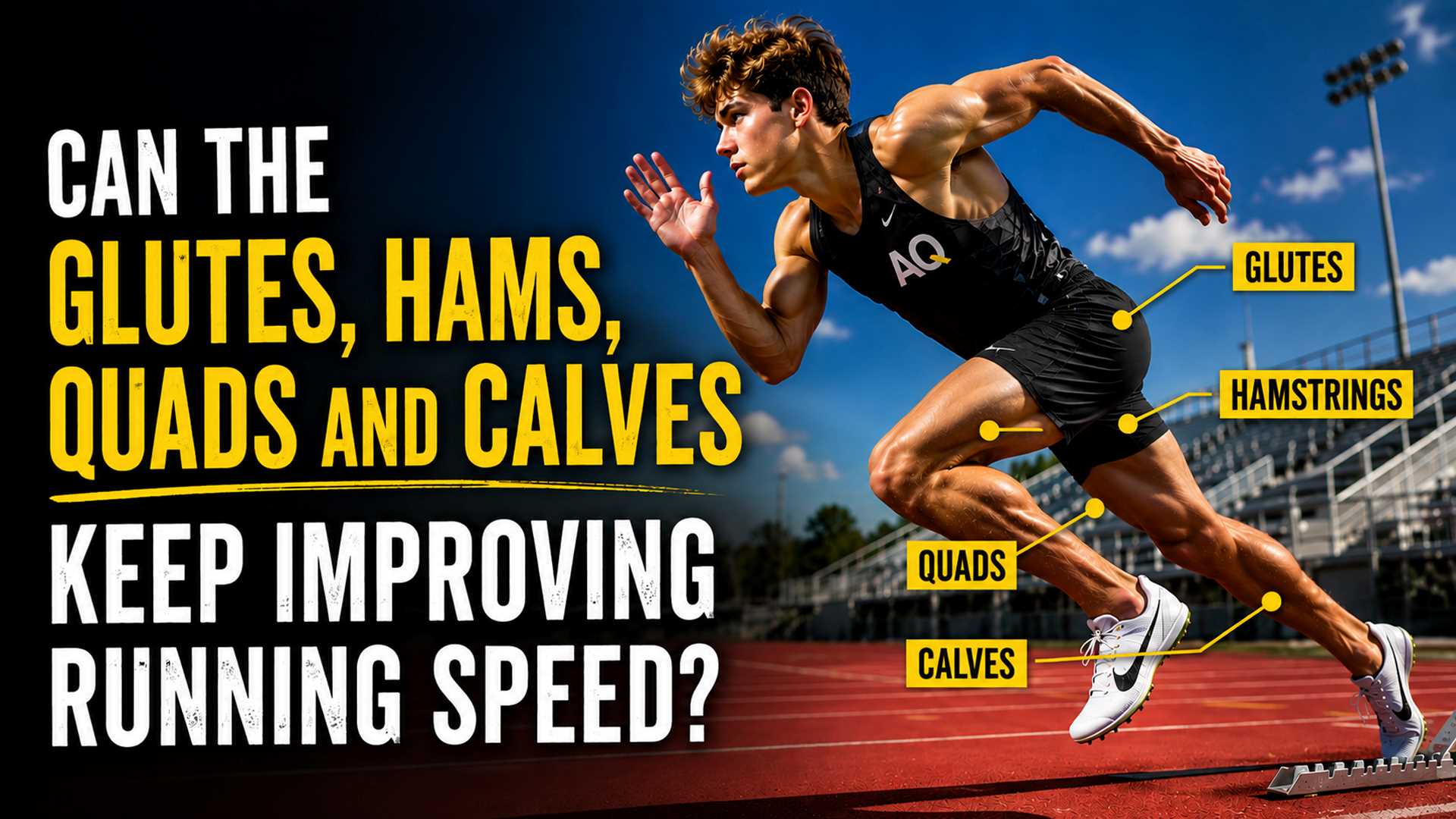
Home » Why You're Not Getting Faster » Can Stronger Glutes, Hams, Quads and Calves Keep Improving Running Speed?
📖 Part 10 of 18
🧠 Introduction
In the last article, we discovered something many athletes never stop to consider.
Some sprinting muscles may receive far more development than others.
For many athletes:
👉 glutes
👉 hamstrings
👉 quads
👉 calves
receive the majority of the attention.
Meanwhile:
👉 hip flexors
👉 arms
👉 torso
often receive far less.
That creates an important question.
💥 What happens when some contributors continue receiving far more development than others?
🚀 At First, Everything Works
For a while, the system seems simple.
The squat improves.
The deadlift improves.
The jump improves.
And speed improves too.
Everything appears to make sense.
Work hard.
Get stronger.
Run faster.
Simple.
⏱️ The Gym And The Stopwatch Start Telling Different Stories
But eventually many athletes notice something interesting.
Glutes, hams, quads, calves say:
👉 stronger
The stopwatch says:
👉 a little faster
Glutes, hams, quads, calves say:
👉 noticeably stronger
The stopwatch says:
👉 maybe
Glutes, hams, quads, calves say:
👉 stronger than ever
The stopwatch says:
👉 not much
Now the athlete finds themselves in a strange position.
One measurement says:
💥 Glutes, hams, quads, calves improved.
The other measurement says:
💥 speed didn’t improve the same way.
Both observations can be true at the same time.
The gym says:
💥 Glutes, hams, quads, calves improved.
The stopwatch says:
💥 speed didn’t improve the same way.
And if they are…
another question hopefully begins to emerge.
💥 What if glutes, hams, quads, calves development is no longer the thing that’s currently holding you back?
Because the gym already confirmed that glutes, hams, quads, calves improved.
So if speed isn’t responding the way it once did…
💥 perhaps the sprint system is trying to tell you something.
🤔 The Trap Almost Everyone Falls Into
The hardest traps aren’t the ones that never work.
They’re the ones that work so well that you stop looking anywhere else.
For many athletes:
Glutes, hams, quads, calves (GHQC) worked.
The squat improved.
The jump improved.
The sprint time improved.
So naturally:
👉 they kept training glutes, hams, quads, calves
👉 their teammates kept training glutes, hams, quads, calves
👉 their coaches kept emphasizing glutes, hams, quads, calves
👉 their training programs kept emphasizing glutes, hams, quads, calves
And for a while:
that made perfect sense.
Because it was producing results.
💥 A Different Possibility
Suppose glutes, hams, quads, calves continue improving.
What if speed doesn’t improve the same way?
That doesn’t automatically mean glutes, hams, quads, calves stopped developing.
The gym may be correctly reporting improvement.
GHQC may genuinely be getting stronger.
But GHQC is only one part of the sprint system.
Not the entire sprint system.
And if other contributors participate in every stride too…
another possibility begins to emerge.
💥 Perhaps improving one part of the sprint system is not always the same thing as improving the entire sprint system.
Remember:
The hardest traps aren’t the ones that never work.
They’re the ones that work so well that you stop looking anywhere else.
And that’s likely where many athletes find themselves.
GHQC worked.
The squat improved.
The jump improved.
The sprint time improved.
So naturally:
👉 they kept looking there
👉 their coaches kept looking there
👉 their training programs kept looking there
Why wouldn’t they?
The approach was producing results.
And that’s where the trap begins.
Not because GHQC (glutes, hams, quads, calves) didn’t matter.
💥 Because GHQC worked so well that many athletes never felt the need to look anywhere else.
👀 Why The Conclusion Seemed Obvious
For years, the evidence appeared to support the idea that:
👉 more GHQC = more speed
The squat improved.
The jump improved.
The sprint time improved.
Again.
And again.
And again.
So naturally, many athletes reached the same conclusion.
💥 The next speed increase would probably come from the same place as the last one.
Then eventually the stopwatch starts reporting something different.
But the stopwatch can only do so much.
It doesn’t explain.
It doesn’t diagnose.
It doesn’t tell you what to train next.
💥 It simply records what it sees.
And for many athletes, what it eventually sees is something interesting.
The gym continues reporting improvement.
The stopwatch doesn’t always report the same improvement.
At that point, the question is no longer:
👉 Did GHQC improve?
The gym already answered that.
The question becomes:
💥 Why didn’t speed improve the same way?
And that’s where many athletes find themselves.
Not because they stopped working.
Not because they stopped improving.
Because the stopwatch can only tell you what happened.
💥 It’s up to you to figure out why.
🧭 Continue The Journey
The gym confirmed something important.
GHQC improved.
Yet many athletes eventually discover that speed does not always improve at the same rate.
💥 Why?
That’s where we’re headed next.