
Contact: Support@AthleticQuickness.com

Digital Products: Immediate Access After Order

Guest Checkout Available

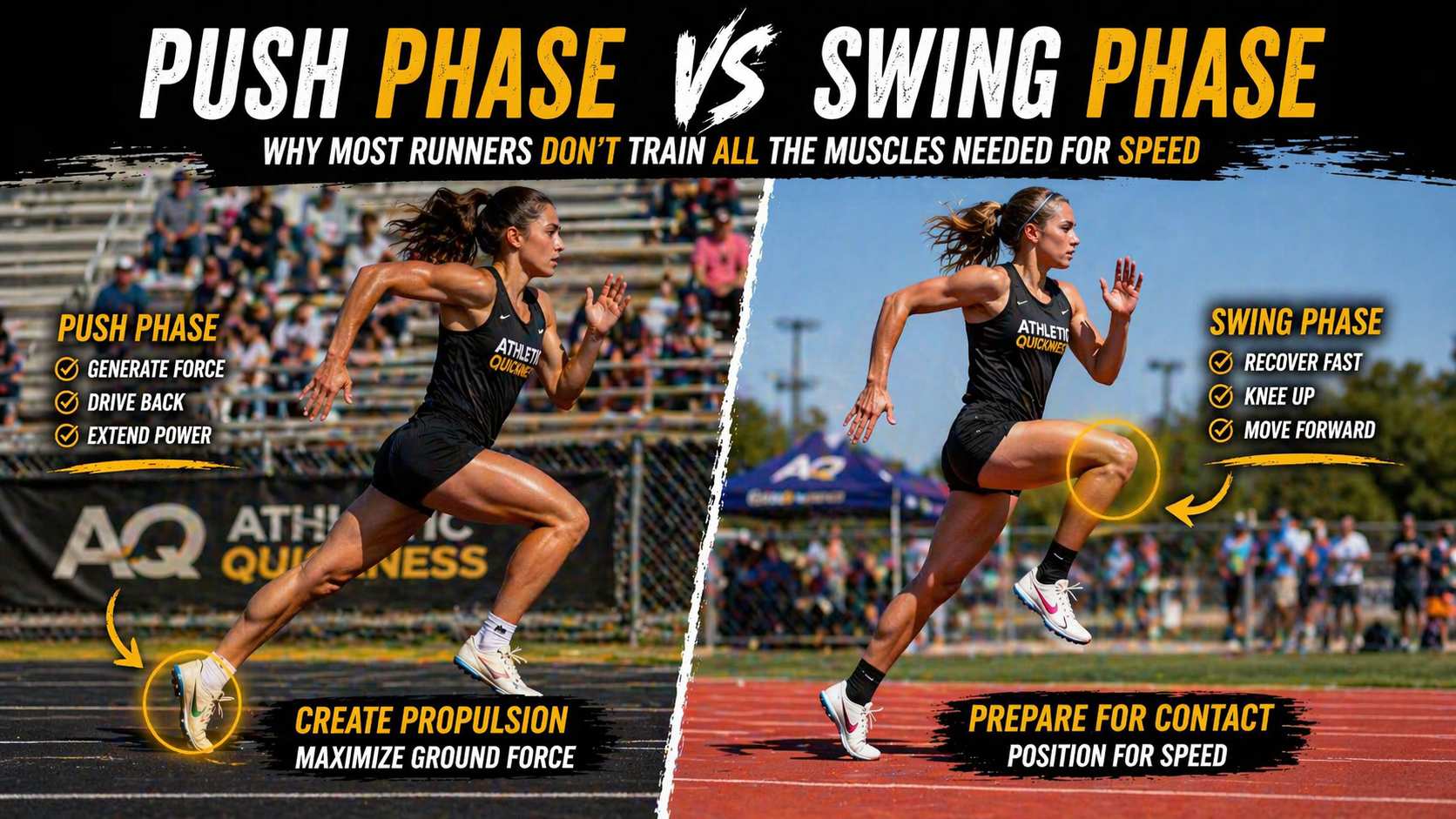
push phase vs swing phase of running

Push Phase vs Swing Phase: Why Most Runners Don’t Train All the Muscles Needed for Speed

Introduction

When comparing the push phase vs swing phase in running, most athletes focus almost entirely on what happens on the ground


Chances are your training looks like:

  • squats
  • deadlifts
  • leg presses
  • sled drags
  • bounding exercises

πŸ‘‰ All of these train what happens when your foot is on the ground


πŸ‘‰ And while that’s important

πŸ‘‰ it’s only part of the system


πŸ’₯ Most runners train the ground phase

πŸ‘‰ but neglect what happens in the air

πŸ‘‰ Want to understand how all phases of speed fit together?
➑️ How to Run Faster: The Complete Guide to Speed, Power, and Performance


⚑ The Phases That Control Your Speed

Every step you take is part of a continuous cycle:

  • push phase
  • swing phase
  • return phase

Push Phase

This is when your foot is on the ground


πŸ‘‰ The body uses:

  • glutes
  • hamstrings
  • quadriceps
  • calves

πŸ‘‰ to generate force


πŸ‘‰ But here’s the problem:

πŸ‘‰ If all you train is the push phase

πŸ‘‰ you’re not really training to run


πŸ‘‰ you’re training to jump


πŸ’₯ Think about how a frog moves:

  • push β†’ land
  • push β†’ land

πŸ‘‰ That’s not running


πŸ‘‰ Running requires continuous cycling


πŸ‘‰ And cycling speedβ€”not just forceβ€”is what determines speed

Learn more about training the push phase:

➑️ Push (Drive) Phase of Running: Why Most Athletes Overtrain It


Swing Phase

This is when the leg moves forward through the air


πŸ‘‰ It is driven by:

πŸ‘‰ the hip flexors


πŸ‘‰ And plays a major role in your stride and how fast your legs cycle


πŸ‘‰ This phase is often overlooked

πŸ‘‰ because the leg is not in contact with the ground


πŸ‘‰ But it still requires:

  • effort
  • coordination
  • acceleration

πŸ’₯ The leg must be moved forward quickly

πŸ‘‰ or speed is limited

πŸ‘‰ What most athletes don’t realize is this:

πŸ‘‰ the hip flexors are loaded with fast twitch muscle fibers

πŸ‘‰ but they are rarely trained in a way that develops speed


πŸ’₯ Which means they often contain a huge reservoir of untapped potential

πŸ‘‰ just waiting to be developed and applied

Learn how the hip flexors improve stride rate:

➑️ How to Increase Stride Rate (Without Overtraining)


Return Phase

This phase prepares the next step


πŸ‘‰ It connects the swing phase back to the push phase


πŸ‘‰ And like the others:

πŸ‘‰ it depends on what happens before it


πŸ”„ Speed Is a Systemβ€”Not a Single Phase

Most athletes train:

πŸ‘‰ individual muscles

πŸ‘‰ isolated movements


πŸ‘‰ But speed doesn’t work that way


πŸ’₯ Speed is a system on both sides of the body


  • push phase β†’ generates force
  • swing phase β†’ drives speed
  • return phase β†’ resets the cycle

πŸ‘‰ All working together


πŸ‘‰ If one phase falls behind:

πŸ‘‰ the entire system is limited

Learn how this speed system is actually trained:
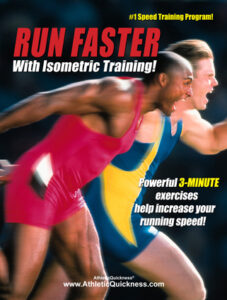
➑️ Run Faster with Isometric Training


βš–οΈ The Real Issue: Strength Imbalance

Running fast is not just about strength


πŸ‘‰ It’s about how balanced your system is at its highest level


πŸ‘‰ The push phase produces force

πŸ‘‰ The swing phase must match it


πŸ‘‰ If it cannot:

πŸ‘‰ the system slows down


πŸ’₯ Your speed is limited by your weakest link


πŸ‘‰ And for most athletes:

πŸ‘‰ the swing phase is that limiting factor


⚠️ Why Most Runners Don’t Train All Phases

Most programs focus on:

πŸ‘‰ force production


So athletes spend:

  • most time on push phase
  • some on return
  • very little on swing

Gym equipment primarily supports the push phase

πŸ‘‰ This creates imbalance


πŸ‘‰ You end up with:

  • strong push muscles
  • decent ground mechanics
  • limited leg cycling speed

πŸ‘‰ And no matter how strong you get:

πŸ‘‰ your speed doesn’t improve

This is where many athletes hit a plateau.

➑️ Why You Hit a Training Plateau (And How to Fix It for Speed)


πŸ”₯ The Overlooked Role of the Swing Phase

Many athletes ignore the swing phase


πŸ‘‰ because the leg is β€œjust in the air”


πŸ‘‰ But the resistance is the leg itself


πŸ‘‰ It still has weight


πŸ‘‰ And it must be accelerated forward


πŸ’₯ This is where speed is unlocked


πŸ‘‰ You can generate power

πŸ‘‰ but if you can’t cycle fast enough

πŸ‘‰ you can’t use it


πŸ‘‰ This creates imbalance


πŸ‘‰ And the system adjusts


πŸ‘‰ Stronger muscles are forced to β€œback down”

πŸ‘‰ to match the weaker ones


πŸ’₯ That’s what limits speed


Understand the missing link:
➑️ Hip Flexors for Running Speed: The Missing Link That’s Slowing You Down


πŸ‹οΈ Why Strength Alone Isn’t Enough

Many athletes try to improve speed by:

  • getting stronger
  • adding resistance
  • increasing intensity

πŸ‘‰ But speed depends on:

  • response
  • timing
  • coordination

πŸ‘‰ Not just strength


πŸ‘‰ This is why athletes get stronger

πŸ‘‰ but don’t get faster

➑️ How Coordination Affects Running Speed (And Why It’s Overlooked)


πŸš€ How to Train All Phases of Speed

To run faster, your training must develop:


1. Push Phase Strength

πŸ‘‰ force production


2. Swing Phase Speed

πŸ‘‰ hip flexor activation
πŸ‘‰ faster cycling


3. Return Phase Efficiency

πŸ‘‰ smooth transitions
πŸ‘‰ controlled contact


πŸ‘‰ But developing all phases is not just about doing more exercises


πŸ’₯ It’s about how your body is trained to respond


πŸ”„ What Most Training Misses

Most programs train:

  • movement
  • strength
  • repetition

πŸ‘‰ But they don’t train how your system adapts under real conditions


πŸ‘‰ Running requires:

  • constant adjustment
  • rapid coordination
  • real-time response


πŸ’₯ Where Isometric Training Becomes Effective

This is where isometric training becomes powerful


πŸ‘‰ Instead of repeating movements

πŸ‘‰ your body is placed under tension and forced to maintain control


πŸ’₯ And here’s the key:

πŸ‘‰ even under ideal conditions
πŸ‘‰ the resistance is not perfectly steady


Because:

  • your body is stabilizing
  • small adjustments are always happening
  • tension is constantly changing

πŸ‘‰ Your system must continuously:

  • adjust
  • stabilize
  • re-coordinate

πŸ’₯ This is also why your muscles often begin to shake:

➑️ Why Your Muscles Shake During Training


πŸ‘‰ And what’s happening internally:

➑️ Motor Unit Recruitment for Speed


πŸ’ͺ Applying This to Real Training

Your training should:

  • develop strength AND speed
  • train ground AND air phases
  • improve coordination

πŸ’₯ This is what creates real speed


πŸ‘‰ This is one of the key reasons this method works:

➑️ Isometric Training for Speed: Why It Works (And What It Adds to Traditional Training)


🏁 Conclusion

If you want to run faster:

πŸ‘‰ stop focusing only on pushing


πŸ‘‰ focus on how your system works together


πŸ’₯ Because speed is not created by one phase


πŸ‘‰ it’s created by how well all phases work together


πŸ”₯ Continue Here

πŸ‘‰ Continue building your speed system:
➑️ Why Strength Alone Won’t Make You Faster


❓ Frequently Asked Questions


What is the push phase in running?

The push phase is when your foot is on the ground and your body generates force to move forward.


What is the swing phase in running?

The swing phase is when your leg moves forward through the air and helps determine how quickly your legs cycle.


Which phase is most important for speed?

All phases are important, but your speed is ultimately limited by how well all phases work together.


Why don’t most runners train the swing phase?

Because it happens in the air and is often assumed to involve little resistance, even though the leg itself still must be moved quickly.


How do I improve both push and swing phases?

Train for strength, coordination, and muscle response while developing both ground and air phases of movement.

Digital Products

Immediate access after order

Easy 60 day returns

100% money back guarantee

Product Availability

Worldwide

100% Secure Pay Options

PayPal / MasterCard / Visa, etc.